Chinese leader Xi Jinping paid a much-touted visit to Europe on May 5-10, visiting three countries on the continent whose leaders have, in different ways, advocated for better relations with Beijing in recent years: France, Serbia, and Hungary. Xi’s mission was to sow division in Europe and rally the countries that may help reverse the continent’s recent push toward “de-risking” against China. The timing of his trip was crucial. European Union (EU) voters will go to the polls in early June to elect the new European Parliament, which will determine the bloc’s general direction on many issues, including its orientation toward China. Only after the parliamentary elections, the appointment of a new European Commission, and Hungary’s takeover of the EU presidency in July will it become clear whether Xi’s visit achieved his goals of creating disunity in Europe and reversing the EU’s de-risking push.
The visit’s timing and destinations show that the Chinese leadership realizes its fortunes in Europe have turned. While the EU has not taken as tough an approach toward China as the United States has since the Trump presidency, European thinking on Beijing has changed in the past few years. Especially since Russia’s full-scale invasion of Ukraine in February 2022, Europe has toughened its approach to China, moved its policies closer to those of the United States, and launched its de-risking strategy. Several Western European countries that previously championed greater trade with China have since moved more toward a balancing and de-risking approach.
Many Central and Eastern European countries, too, have turned against greater cooperation with China. Russia’s war in Ukraine and the region’s political turnover have pushed Czechia, Slovakia, Latvia, Lithuania, Estonia, and Slovenia to take a more skeptical stance toward China. This has left Hungary and Serbia as the remaining champions of China’s interests in the region and, not surprisingly, two destinations of Xi’s visit. Of course, Hungary, as a member of the EU and NATO, is the more useful of the two for Beijing’s bid to expand its influence in Europe.
To better understand where China-Europe relations go from here, it is worth looking at each stop on Xi’s trip. Each had a very different choreography and emphasis.
France: What a difference a year makes
While French President Emmanuel Macron did his best to receive Xi with as much pomp and circumstance as possible, he disappointed the Chinese leader on the substantial issues of Russia’s war in Ukraine and Chinese state subsidies. During the French president’s visit to Beijing last year, Macron presented himself as opposed to the United States’ balancing strategy on China and in favor of a rapprochement with Beijing, especially on Taiwan. During this visit (and under pressure from Washington), Macron took a different approach.
On Russia’s war in Ukraine, Macron pushed Xi to stop supporting Moscow’s war efforts. He also invited European Commission President Ursula von der Leyen to the meeting, and they jointly pressed the Chinese leader to stop giving unfair advantages to Chinese companies operating in the global market. Xi, however, offered no compromise on either issue. Although Macron and von der Leyen presented a rather unified front, the fact that German Chancellor Olaf Scholz had taken a conciliatory tone in Beijing in April and then declined Macron’s invitation to the Paris summit indicates that the European disunity Xi hopes for may indeed be in the making.
Serbia: “Confront hegemony and power politics”
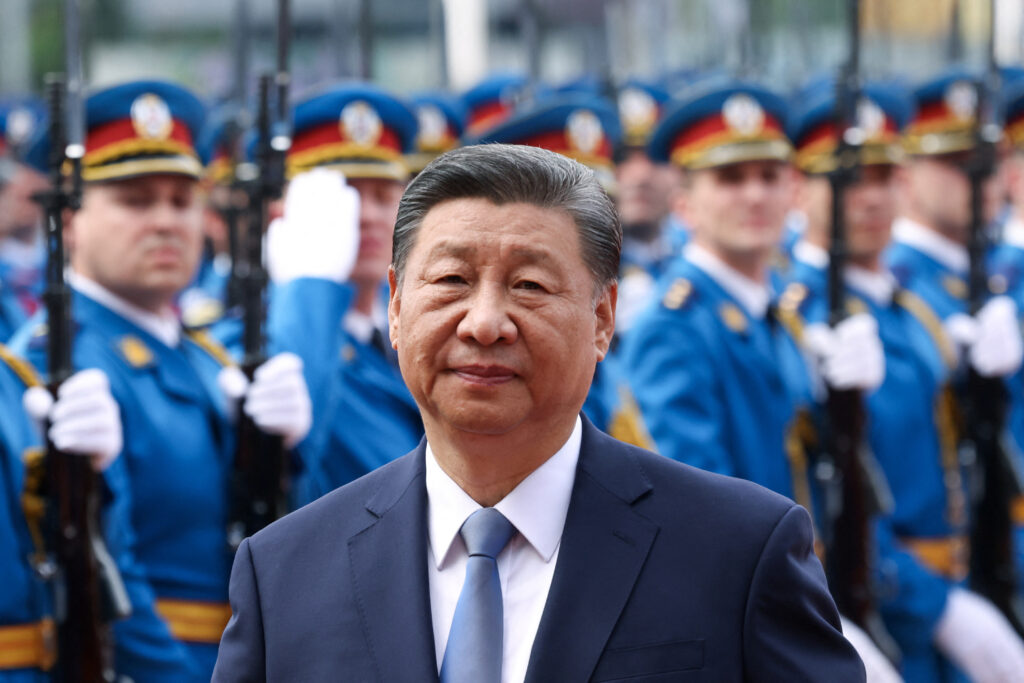
Next, Xi visited Serbia, where he and Serbian President Aleksandar Vučić further elevated their strategic partnership and made joint verbal attacks on the United States and NATO. Xi touted that Serbia became China’s first strategic partner in Central and Eastern Europe eight years ago, and it is now the first country in Europe with which China has said it will build “a community of shared future,” one of Beijing’s new flowery terms for its international relationships. The two leaders signed a free trade agreement—the first between China and a European country in a long time—and twenty-eight other agreements, including launching new Belt-and-Road-Initiative infrastructure projects.
Notably, Xi and Vučić used the visit to take a verbal swipe at the United States and NATO. The two leaders commemorated the twenty-fifth anniversary of NATO’s accidental bombing of the Chinese embassy in Belgrade, with Xi saying that the two countries will “jointly oppose hegemony and power politics,” a clear reference to opposing the United States’ role in the world.
Hungary: An “all-weather” partnership
Much like Macron, Hungarian Prime Minister Viktor Orbán received Xi with much ceremony. But unlike in Paris, the two leaders in Budapest spoke in unison on most issues, from “cooperating for a multipolar world” to wanting “peace” in the Ukraine war, with Hungary endorsing China’s proposed peace plan.
Under Orbán, Hungary has in the past decade become China’s main champion in the EU and NATO, doing Beijing’s bidding on Taiwan, downplaying concerns about China’s human rights record, and opposing de-risking. During their meeting, Xi and Orbán vowed to establish an “all-weather comprehensive strategic partnership” and take their relationship on a “golden voyage.” Cash-strapped and having most of its outstanding EU reconstruction, structural, and cohesion funds blocked by the European Commission, Hungary is increasingly relying on Chinese financing for its economic development. As a result, it is letting Beijing penetrate its critical infrastructure, from new railways to border fortifications to, as Orbán said, the “whole spectrum of the nuclear industry.”
The timing of Xi’s visit was crucial in several respects. Hungary will assume the rotating presidency of the Council of the European Union in July. Orbán promised Xi that Hungary, as the holder of the presidency, will try to advance China’s interests and, in effect, reverse de-risking.
The Hungarian prime minister may talk big, but there are serious limitations to what he can do during his country’s time leading the Council. The country in charge of the presidency is mostly constrained to setting the schedule and agenda of the Council, rather than substantially influencing its decisions. That said, the Hungarian government will seek to shape the Council’s work through these limited powers. It is likely to seek to minimize the actions that could harm Chinese interests.
More importantly, it is not the Council of the European Union (an intergovernmental legislative body of the EU) but the European Commission (in essence, the EU’s “cabinet”) that drives most of the de-risking initiatives aimed at curbing China’s penetration of the European economy. Among these initiatives, the Commission launched in October 2023 a crucial investigation into subsidies for Chinese electric automakers that could conclude shortly and result in EU tariffs against Chinese imports. The Commission has several similar ongoing anti-subsidy investigations against China on wood flooring imports, public procurement of medical devices, wind turbines, solar panels, and flat-rolled iron or steel products plated or coated with Chinese tin, and those initiatives are expected to progress further. Hungary’s presidency of the Council will have no real effect over these investigations.
Xi’s visit was also timed a month before the upcoming European Parliament elections in early June. While it is not the sole legislative body of the European Union, the European Parliament has nonetheless significantly increased its influence in the past decade and, importantly, has a say in choosing the composition of the next European Commission. Orbán and other nationalist radical right-wing leaders hope that their parties will make strong gains in these elections, shrinking the influence of the traditional center-left and center-right mainstream parties and making the European nationalist right the kingmakers of the new Parliament and Commission. While the European radical and far-right is divided on its approach to China, Orbán’s Fidesz party still has several like-minded partners that want to improve EU-China relations and reverse de-risking. Xi’s visit also served to boost the strength of these political forces ahead of the crucial European Parliament election.
It is too early to tell whether Xi achieved his geopolitical goals, but he was certainly able to appear to the Chinese audience and the international public as a world leader who is received with ceremony in Europe. He has also exposed some fissures between countries on the continent that could grow larger and cause problems. The second half of 2024 will be the real test of whether Xi’s visit managed to fulfill the Chinese leadership’s goals of sowing European disunity and creating a pushback against de-risking in the service of China’s interests and damaging Europe’s own.
Zoltán Fehér is a nonresident fellow with the Atlantic Council’s Global China Hub. Previously, he worked as a foreign policy analyst at the Hungarian embassy in Washington, DC, as Hungary’s deputy ambassador and acting ambassador in Turkey, and as Joseph Nye’s assistant at the Harvard Kennedy School.
Further reading
Image: Chinese President Xi Jinping looks on, on the day he meets with Serbian President Aleksandar Vucic as part of the Chinese President”s two-day state visit, in Belgrade, Serbia, May 8, 2024. REUTERS/Zorana Jevtic