For the past year, the Smithsonian Institution has found itself in the awkward position of telling the nation’s story while being supported in part by a government that wants to narrow how that story is told. In December, the White House threatened to revoke funding to the institution if it did not hand over a trove of wall texts and exhibit plans for a review. So when a permanent exhibition of presidential portraits closed for a refresh earlier this spring, whether some important but unsavory facts about the current president would be there when it reopened was unclear.
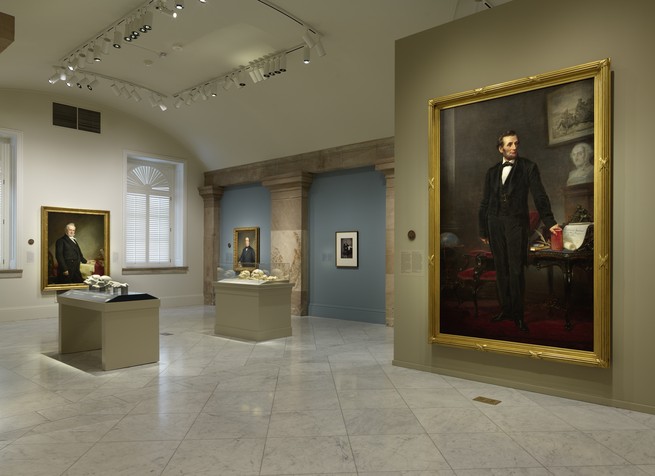
Now we know: The “America’s Presidents” galleries at the National Portrait Gallery in Washington, D.C., are back, and President Trump’s two impeachments are technically there. But they are mentioned without context, in a way that underlines the Smithsonian’s touchy relationship with an administration that has not hesitated to strong-arm the institution.
Last summer, the Smithsonian National Museum of American History quietly took down references to Trump’s two impeachments from a display on presidents who had faced the removal process. The change came amid a content review that the Smithsonian had begun under pressure from the White House, but following a public outcry, mention of Trump was restored. Then, months later, when the National Portrait Gallery swapped out a portrait of the president for an image he preferred, it also removed accompanying wall text that had touched on his impeachments and the January 6 insurrection. The new image was shot by the White House photographer Daniel Torok, and the new text was a “tombstone label,” the museum world’s term for signage that includes minimal information. (Months earlier, a Trump official had complained about the wall text.)
In a museum known for long-winded labels, the monthslong quiet about Trump was loud—especially as wall texts on, say, Bill Clinton and Richard Nixon nodded to their respective controversies. By saying nothing at all, the museum seemed to be saying everything.
Now the National Portrait Gallery has found a voice again—but one that isn’t quite its own.
In the refreshed galleries that reopen today, the Torok photograph is paired with a 178-word excerpt from Trump’s 2021 farewell address. In it, Trump outlines his hopes for his legacy as a president who “restored self government” and “the idea that in America no one is forgotten, because everyone matters and everyone has a voice.”
On the other side of the portrait, the museum has mounted what you might call a presidential résumé listing Trump’s education, major pieces of legislation, and key events during his first term. Here, his impeachments and the “January 6 U.S. Capitol attack” are noted without further information. The word insurrection does not appear.
The previous label had described Trump’s rise to power, listed landmark moments in his first term, and explained that he was “impeached twice, on charges of abuse of power and incitement of insurrection after supporters attacked the U.S. Capitol on January 6, 2021.” It went on to note, “After losing to Joe Biden in 2020, Trump mounted a historic comeback in the 2024 election.” The new text makes no mention of his 2020 defeat.
The new treatment—a farewell quote and a CV—is given to every recent president beginning with George H. W. Bush, who was the first for whom the National Portrait Gallery commissioned a painting.
Mindy Farmer, a historian at the museum, told me during a walk-through that the gallery felt that the farewell address, which is “the very first time that a president speaks to their entire legacy,” combined with the commissioned portrait, “was a very powerful way to think about how they want to be remembered.”
But the thinking part has been left to the public. After visitors see a series of galleries in which the museum confidently narrates the story for each of the first 39 people to occupy the presidency, the latter six presidents appear as though they are merely in the application process for a job as a historic figure.
It’s a role that Trump is acutely interested in. During the past year, the president’s name has been added to a “living memorial” to a slain president and tacked onto an airport. His face has been plastered alongside George Washington’s on National Park Service entrance cards, hung beside Abraham Lincoln’s on a banner in the nation’s capital, and added to special-edition passports. He has pitched changes to D.C.’s landscape in order to chisel his legacy in stone. He has shown himself eager to become historic in real time, to shape public memory of himself before he’s gone.
It is fitting, then, that his portrait at the National Portrait Gallery, ground zero for presidential-image making, has caused such drama.
Typically, presidents are added to the National Portrait Gallery after they leave the White House. First, the museum mounts a placeholder photograph, and later, it switches in a commissioned portrait. But Trump is the only chief executive to return to the presidency in a nonconsecutive term since the museum opened, in 1968 (and only the second to do so ever, after Grover Cleveland). Short of taking his portrait down, curators’ only choice was to perform the political tightrope act of having a sitting president—one deeply concerned with his own image—on view in the museum.
This predicament has been complicated by the president’s unprecedented attempt to influence programming at the wider institution. In an executive order last spring, Trump complained about what he called “divisive narratives” in the museums. He went on to accuse the Smithsonian of focusing too much on slavery, and later, his administration published a list of Smithsonian materials that it found objectionable.
The National Portrait Gallery, where Trump’s interest in his personal legacy and the nation’s history intersect, has repeatedly found itself in political crosshairs. Last summer, Trump attempted to fire its director, Kim Sajet, whom he described as “highly partisan” and who eventually resigned. The artist Amy Sherald pulled a show after a dispute over how and whether to display her portrait of a transgender woman as the Statue of Liberty. Although the Smithsonian asserted during the Sajet episode that only the institution’s secretary could fire museum directors, the controversies combined to illustrate the toll of political pressure.
Now, after pulling down the earlier Trump wall text in January, the National Portrait Gallery is “exploring” using different kinds of labels, the museum spokesperson Concetta Duncan has said. The exhibition for its Outwin Boochever Portrait Competition is dominated by tombstone labels. And now the six most recent presidents’ portraits have no institutional narration next to them.
The change is a real departure for the Smithsonian, which just a few years ago was, like many other museums, eager to dive into the political moment. The museums forged “rapid response” collecting teams to preserve objects from touchpoints such as the George Floyd protests and mounted displays about the coronavirus pandemic.
Now the Smithsonian is experiencing a resurgence—perhaps a conveniently timed one—of the idea that public memory must crystallize before it’s institutionalized. “Trump is literally making history every day,” Farmer, the historian, said, stressing that his legacy could change as documents come out, academic research is undertaken, and time shapes perception. “That’s really more what we’re focusing on here—giving ourselves time to really not try and predict what will be a presidential legacy or some of the biggest takeaways, but for that scholarly consensus to emerge so that we can draw from that,” she added.
The idea of a waiting period is common for monuments and memorials. There is a law, for example, about how long a person must be deceased before being monumentalized on federal land in the capital region. Although former presidents have always been eligible for the gallery’s collection, until 2001, the museum had a rule that it would not collect living sitters until a decade after their death.
The museum got into the touchy territory of commissioning portraits of living presidents in 1994. This has served them well in the past: The splashy unveiling of Kehinde Wiley’s and Sherald’s portraits of Barack and Michelle Obama in 2018 put the museum, a staple of school tours, at the center of a cultural flash point.
Under Trump, though, the National Portrait Gallery has found itself in a difficult spot. The artist Ronald Sherr completed Trump’s portrait for the museum several years ago, but it has never been publicly unveiled. It’s currently on loan to the White House, according to the museum, and The New York Times reported this year that the administration has requested they commission a new one for the museum.
Meanwhile, the White House has loaned the museum the Torok photograph, which shows Trump glowering over his desk. It’s an expression that Trump seems to like—the same one can be seen in the banners that the administration has hung in D.C. and placed on National Park cards.
What do we learn from an encounter with this image and its labels? Perhaps visitors familiar with Trump’s first term will see beyond how Trump wants to be remembered. But for those less familiar—say, a teenager who was just 10 when the January 6 insurrection happened—the museum does not guide. It presents a few events with no clear links among them.
David Ward, a former National Portrait Gallery historian, told me that the controversy over impeachment descriptions and the proliferation of tombstone labels recalled something that a Smithsonian leader suggested in the 2000s—that the museum wouldn’t need curators anymore, because the world now had Wikipedia. It caused “universal despair on the part of the curators and historians,” Ward said.
The National Portrait Gallery doesn’t quite go that far. Placed in an undeniably uncomfortable situation, the museum gives us some information about recent presidents, including the one in the Oval Office. Visitors have a list of facts and some quotes to work with. But from there, it’s up to them to tell the story.