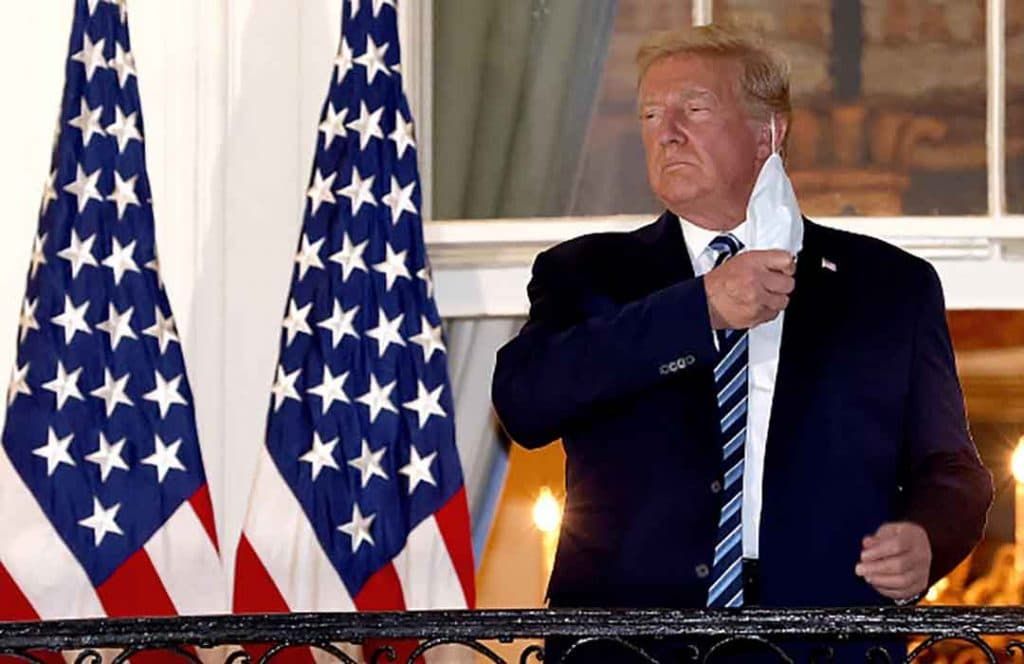
 Former president Donald Trump removes his mask upon return to the White House from Walter Reed National Military Medical Center on October 05, 2020 in Washington, DC. Trump spent three days hospitalized for coronavirus. (Photo by Win McNamee/Getty Images)
“I’ll make a decision,” Donald Trump said about whether to ban certain vaccines—before winning the presidential election Tuesday. He said he would do so after talking to Robert F. Kennedy Jr., the prominent anti-vaccine activist. The comment was only one of many that have given experts in public health and related fields heartburn. While last in office, after all, Trump presided over the first year of the COVID-19 pandemic when he was frequently dismissive of the scientists working to tame the crisis.
Though the COVID pandemic has receded in the public consciousness, the challenges the future Trump administration will face from infectious diseases have certainly not. The spread of H5N1 avian influenza in farm animals and a new strain of mpox in parts of Africa raise the specter of future outbreaks and possible pandemics. New capabilities in artificial intelligence (AI) and emerging biotechnologies, meanwhile, could create biological risks that rival those that might arise naturally.
The Bulletin reached out to a variety of experts in public health, biosecurity, vaccine policy, and other biology-related fields and asked them to share their take on Trump’s win and what it might mean for their areas of practice and research. Their responses will be published below, as they come in.
An isolationist on global health
Donald Trump’s win on Election Day raises the possibility that the United States will pursue isolationism not just in economic or military policy but also in health affairs. The United States remains the largest voluntary financial contributor to the World Health Organization (WHO), but withdrew its participation in the organization during the first Trump presidency. A similar decision would destabilize the most important health-related international organization not only in financial terms but also in terms of international acceptance of its authority. Similarly, we should expect that funding for an important global health initiative begun during George W. Bush’s presidency, the President’s Emergency Plan for AIDS Relief (PEPFAR) as well as active participation in other international health-related initiatives will also be at risk. Withdrawing or reducing US support for the WHO and cutting funding for other health programs will put in jeopardy critical achievements against infectious diseases.
I don’t believe that Robert F. Kennedy Jr. will be an integral part of the coming Trump administration, but rogue opinions and disinformation have already been normalized through Trump-Kennedy interactions. I expect that more Americans will share Kennedy’s vaccine skepticism four years from now, and if school vaccine mandates are no longer strongly supported, we can expect the resurgence of preventable childhood infections. (On the other hand, if Kennedy does get an important appointment, and the scenario evolves, then the United States will proceed down a path of fatal science denialism, just as the former Soviet Union did under the influential biologist Trofirm Lysenko, who’s contrarian views on genetics led to the persecution of scientific critics and a retrenchment in Soviet science.)
–Georgios Pappas is a physician who’s research focuses on zoonoses, epidemic preparedness, and the social aspects of infectious diseases.
A deeply concerning result for public health
Right now, I think you’d be hard-pressed to find many in public health, healthcare, and pandemic preparedness/response, who are not deeply concerned. The recent notion that Robert F. Kennedy Jr. could be in charge of public health for the United States poses a real danger. From his claims that vaccines are harmful or unnecessary to his proposed efforts to remove fluoride from public water systems, Kennedy continuously pushes anti-science rhetoric and dis/misinformation.
History has shown us what might happen under another Trump administration during times of crises, from extreme weather events to a pandemic. We have seen how an administration that pits itself against science and dedicated public service officials reacts. As we face an ongoing H5N1 outbreak, persistent outbreaks of emerging infectious diseases, an erosion of trust in public health, a rise in dis/misinformation, and widening social disparities, we need leadership that will unite rather than divide.
We are at a critical time in forming effective and pragmatic policies to address complex issues such as the ways in which developments in artificial intelligence (AI) will affect biosecurity, the safety and security around critical research of dangerous pathogens, the effects of climate change on infectious diseases, and the need to strengthen global health through equity and partnership.
Developing policies in these areas will require strategies based on collaboration and evidence-based measures–not inflammatory, inaccurate, and harmful rhetoric that furthers partisan divides and enflames social discourse. It’s our responsibility to find a path that ensures the protection of public health and global health security. We’ve got a lot of work to do, and I fear a hard road ahead of us.
–Saskia Popescu is an assistant professor in the Department of Epidemiology & Public Health at the University of Maryland School of Medicine.
Will Trump have quality scientific advice?
The next four years will see a continued need to respond to disease outbreaks domestically, for example, the H5N1 avian influenza spreading in pigs, cattle, and poultry and internationally, where pathogens such as the Marburg virus or mpox are circulating. Meanwhile, biotechnology and artificial intelligence (AI), continue to develop rapidly, presenting both risks and benefits for pandemic preparedness and other fields. To address outbreaks and remain economically competitive, the United States should press for further investment in the biotechnology sector. The country needs to continue to monitor the effects of artificial intelligence (AI) tools on biology.
A president should have strong scientific advice to tackle these issues. But Donald Trump has indicated plans to reclassify federal employees from permanent positions to appointee positions, which would be likely to reduce the amount of long-term, non-partisan scientific expertise available to policymakers. Trump’s policy preference will be compounded by the Supreme Court’s overturning of the so-called “Chevron doctrine” in June, under which federal agencies had leeway in translating laws into regulation. The ruling promises to transfer even more power away from experts and toward political appointees, reducing the ability of scientists to meaningfully advise on policy.
Trump was president when COVID began, but despite the severity of the pandemic and the damage it inflicted on his own presidency, he has promised to disband the Office of Pandemic Preparedness and Response Policy, which would reduce the United States’s ability to prepare for new pandemics. His statements about the cost borne by the country in global alliances like the World Health Organization (WHO), which he set about pulling the United States out of during his term, indicates that he may restrict US foreign aid that goes toward addressing global health issues.
There is a substantial risk of Trump appointing a non-scientific secretary of Health and Human Services, which could derail vaccine development and uptake as well as domestic health funding and priorities that conflict with the appointee’s personal beliefs. Although Trump’s statements on the campaign trail may not reflect what he actually does, he has mentioned things like banning vaccines and appointing the anti-vaccine activist Robert F. Kennedy Jr. as secretary of Health and Human Services. Such statements indicate a concerning and cavalier attitude toward public health and pandemic preparedness.
–Allison Berke is a bioengineer and the director of Chemical and Biological Weapons Nonproliferation at the Middlebury Institute of International Studies at Monterey.
How the next Trump presidency could impact immunizations
The first Trump administration invested billions of dollars in vaccine research and development to combat COVID-19, leading to what was arguably the most successful vaccine development program in history. This investment in American innovation and biotechnology, including mRNA vaccines, saved countless lives and has the potential to revolutionize the prevention and treatment of serious diseases. However, Trump also weakened public trust in science and threatened health agencies with funding cuts that could have compromised vaccine programs and outbreak monitoring—cuts that Congress had to override repeatedly.
Now, a second Trump administration could jeopardize our ability to defend our families from disease, putting human lives and local economies at serious risk. Talk of repealing laws like the Affordable Care Act could strip vaccine access for millions, especially vulnerable groups like seniors who rely on Medicare for free vaccines. In addition, the conservative presidential transition project known as Project 2025 advocates for the dismantling of vaccine requirements and removing the Center for Disease Control and Prevention (CDC)’s role in setting the national vaccine schedule, putting children at risk by allowing preventable diseases to resurface in schools. Project 2025 also calls for ending the use of long-established cell lines in vaccine development—a move based on outdated misconceptions about science. Major religious groups support vaccines, and these cell lines have contributed to lifesaving medical advancements.
Of course, there is also the question of Robert F. Kennedy Jr.’s potential role in the Trump administration. Kennedy runs one of the nation’s largest anti-vaccine organizations and has promoted long debunked conspiracy theories about childhood immunizations that are again gaining a foothold in public discourse. Trump has signaled support for Kennedy’s spurious claims and Kennedy claimed that Trump would give him control over health agencies, including the CDC.
Overall, we could see a dismantling and restructuring of federal health agencies, which would fundamentally alter our national health policies and disrupt—or even reverse—the progress we have made in preventing many vaccine-preventable diseases. Now is the time for the pro-vaccine majority to make their support for immunizations heard. SAFE Communities Coalition and our Families for Vaccines state chapters will continue to advocate for immunizations policies based on science and evidence. The same policies that helped the United States to eliminate many vaccine preventable diseases—diseases we don’t want to see our children needlessly suffer from.
–Jennifer Herricks and Crystal Rommen. Herricks is the advocacy director for the SAFE Communities Coalition and founder of Louisiana Families for Vaccines, where Rommen is a board member.
Less access to health care and worse public health
Donald Trump’s first term as president came to a tumultuous end in 2020 during the COVID-19 pandemic. The prospect of his return to office now raises an array of public health repercussions for millions of Americans.
Let’s start with vaccines. During the pandemic, the Trump administration’s key achievement was developing COVID-19 vaccines in less than eight months. Even though Trump was inoculated and subsequently encouraged others to follow suit, he and his right-wing health advisor, Robert F. Kennedy Jr., now spew anti-vaccination messages. They have proposed rolling back vaccine mandates, deconstructing the Centers for Disease Control and Prevention (CDC), and gutting its budget.
Americans’ access to additional health services through the Affordable Care Act (ACA) is also at risk. Congressional leaders have again targeted the act, sometimes called “Obamacare” for repeal and replacement, despite unsuccessful prior attempts during Trump’s last administration. Rescinding the act’s protections is politically unpopular. Yet the coming Trump administration seems committed to assuring health care access remains “for sale” in the United States, and not simply handed out. Expect diminutions in access to programs like Medicaid or Medicare, critical health safety nets for low income people and the elderly, respectively. Higher health care costs means less access, which will contribute to diminished public health outcomes.
The cumulative impacts of these and other anti-public health strategies and initiatives, including potential limits on abortion access or reversals of climate change policy, are entirely predictable. Americans may experience lowered rates of life expectancy. Millions will needlessly suffer. And excess deaths due to ill-advised, non-scientific, unproven, and punitive policies are going to rise absent resistance and derailments of planned interventions.
–James G. Hodge, Jr. is the Peter Kiewit Foundation Professor of Law and the director of the Center for Public Health Law & Policy at the Sandra Day O’Connor College of Law at Arizona State University (ASU).
Less biosecurity regulation and oversight to come
As the Trump administration assumes its offices next year, we can expect to see a general loosening of federal biosecurity regulation and oversight across various sectors.
US agricultural biosecurity, the protection of plants and animals from disease threats, will not significantly change. Congress has generally allowed the food industries to regulate themselves while keeping an eye on food imports to the United States. The Trump administration will likely not engage in this area.
With regards to laboratory biosecurity, despite the past debates over the origins of the COVID-19 virus, there will be no advances to improve US laboratory biosecurity or biosafety. Given the significant growth of biological research within the United States, we ought to see more federal regulation and transparency to ensure safe practices across the nation. Instead, we should expect to see the Trump administration waive or reduce biosecurity regulations that might impinge on US pharmaceutical and biotechnology firms’ research and development efforts. China’s continued dominance in synthetic biology will be a motivating factor to limit federal restrictions on US firms so as to allow them to compete internationally in this area.
As for military biodefense, the Pentagon conducted a Biodefense Posture Review in 2022 that included plans to enhance biosecurity and biosafety at its relatively few biological research facilities. But if the Trump administration seeks to reduce excessive government oversight and improve military readiness against biological warfare, it should eliminate future reviews and the excessive management structure created by this annual reporting while directing the offices in the military to work with the Defense Health Agency to maintain proper management of its biosafety labs.
–Al Mauroni is a senior policy analyst with 40 years of experience with US military chemical and biological defense and is the author of BIOCRISIS: Defining Biological Threats in U.S. Policy.