The first impression America gave me was gentle carelessness. We were driving down from Canada to visit family friends in Texas sometime in the mid- to late 1980s, and a young border patrol agent at a booth, crouched over a newspaper, leaning back in his chair, carelessly waved my family’s station wagon across without looking up. You didn’t even need a passport to enter the United States until I was 33.
You need clear eyes at the border today. Europe and Canada have issued travel advisories after a series of arbitrary detentions, deportations to foreign jails without due process and hundreds of valid visas pulled or voided amid a sense of general impunity. While I have crossed the border a hundred times at least, sometimes once a month when I lived there, I cannot say when I will see America again, and I am quite sure I will never return to the country I once visited.
The America I knew, the America I loved, has closed.
And so I find myself like a man who has been admiring bubbles floating in the air, trying to recall their shape and swerve and shine after they’ve popped.
America was a country of bubbles. I loved it as one loves anything that is both real and fantastical.
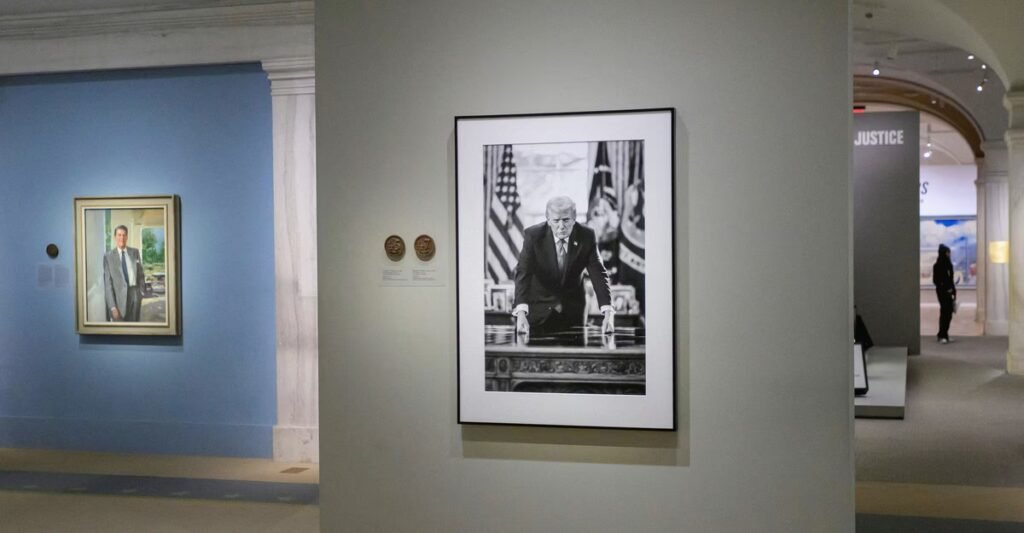
Donald Trump has blown himself into a bubble of gilded ceilings, ersatz Roman murals, sycophants on tap and midnight rants of imperial conquest on personally owned social media networks. He is only one story. America was millions of bubbles. For some reason, I find myself remembering Tom Waits in a junkyard making Bone Machine, turning rusted fenders and tossed-out dry cleaners and cracked sheet metal into a scrap marimba of his own invention. Even its dumps could give birth to magic.
Golf course palaces and wrecking-lot percussion: twin American truths.
You felt the meaning of America the moment you entered. In Canada, wilderness is wilderness. The northern forests I come from resist interpretation; that is their power. But when you cross the border from, say, Quebec into Maine, you can feel myth accruing around the bark of the trees. You are in the haunted forests of New England, redolent with burned witches and ghost stories. Further south, the foggy murderous oaks loom gothically. Out west, the deserts beg for cowboys to cross them. Canada is a country that disillusions you. America is one illusion after another, some magnificent, others treacherous or vicious.
Every landscape in America is setting, and you have to pose inside them. In my 20s, I drove Highway 1 from San Francisco to Los Angeles. An older and wiser friend told me to rent a convertible, and I laughed the suggestion off, since it felt like something you would do in the movies. Huge mistake. That drive down the California coast – cows by the big-wave Pacific, condors in the clefts of Big Sur – demands an open roof.
I learned then: when you go to America, always pick the option that feels like what you would do in the movies.
In San Francisco, right by the Yahoo offices on Mission Street, was a small homeless encampment. I could just see inside one of the tents through an open flap, where a boy – he would have been about 10 years old – was playing with little treasures on a small tray – a ring, a toy car, a key chain. Even the tents of the homeless were little bubbles.
In Malibu, at a sushi bar, elegant Japanese surf bums lounged between orders, watching Game 7 of the World Series, languidly curling out cucumber spirals the chefs used instead of seaweed. That was their thing – cucumber-based rolls. That restaurant is ash now.
Sometimes, you can see the bubbles better from the air. Flying into Palm Springs, the desert circumscribed, encroaching, revealed the furious machinery working to push it away. Palm Springs is pure delight on the ground: the misted pools, the cocktails filled with the exactly the right ice shapes, the street names hanging on to the faded glamour of the tacky talkshow guests from half a century ago.
The airport has no roof; that’s how crazy a city it is. A glistening shivering bubble, effortless once inside.
The sheer prosperity of the country could be breathtaking. I had just come back from Senegal when the Guardian sent me on assignment to rust belt Ohio, during the first stirrings of Trumpism, back in 2015. I was there to report on the growing swell of populism by way of the postindustrial immiseration of middle America.
I was stopping for gas on the way to a rally, and at the station they were selling a hotdog with as much chilli and cheese as you liked for $1.99. The chilli and cheese came out of the wall. You pressed two buttons, one for chilli and one for cheese.
On the streets of Dakar, children hawk packs of peanuts and plastic bags of clean water on the street, and I wondered if you could even explain to them that there existed a place, on the same earth, where chilli and liquid cheese came out of a wall, and you could have as much of it as you liked for the equivalent of 20 minutes’ work at the minimum wage, and that some of the people in that place considered themselves so hard done by that their resentful fury threatened the political order, that they just wanted to burn it all down.
It was more than money and grandeur, though. The openness, the generosity of ordinary people, floated free over the country.
When I was researching my book The Next Civil War, the far-right people I met, the militia folks, in Oklahoma and in Ohio, at gun shows and Trump rallies and prepper conventions, were, without exception, polite in person – no doubt because I’m white, with blond hair and blue eyes, so I can pretend to be a good ol’ boy when required. They lived in dark bubbles, bubbles of serpentine paranoia and weird loathings and strange fantasies of breakdown.
They welcomed me into their bubbles as equably as concierges. Militia pie is delicious; the crusts are richer, flakier. I think they use lard. Anyway, they talked to me about their hopes for the destruction of their government cheerfully and frankly, because they were living the movies playing in their minds and they wanted me to witness the projection.
At one prepper convention I remember, a vendor was selling gluten-free rations for bunker survival. That was America in a bucket to me: even at the end of the world, don’t let a gluten allergy interfere with your active lifestyle.
Much later, for another publication, I attended a human-fairy congress in rural Washington state. Both humans and fairies were welcome to attend but only humans could enroll in the courses on fairy gardening and fairy marriages. They were the residue of the hippies, I suppose. The final event was a big dance where the fairies joined them and parlayed a message from the spirit realm. A young man dressed in Tibetan shaman robes ran into the luscious meadow set between ponderosa pines shouting “I! Feel! Better!” He was a definitive American type – a seeker who just went with his seeking.
In America, one bubble was as good as another: the next week, many of the human-fairy enthusiasts were headed to a cosmic Sasquatch festival.
On the other side of the state, in the Olympia forest, I interviewed illegal lumber poachers who cut a cord of firewood a day from the dead trees on public lands for meth and food and gas money, a primitive existence not that far from stone age tribes or medieval peasants. As I approached their compound, a coagulation of wrecked cars and rotten RVs and driftwood lean-tos with hanging tarps, a turkey strutted out to defend their ad hoc architecture of detritus. They had a guard turkey. The guard turkey was the shine of their bubble, like something in a dream.
The American dream. For technocrats, a dying breed in the US, the term was shorthand for each generation doing better than the one before, for generally upward social mobility. There was more to it than that. There was an idea, an assumption really, that if you had enough talent and worked hard and did the smart thing, with a little luck you could live life just as you wanted. The country’s founding promise, after all, is “life, liberty and the pursuit of happiness”.
That promise is why success in America does not lead to gratitude but to an intense sensation of loss. The elite take any deviation from their fantasy existence as a broken contract. They’ve been ripped off. That is a big feeling among the most successful people in America: the sense of being ripped off.
The country clubs are rife with men and women, in incredible luxury, complaining bitterly about the state of the country. The richest and most powerful, the Americans who have won, who have everything, are still not happy, and why? Their answer is that the American dream must be broken. There is no one who feels more betrayed by the American dream than the world’s richest man. Why else do you think he’s out there with a chainsaw?
The American elites of the past 20 years have called their foremost principle freedom, but what they meant was impunity. That’s what the original slave masters built: a world where they could do whatever they wanted to whomever they wanted, without consequences. That’s what the techlords dream of today.
The truly frictionless world they seek eludes them exactly because it is a dream, because it is unreal. The ultimate truth of bubbles is that they pop.
Another bubble: when I was teaching Shakespeare in Harlem, at the City College of New York, I had a homeless student who slept in his car and never missed my seminar on revenge tragedy. You can only live that way if you live in a bubble buoyed by dreams.
I, too, have floated in American bubbles. I have inhabited its intoxication. If it were not for America, I would be working part-time in a coffee shop.
In the early 2010s, I was a writer stuck between Toronto and New York, and I had written my attempt at the great Canadian novel, about Alberta and Quebec and the unspoken fascination between them – between Montreal, with its wild heart, and the wild prairies filled with longing for a distant recognition. Nationalism was completely out of fashion then. No one in Canada would even look at the manuscript. My friends at small presses stopped accepting my invitations for drinks. You can be a loser and you can be a nag, but nobody wants both at the same time – even in Canada.
I had been sitting on the book for a year when David Granger, my editor at Esquire, invited me down to New York, rented out a room at a Midtown Manhattan restaurant, and threw a party for me, just to give a speech to the gathered editors of Hearst about what a great writer I was. I returned to Canada, asked myself what the hell was I thinking trying to tell the stories of people who didn’t care if their stories were told, rewrote the novel so it was set in New York, and sold it in a few weeks for six figures.
People used to say, about New York: “If you can make it here you can make it anywhere.” Nothing could be further from the truth. The whole point of New York was that it was the city that wanted you to make it. David Granger blew a bubble around me, and the David Grangers on this planet are all American; that’s the fact of the matter.
You work hard, you play hard. So many Americans will do whatever it takes to prevent their bubbles from bursting. The second Trump administration has clarified this national trait. As the authoritarian impulse strips America of any motivating ideals, the only -ism surviving is careerism.
The past decade has demonstrated that there is nothing that will cause an American politician to resign. There is no line they won’t cross. To keep the bubble from popping, they will drink their own blood until there’s nothing left but a husk. There are currently people in America who are racist, not because they actually think other races are inferior, but because they think it will advance their careers, just as there were people pretending to be civil rights activists when they thought it looked good on a résumé.
At the same time as there can be a terrible indifference to those outside the bubbles, there is no other group of people, in the world, happier to see others succeed than Americans. In Florida, there was a private poker room I used to go to, under a dog track in Sarasota, where you could meet the full spectrum of the Floridian population – grill-fronted southern bubbas, Jewish grandmothers, tweakers.
They were just so much fun to sit playing cards with, discussing whether life had any purpose or discernible order. I remember, cancer had struck one of the dealers, who was in her mid-20s, and, to help with the medical bills, the house gave all the profits from a night over to her. It wasn’t just the rake, either. They held a silent auction, old customers forked over fistfuls of dollars straight up, and it was magnificent, a sheer festival of generosity.
But my little Canadian heart reserved an obvious thought: “You don’t have to do all this.” You don’t have to live this way. No other industrialized country in the world has to throw parties to raise money for its sick people. They could not see their own strangeness. Their bubbles reflect themselves back to them as the world.
But it was a hell of a fun night.
Fun. America was fun.
Other countries do pleasure or luxury or celebration. America did fun. The Beatles were fun because they played American music. McDonalds conquered the world because they put a fun-for-five-minutes piece of plastic in with the fries and called it the Happy Meal. “What’s great about this country is that America started the tradition where the richest consumers buy essentially the same things as the poorest,” Andy Warhol once wrote. “A Coke is a Coke and no amount of money can get you a better Coke than the one the bum on the corner is drinking.”
Everyone drinks the drink of bubbles, the fun drink.
The bubbles by which they lived were the subject of their greatest works of art. In the great one-hit wonder paintings, like Christina’s World by Andrew Wyeth or Nighthawks by Edward Hopper, you can feel the souls pressed up against their bubbles or sinking back in them. This year is the 100th anniversary of The Great Gatsby, and obviously it is the great American novel, the novel of the careless people who smash up the world and retreat into their money and their supreme indifference, the novel of bubbles.
But the definitive work of American art isn’t Gatsby; it’s the roadrunner cartoons. If Coyote keeps running, he can run over air. It is only when he looks down that he falls.
In Judaism, it is forbidden to throw out sacred books. They keep the shreds of exhausted texts in a storage room called a genizah.
The American text is exhausted. I am going to keep my memories of America in a genizah in my mind, the ones I have written here but also: dawn over the Shenandoah seen from the flatbed of an F-150; Broadway Boogie Woogie by Piet Modrian in the MoMA; a New Orleans band that must have played When the Saints Go Marching In 10,000 times playing it as if it were the first time; the smell of tacos al pastor in a Tulsa parking lot; low-limit craps in Vegas; a western oriole strutting in pine needles; the stump of the “Tree of Hope” in Harlem; the Siesta Key Oyster Bar, where the walls were covered with Iraqi money stapled there by returning soldiers; the sausages at the Wrigley Field ballpark in Chicago; the New York hustler who went down the A train selling his romance novels out of a box; that wave at the border I may have half-imagined.
Countries fall out of the free world. They fall back in, too. These memories are not yet dead. They are only closed.
But for now, a great foam is lifting, drifting, blowing through unsettled air, and all I can hear, in the distance, is the sound of bubbles popping.