Supply & Demand in the Stock Market

A reader asks:

You guys have recently quoted Slock in two podcast episodes that Private Equity Companies, those with over 100 million dollars in revenue make up 87 percent of that category versus only 13 percent of publicly traded company fall into the 100 million in revenue category, and that number is only increasing.

With that said, is this ONE of the reasons stock prices seem to continuously increase. As private equity companies continue to increase in number, there are less publicly traded companies therefore there is more money chasing the ever decreasing number of public companies?

Here’s that stat from Apollo’s Torsten Slok:

The Atlantic shared some data about the dwindling number of publicly traded stocks along with the corresponding growth in private equity investments:

The publicly traded company is disappearing. In 1996, about 8,000 firms were listed in the U.S. stock market. Since then, the national economy has grown by nearly $20 trillion. The population has increased by 70 million people. And yet, today, the number of American public companies stands at fewer than 4,000. How can that be?

One answer is that the private-equity industry is devouring them.

In 2000, private-equity firms managed about 4 percent of total U.S. corporate equity. By 2021, that number was closer to 20 percent. In other words, private equity has been growing nearly five times faster than the U.S. economy as a whole.

Private equity managed less than $1 billion in the mid-1970s.  Today it’s more than $4 trillion. There is more than $2.5 trillion in dry powder alone globally:
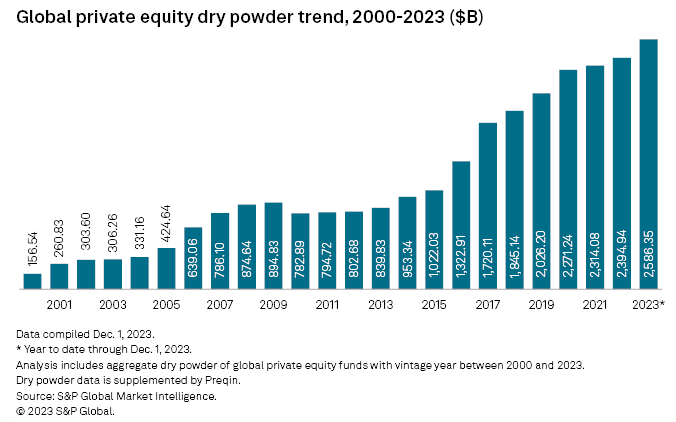
Private equity is a big part of the U.S. and global economy now.

Here’s a look at the shrinking number of public stocks in the U.S. via Barron’s:
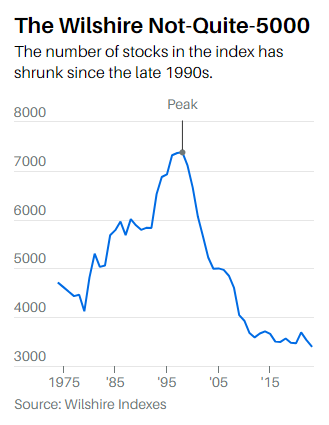
We’ve gone from more than 7,000 stocks in the mid-1990s to more like 3,500 now. The number of public companies has been more than halved.

The Wilshire 5000 is more like the Wilshire 3500. The Russell 3000 currently has only 2,668 stocks, while the Russell 2000 has just 1,665 stocks.

We’ve reached the point where the indexes feel like false advertising.

From a purely supply and demand perspective, it would make sense that more dollars chasing fewer stocks would drive up prices.

But there’s more going on here. You also have to look at the types of companies that have gone away.

That spike in new corporations during the 1990s was something of an aberration of the dot-com bubble. It was mostly tiny micro-cap companies.

Vanguard shared the data on this with Institutional Investor a few years ago:

Rowley says the proportion of large-cap, mid-cap, and small-cap companies that make up overall market capitalization is very consistent going back to 1979. He says many analysts have made 1996, which had a record number of public companies, a de facto anchor point. However, the late 1990s markets were at a high point, with many companies eager to go public and cash in on rich valuations.

“If you look at the general trend in history, there’s an increase in the number of public companies leading up to 1996, and there’s been a decrease down from that point,” says Rowley. “But again, it’s almost exclusively the domain of micro-cap stocks.”

In 1979, there were 2,044 public micro-cap companies. In 1997, there were 4,193, and in 2014 there were 1,549. But they are a small part of the publicly traded universe. In 1979 and 1997, micro caps represented 3 percent of the market. In 2014, micro-caps represented 2 percent of the market. Micro-caps fell to 1 percent by 2016.

Most of those micro-cap companies from the 1990s ended up going out of business because they had no business model or fundamentals. They were looking to cash in on the euphoria at a time when there wasn’t as much VC or PE money sloshing around.

And micro-cap companies are a sliver of the U.S. stock market from a market cap perspective.

Holding ten one-dollar bills doesn’t put you in a better position than the person holding a single one-hundred-dollar bill.

Sure, there are some smaller companies investors have missed out on because of more venture capital money, M&A and buyout activity. But you could argue the remaining companies are now even higher quality because of this.

Michael Mauboussin wrote a paper about the shrinking number of stocks back in 2017 making this exact argument. This was the main takeaway from that report:

As a result, listed companies today are on average larger, older, and more profitable than they were 20 years ago. Further, they operate in industries that are generally more concentrated. The overall size and maturity of listed companies means they are more likely to pay out cash to shareholders in the form of dividends and share buybacks than companies were in the past.

We speculate that the maturation of listed companies has also contributed to informational efficiency in the stock market. Gaining edge in older and well established businesses is likely more difficult than it is in young businesses with uncertain outlooks. In turn, the greater efficiency may be one of the catalysts for the shift that investors are making from active to indexed or rule-based strategies.

It makes sense this has created an environment where it’s now harder to outperform the market.

There are many reasons the stock market has been going up over time.

The number of stocks listed on the exchange is not one of them.

We discussed this question on the latest edition of Ask the Compound:


Barry Ritholtz joined me on the show this week to answer questions about the actual inflation rate, how fiduciary duty works, worries about U.S. government debt and if we will see a flood of homes hit the market when baby boomers begin dying off.

Further Reading:
The Rebirth of the IPO

Source link

Visited 2 times, 1 visit(s) today

Related Article

Nvidia’s trillion-dollar run puts pressure on the bulls

BEIJING, CHINA – MAY 14: Nvidia CEO Jensen Huang (C) gestures as he prepares to depart following a welcome ceremony at the Great Hall of the People on May 14, 2026 in Beijing, China. President Trump is meeting with President Xi Jinping in Beijing to address the Iran conflict, trade imbalances, and the Taiwan situation

Permutations in Europe: What’s still at stake in final weeks of season?

There’s still plenty to play for across Europe as we head into the final matches of the club season. Here are all the title races, Champions League fights, and relegation battles left to be decided in the top leagues this month. This story will be updated until the end of the campaign. 👉 Jump to:EPL

Brewing a Better Half-Gallon Batch

Today I finally ran an experiment I’ve wanted to try for a long time. If you’re a professional barista—or you run a busy café—this may save you some time. Most coffee shops use 1–1.5 gallon batch brewers (Bunn, Curtis, Fetco, etc.). When I opened Short Sleeves Coffee, I intentionally avoided brewing full 1-gallon batches. I

5 Frozen Breakfasts Chefs Say Keep You Full All Morning

Chef-approved frozen breakfasts with more protein and better ingredients. Eating a healthy breakfast every morning is a great way to start the day, but most people don’t have time to cook. Whether you’re rushing out the door in the morning for work, taking the kids to school or both, there’s usually not much time in

CA scales back plan to ban student use of cell phones

By Carolyn Jones, CalMatters This story was originally published by CalMatters. Sign up for their newsletters. Until last month, California was poised to join nearly a dozen other states that ban cell phones in K-12 schools. But under pressure from school boards and administrators, lawmakers scaled back a bill that would have required such a

BulkQuant Launches AI Trading Bot for Crypto, Forex, and Stock Markets

BulkQuant Launches AI Trading Bot for Crypto, Forex, and Stock Markets

London, United Kingdom, May 15, 2026 (GLOBE NEWSWIRE) — BulkQuant has officially launched its AI trading bot platform designed for crypto, forex, and stock market traders seeking a simpler way to automate trading strategies across multiple financial markets. The platform combines AI-powered quantitative analysis, automated trade execution, portfolio monitoring, and adaptive risk management into a

IMF lauds resilient Hong Kong economy but warns of risks linked to Middle East war

IMF lauds resilient Hong Kong economy but warns of risks linked to Middle East war

The International Monetary Fund (IMF) has lauded the resilience of Hong Kong’s economy, noting a sustained recovery despite economic activity having yet to return to pre-Covid levels, while warning of downside risks stemming from escalating geopolitical tensions. It also urged Hong Kong to pursue medium-term financial reforms, including the introduction of a goods and services

Smithsonian Presidents Exhibit Reopens With Low-Key Trump Impeachment Mention

For the past year, the Smithsonian Institution has found itself in the awkward position of telling the nation’s story while being supported in part by a government that wants to narrow how that story is told. In December, the White House threatened to revoke funding to the institution if it did not hand over a

Marvel’s Daredevil Follow-up Is Already Dominating on Streaming

A follow-up to Daredevil: Born Again Season 2 on Disney+ has become a massive streaming success within days of its launch. The Punisher: One Last Kill has quickly climbed to the top of multiple charts, beating out other titles on the platform. The MCU television special follows the gun-toting vigilante, who finds himself targeted by

Is Now a Bad Time to Invest?

The market has been on a roll lately, with the S&P 500 (SNPINDEX: ^GSPC) setting new highs throughout May. If you think you missed your opportunity when the market bottomed in late March, don’t fret. The market hitting new all-time highs is not particularly rare and should not change your investment strategy. And if you

6 bids for Hong Kong land sale signal renewed confidence despite market caution

6 bids for Hong Kong land sale signal renewed confidence despite market caution

The Hong Kong government’s first land sale in the current financial year has drawn six bids, according to the Development Bureau, including those from the city’s largest developers, suggesting a more confident outlook for the residential property market. At the close of tender for Tung Chung Town Lot No 54 at Area 106A on Friday

Each Premier League team reranked: Man City rise; Chelsea, Liverpool collapse

Ryan O’Hanlon Close Ryan O’Hanlon ESPN.com writer Ryan O’Hanlon is a staff writer for ESPN.com. He’s also the author of “Net Gains: Inside the Beautiful Game’s Analytics Revolution.”  and  Bill Connelly Close Bill Connelly ESPN Staff Writer Bill Connelly is a writer for ESPN. He covers college football, soccer and tennis. He has been at

Trump departs China after two-day summit

Trump departs China after two-day summit

IE 11 is not supported. For an optimal experience visit our site on another browser. Trump Wraps China Summit With Xi Jinping: What Are the Results? 05:41 Xi gives Trump rare tour of secret garden at heart of Chinese government 01:04 Now Playing Trump departs China after two-day summit 01:01 UP NEXT Special Report: Trump

Carol Chow was facing a bankruptcy petition by five people over unspecified debts at the time of her death. Photo: Dickson Lee

Embattled Hong Kong developer sued for HK$130 million, days after founder’s death

A Hong Kong property developer has been sued for HK$130 million (US$16.6 million) over allegedly breaching guarantor obligations in two bond subscription agreements, becoming the latest lawsuit to implicate the embattled company and following its founder’s sudden death earlier this week. Lofter Group, known for its urban renewal projects across the city’s core districts, and

Trump’s China visit left chip export issue unresolved

This report is from this week’s The Tech Download newsletter. Like what you see? You can subscribe here. One look at the roster of U.S. execs that cozied up to U.S. President Donald Trump on the 20+ hours flight from Alaska to China on Wednesday and you get a sense of the American delegation’s key focus

Why the Cerebras IPO matters for the AI race with China

Why the Cerebras IPO matters for the AI race with China

Cerebras, an AI chipmaker, saw its shares nearly double on Nasdaq, closing up 70% with a $95B market cap. Cerebras’s powerful chips are key in the US-China AI tech race. Chris Buskirk, co-founder and chief investment officer of 1789 Capital, a key Cerebras investor, says the company’s IPO is geopolitically significant. On Thursday, shares of

Fitbit Air vs Whoop Strap Comparison: Price, Features and AI

The Google Fitbit Air is very much the talk of the fitness tracking town right now, not only because it’s the first new Fitbit device that we’ve had in years, but it’s also one of the first big brands to go head-to-head with the established Whoop Strap (if you don’t count the Polar Loop and

0
Would love your thoughts, please comment.x
()
x