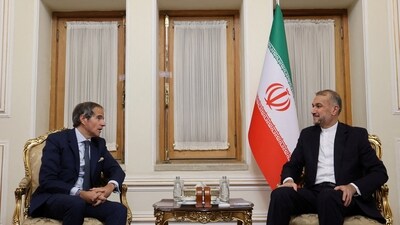
ON MAY 6TH Rafael Grossi, the director-general of the International Atomic Energy Agency (IAEA), travelled to Tehran and met Hossein Amirabdollahian, Iran’s foreign minister. Less than two weeks later, on May 19th, Mr Amirabdollahian was dead, killed in a helicopter crash that also took the life of Ebrahim Raisi, Iran’s president, among others.
Their deaths throw Iran’s sclerotic theocracy into a moment of confusion and uncertainty, one with far-reaching implications for the country’s nuclear programme. Mr Grossi, fresh from his trip to Iran, recently spoke to The Economist about the Iranian nuclear file, as well as the other items on his forbidding to-do list, from the Russian-occupied Zaporizhia nuclear-power plant in Ukraine to the “growing attraction” of nuclear weapons worldwide.
The Vienna-based IAEA has two jobs, both enshrined in the Nuclear Non-Proliferation Treaty (NPT) of 1968. One is to promote the peaceful use of nuclear energy. The other is to ensure that using such energy does not lead to countries developing the bomb. And the country of principal concern today is Iran.
Bold plans
Iran’s nuclear programme is expanding rapidly in size and sophistication. It has 27 times as much enriched uranium as was permitted under the Joint Comprehensive Plan of Action (JCPOA), a multinational nuclear deal abrogated by Donald Trump in 2018. It is now an “empty shell”, says Mr Grossi, who was speaking prior to Mr Raisi’s death. That stockpile, some of which is enriched to 60% purity, close to weapons grade, is enough for about three bombs (see chart 1). Along with Iran’s use of newer and faster centrifuges, these developments have “completely superseded” the JCPOA, he says. The result is that Iran could produce a bomb’s worth of weapons-grade uranium in just a week and enough for seven over a month, according to research by the Institute for Science and International Security, an American think-tank.
When Mr Grossi visited Iran in March 2023 the country promised to co-operate more fully with the IAEA, including by reinstalling surveillance equipment it had removed earlier. That progress “quickly stalled”, says Mr Grossi, with both sides “talking past each other”. He has said that the IAEA has lost “continuity of knowledge” about, among other things, Iran’s production and stockpiles of centrifuges, heavy water and uranium-ore concentrate. These could be used to reconstitute a nuclear-weapons programme in secret, rather than using known facilities that could be bombed. On May 7th Mr Grossi returned to see whether he might break the impasse. There had been hopes that Iran would slow down its accumulation of 60% enriched uranium by “downblending” it to lower levels. But there was no such commitment, says Mr Grossi. Iran seems to have been stringing everyone along throughout.
He is also concerned by a growing number of statements by senior Iranians that the country might be more open to a bomb. In April, as Israel and Iran exchanged missile fire, the head of the Iranian Revolutionary Guard Corps unit responsible for the safety of nuclear sites hinted that Iran might rescind a “fatwa” against nuclear weapons issued by Ayatollah Ali Khamenei, the country’s supreme ruler, in 2003. In May Kamal Kharrazi, an adviser to Mr Khamenei, issued the same threat twice within days. “This is unacceptable,” says Mr Grossi, “unless the country would choose to denounce or leave the NPT.”
There is no consensus among experts and Western officials on whether these statements are signals that Iran intends to build a bomb or whether it simply wants to shore up deterrence against America and Israel at a tense time. Mr Grossi says he is consoled by the fact that neither the late Mr Amirabdollahian nor Mohammad Eslami, Iran’s vice-president and head of the country’s Atomic Energy Organisation, had repeated these statements. He says a new agreement—“a JCPOA rebooted or a JCPOA 2.0”—is imperative. Yet the death of Mr Raisi is likely to shake up the system and complicate the matter in several ways.
A vulnerable and isolated regime could be tempted to develop nuclear weapons for more security. It could also affect decision-making. Mr Raisi’s ideological allies have no obvious successor in his mould. Reformists were shut out of Iran’s sham elections for the presidency in 2021 and parliament in 2024, and could be again: under the constitution, a presidential election is due 50 days after a president’s death. It’s possible that a more pragmatic, conservative candidate could become the next president, making negotiations over a new nuclear deal possible, if not probable.
Moreover, Mr Raisi was a candidate to succeed the ailing Mr Khamenei. His death improves the chances of Mojtaba Khamenei, the latter’s son, taking over instead and could strengthen his allies in Iran’s Revolutionary Guards—the driving force behind the nuclear programme for almost 40 years.
These issues may dominate a meeting of the IAEA’s board of governors between June 3rd and 7th. Some Western countries want to refer Iran to the UN Security Council (UNSC). In the past, the veto-wielding P5 countries had a “common denominator” on Iran, agreeing on sanctions, says Mr Grossi. “Now that would not happen,” he acknowledges, in light of deep splits between America, Britain and France on one side, and Russia and China on the other. That great-power gridlock, in turn, means that Iran can proceed with relative impunity.
Mr Grossi warns that an Iranian bomb would have far-reaching consequences. “The Korean peninsula had very circumscribed…parameters that made a domino very, very difficult in that circumstance,” he says, referring to North Korea’s acquisition of nuclear capabilities in 2006. “I think the Middle East is completely different. Here, you would have a situation which would lead to more countries, if not openly seeking nuclear weapons, trying to get latency and trying to get closer to that because they would feel that the system is failing.”
In September Muhammad bin Salman, Saudi Arabia’s de facto leader, reaffirmed that the kingdom would seek a bomb if Iran developed one. It is seeking permission to enrich uranium and reprocess spent fuel—steps that would allow it to produce fissile material—as part of a broader energy and defence pact with America that is under intense discussion. Mr Grossi is circumspect when asked about that, saying only that he intends to “work very closely” with the kingdom. But he clearly worries about nuclear proliferation. “I think it would spread” beyond the Middle East, he says. “Unfortunately, what we see is a trend, a growing attraction, the lure of nuclear weapons is there. We cannot deny it. It is very, very regrettable.”
Keep the lights on
The threat of nuclear conflict in the Middle East is not the only terrifying problem on Mr Grossi’s agenda. Russia has also said it intends to restart the Zaporizhia nuclear power plant in southern Ukraine, which it has occupied and militarised. The plant has repeatedly come under attack from shells and drones, most recently in April. Mr Grossi, who visited the site in February and met Vladimir Putin in Moscow the next month, says that talks over the restart are ongoing and “very delicate”.
He argues that the IAEA has played a vital role. When the invasion began, he says, no one asked the agency, or Mr Grossi personally, to visit Zaporizhia; had he asked permission, he says, he might well have been rebuffed. With the support of America, Britain and France—Mr Grossi singles out Emmanuel Macron for his support—he chose not only to go, but to stay. “I went there to visit and I forgot a group of people,” he quips, referring to inspectors who remained behind and are still present there and at every other Ukrainian nuclear site. “And then we were there, and who is going to kick us out?”
That enduring presence has allowed the IAEA to maintain a technical dialogue with the Russian operators of the plant and to serve as a source of ground truth. “You may have seen that when it comes to Zaporizhia, there’s almost no fake news…we have an update every day.” Despite attacks, he says, both parties have broadly respected his demands to avoid turning the plant into a military target. “Until this war…ends without an accident, we will not be able to say mission accomplished. But I think it has been a good example of what can be done.” Ukrainian officials are more sceptical, believing that Russia has pulled the wool over the IAEA’s eyes.
If Iran and Ukraine were not enough, the agency’s job is growing. In March, for the first time in 13 years, Mr Grossi visited Damascus, where he had a “frank conversation” with Bashar al-Assad, Syria’s president. In 2007 Israel bombed an incomplete reactor in the east of the country, believing it to be part of a Syrian nuclear weapons programme. It had not been declared to the IAEA.
Mr Grossi accepts that the agency will get few answers on that—“that piece of infrastructure was disposed of, to put it mildly”—but he wants the Syrians to open up on related facilities. He is cagey on whether that will happen—“we are working on having a possibility to access these places”—but the dialogue is a start. The IAEA has no contact with North Korea, but Mr Grossi warns that “the programme is growing in every direction” and with “a huge question mark on nuclear safety”.
In the coming years, the agency will also have to safeguard a deluge of nuclear-energy projects (see chart 2). “There’s going to be more nuclear in the world, in developing countries, in other places,” says Mr Grossi. The agency expects a 30% rise in the number of countries operating power plants by 2035. At least 59 are under construction, some in countries with no nuclear experience. Many are being built by Russia or China, which have tended to impose weaker safeguards on clients than does America.
Mr Grossi is also in discussions with America, Britain and Australia over the AUKUS deal, which will see Australia, a non-nuclear country, operate submarines with reactors powered by highly enriched uranium. Technology increasingly helps to keep tabs on nuclear material. The agency has developed “simply amazing” means to detect enriched uranium in the past few years, he says. “You can build a supermarket on top of a place where 35 years ago there was uranium—we’re going to find it.”
Moving on up?
Mr Grossi says that his Russia-Ukraine shuttle diplomacy “is an indication, in these times of enormous scepticism about multilateral organisations, of the role these organisations can play.” The IAEA’s stock has risen accordingly. In a change from the past, says Mr Grossi, the UNSC “wants to hear from us, they want to know what is happening”. Perhaps unsurprisingly, he is mentioned as a possible candidate to succeed António Guterres as UN secretary-general in two years.
The conventional wisdom is that the next secretary-general will need to be a woman. Some in the UN are aggrieved at what they see as Mr Grossi’s very public role in Zaporizhia, says Richard Gowan of the International Crisis Group, a think-tank. “His candidacy is rather intimately tied to [Zaporizhia] being intact in 2026, and the Iranians not having a bomb,” says Mr Gowan. “Neither of which is fully assured.”
Editor’s note (May 22nd 2024): This piece has been amended so as to include a reference to research by the Institute for Science and International Security.
© 2023, The Economist Newspaper Limited. All rights reserved. From The Economist, published under licence. The original content can be found on www.economist.com