China’s economic recovery, long awaited after the Covid lockdowns, remains stubbornly elusive. Growth has stalled, consumer spending is muted, and confidence — both domestic and global — has frayed. The initial buzz created by policy pivots announced last September and reaffirmed at December’s Central Economic Work Conference has fizzled. The world’s second-largest economy feels stuck in second gear, unable to reclaim the momentum that once defined the “China speed.”
At first glance, the reasons seem clear: heavy-handed regulatory crackdowns, a fixation on supply-side investment, and a refusal to unleash meaningful fiscal support for households. But a deeper issue lies beyond these missteps. The heart of the problem is political. China’s economic malaise is a reflection of its governance, and in particular, the language used by Xi Jinping’s Communist Party and its structure. The very system that consolidated Xi’s power now acts as a drag, incapable of the agility needed in a time of crisis.
Directives from Beijing arrive swiftly, but the system falters where it matters most: execution. Communication within the bureaucracy is deeply asymmetrical. Orders flow downward in a torrent of dense, ideological language, leaving local officials scrambling to interpret Xi’s true priorities. Feedback from the ground up, meanwhile, is slow, fragmented, and distorted in a system that discourages honesty. Local officials, already crippled by debt and resource shortages, are preoccupied with studying ideology and attending political sessions, leaving little time — or capacity — for practical problem-solving. Even when they spot issues, they lack the language to express them in a hierarchy that rewards ideological loyalty over results. Paralyzed by contradictory demands — reduce debt, expand welfare, boost spending — and fearful of political missteps after years of anti-corruption purges, officials default to inaction. The result is a bureaucracy spinning its wheels, incapable of bridging the widening gap between lofty directives and ground-level realities. Beijing speaks to itself in an echo chamber, while the economy sputters under the weight of this fractured communication.
Xi has retreated into a cocoon of tightly scripted speeches and ideological platitudes, shielding himself from any meaningful communication with either the domestic audience or the international market.
This communication breakdown isn’t merely a glitch in the bureaucratic system — it’s rooted in language itself. Marxist-Leninist philosophy, with its emphasis on dialectical materialism and the resolution of contradictions, forms the ideological backbone of the Party’s governance. In theory, it provides a framework for balancing competing priorities and navigating complexity. In practice, it often generates dense, impenetrable language that obscures intent. Xi has entrenched this style into a rigid dialect of governance, leaving both officials and markets struggling to decipher his true aims. The hallmark phrases of Xi Jinping Thought — contradictory by design — frequently confuse more than they clarify. Take the ubiquitous “既要…也要…” constructions: “we must both do this and that,” a quintessential expression of Marxist dialectics. This rhetorical style, while ideologically cohesive, leaves markets guessing and officials floundering. Does Beijing prioritize short-term consumption or long-term investment? Is property sector support a temporary fix or a fundamental shift? The answer, invariably, is “both.” This ambiguity doesn’t just cloud decision-making — it erodes the clarity and focus essential for driving economic recovery.
Segments from a speech delivered by Xi Jinping on the 70th anniversary of the founding of the People’s Republic of China, October 1, 2019. Credit: CCTV Video News Agency
For a market economy, this style of expectation-setting is disastrous. Restoring confidence requires clear, decisive policy signals, while economic recoveries depend on bold, swift action that can be adjusted in real time. Former U.S. Federal Reserve Chair Ben Bernanke’s “bazooka” metaphor captures the essence: in a crisis, you overshoot to make an impact. But China’s governance, with its reliance on ideological slogans and rigid timelines, struggles to deliver this kind of urgency. Key decisions are tethered to set-piece events like the annual legislative sessions in March, leaving months of inertia between acknowledgment of a problem and the rollout of solutions.

Even when policy announcements do arrive, they often carry the baggage of Xi’s legacy slogans. “房住不炒” (“housing is for living, not speculation”) continues to anchor fears of insufficient property market support. “共同富裕” (“common prosperity”) conjures memories of Maoist egalitarianism and spooks private enterprise. These catchphrases may embody Xi’s vision for a more equitable China, but they inadvertently dampen the confidence needed to accelerate economic recovery. Efforts to reassure the private sector are undermined by the inherent contradictions in these slogans, which signal both change and continuity, leaving businesses uncertain about where the boundaries truly lie.
This ambiguity is rooted in the Leninist style of communication that defines Xi’s governing philosophy. Unlike Mao, who relied on mass mobilization to challenge and reshape the Party, Xi derives his power from its institutional structure and rigid hierarchies. He sees the Party not just as a tool of governance but as the very foundation of his authority. This deeply Leninist approach, with its emphasis on discipline, ideological purity, and procedural rigor, ensures tight control but leaves little room for flexibility or responsiveness. The result is a bureaucracy bound by rigid language and ritual, ill-suited to managing the complexities of a dynamic economy.
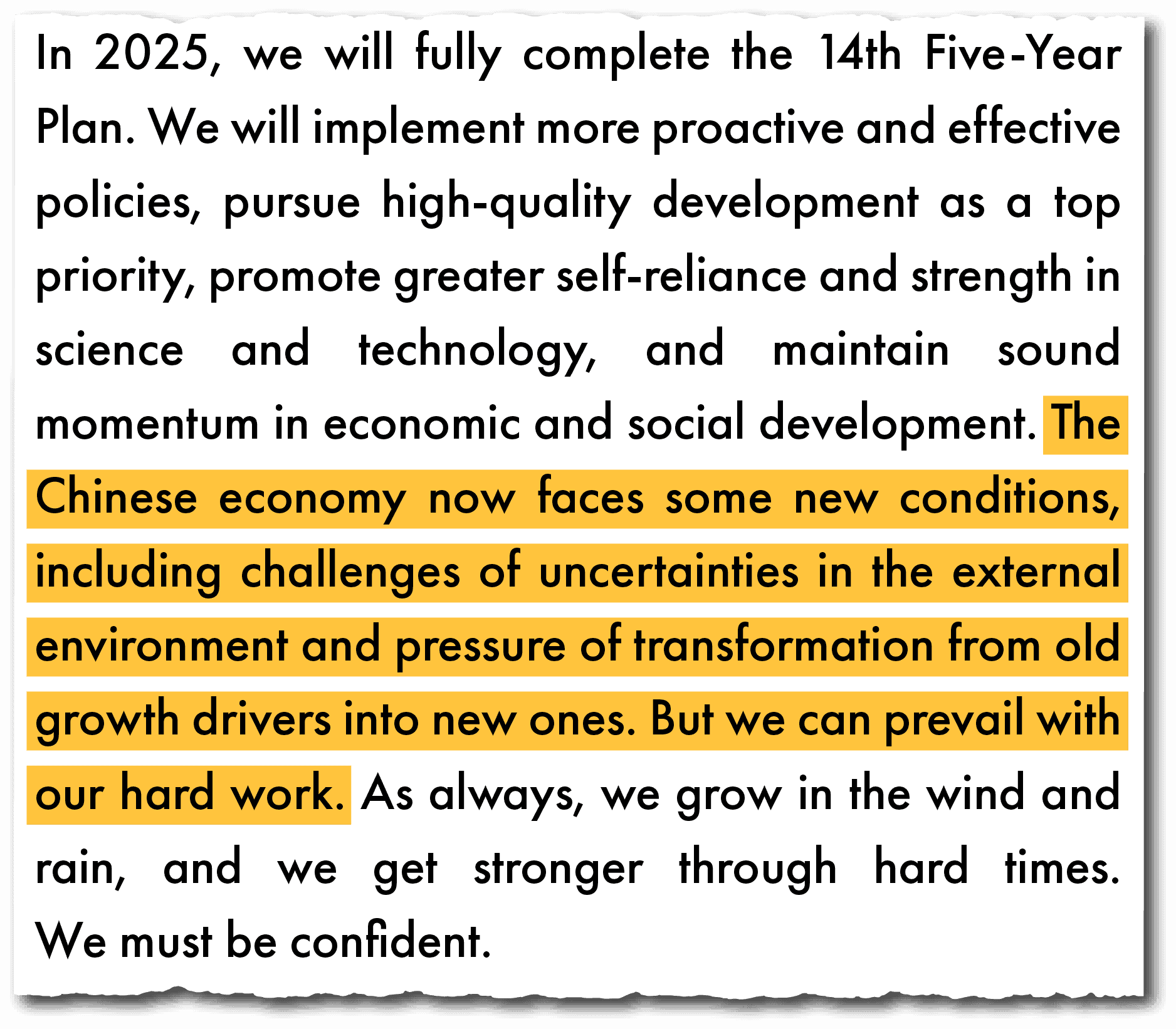
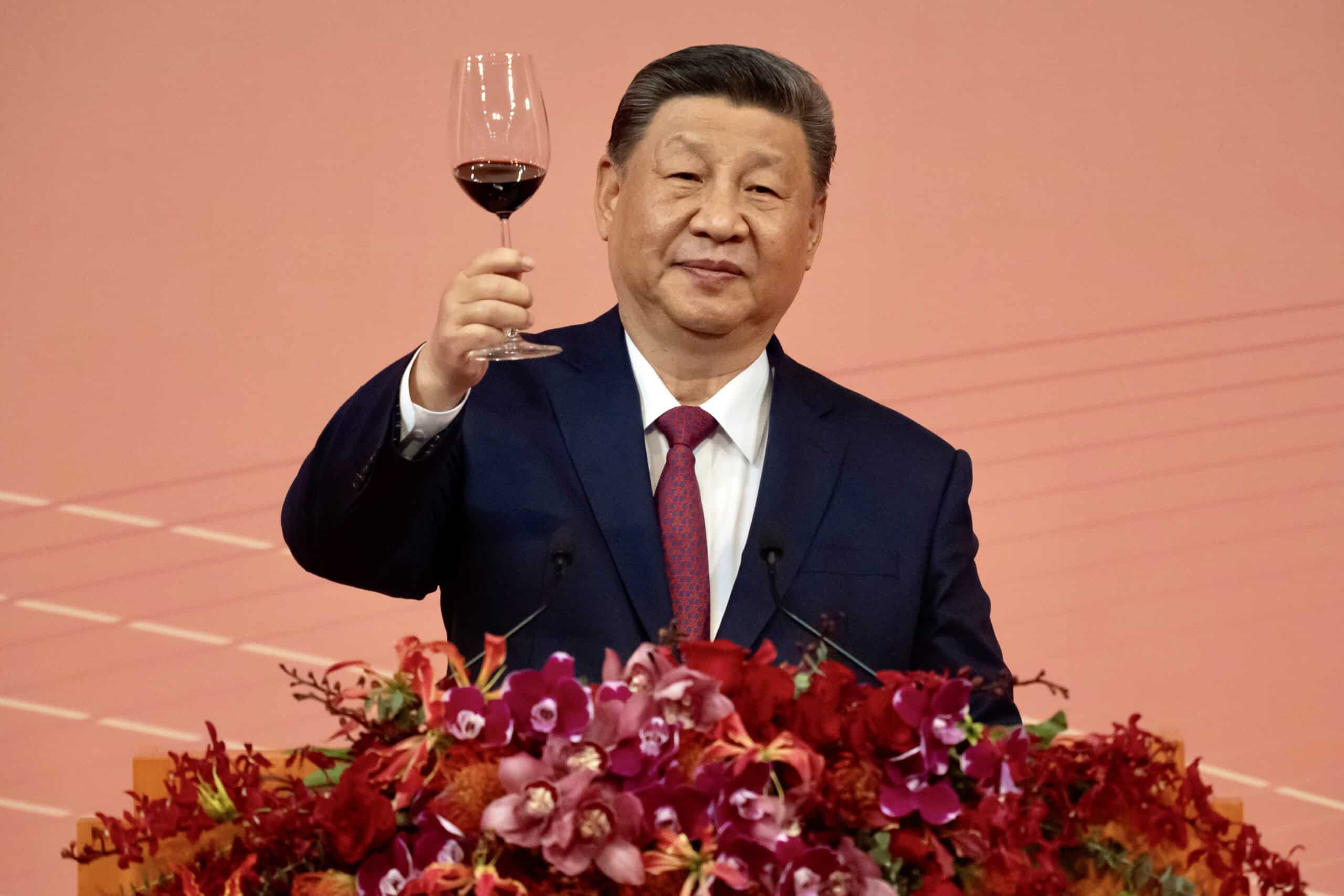
This rigidity contrasts sharply with the more relatable, unscripted Xi glimpsed in the early years of his leadership. In those days, he occasionally went off script, engaging more naturally with the media and the public. Those moments, while rare, offered a glimpse of his personality and priorities. Over time, however, Xi has retreated into a cocoon of tightly scripted speeches and ideological platitudes, shielding himself from any meaningful communication with either the domestic audience or the international market. This shift underscores his deep reliance on the Party apparatus for control but has left the world — and perhaps even his own bureaucrats — guessing about his true intentions.
Meanwhile, the market is growing impatient. Consumers remain cautious, weighed down by deflationary pressures, job insecurity, and dwindling savings. Business leaders, unnerved by regulatory crackdowns, hesitate to invest. While Beijing has pledged more fiscal spending and social welfare reforms, it resists direct cash transfers that could immediately spark consumption, warning against “welfarism” and the dangers of “feeding lazy people.”
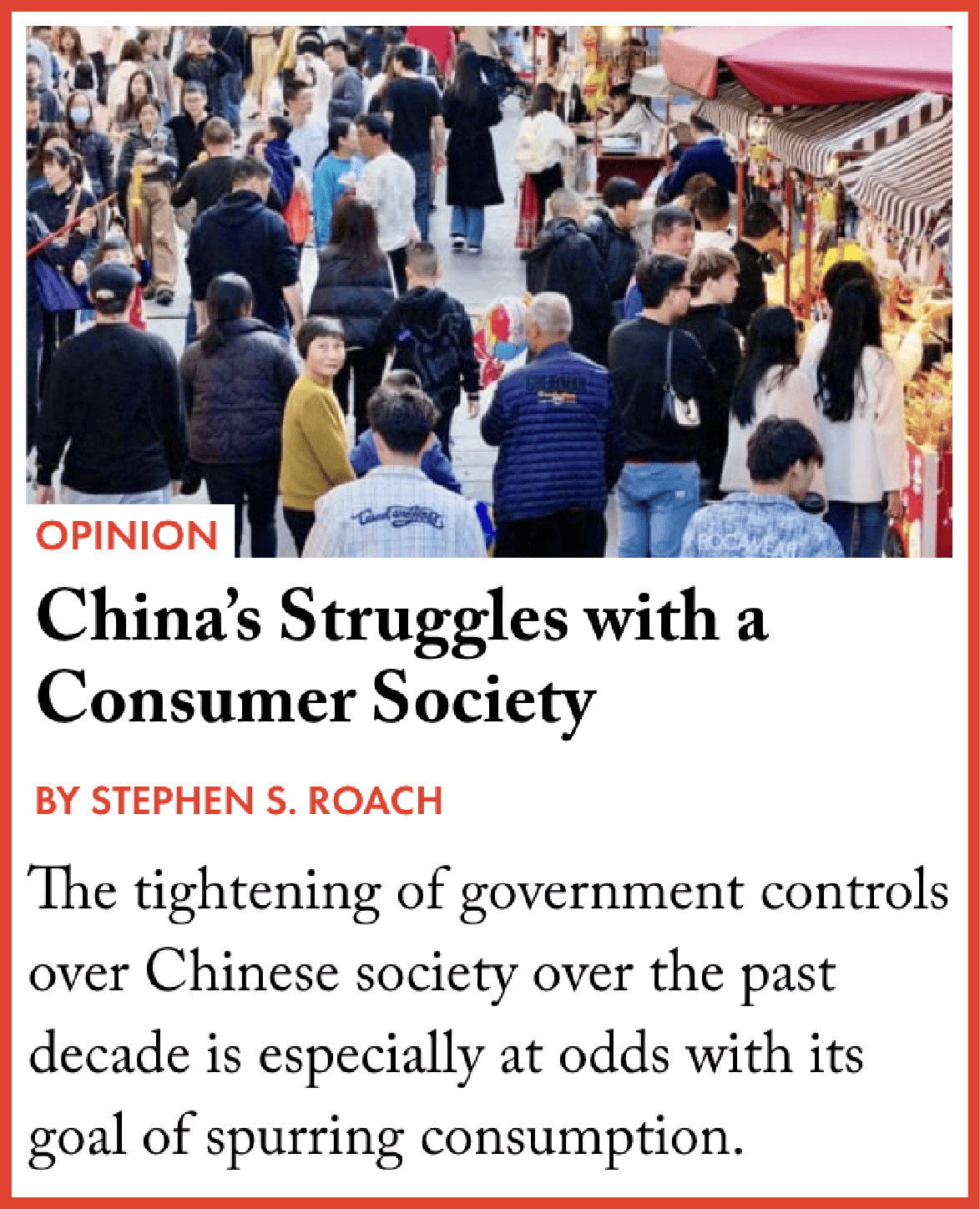
The Party is not blind to the stakes. Promises to boost consumption, raise pensions, and expand healthcare signal a recognition of the problem. But announcements alone fall short. Markets and citizens alike are demanding action, not rhetoric. Herein lies Xi’s dilemma: the very system he has meticulously built — anchored in ideological loyalty and institutional control — is the same system that now hampers his ability to act decisively. His slogans, crafted to inspire loyalty and discipline, have become shackles, binding China’s policymaking at critical moments.
For Xi, the challenge is existential. His vision of a stronger, self-reliant China — a vision steeped in Marxist nationalism — depends on sustained economic success. Yet his governance style, rooted in discipline over dynamism, threatens to undermine it. For now, Xi remains a prisoner of his own language, trapped in a system that enforces control at the expense of adaptability. The walls of that prison aren’t cracking — they’re closing in.

Lizzi C. Lee is a Fellow on Chinese Economy at the Asia Society Policy Institute’s (ASPI) Center for China Analysis (CCA). She is an economist turned journalist, and graduated from MIT’s Ph.D. program in Economics before joining the New York-based independent Chinese media outlet Wall St TV.