A jailed activist, linked to the now-dissolved alliance behind Hong Kong’s Tiananmen Square vigil, has argued in court that a presiding judge should be recused, given the justice’s prior knowledge of police allegations which could undermine her right to a fair trial.
Chow Hang-tung, 39, on Monday represented herself in the High Court before the three-judge panel, in seeking the recusal of Madam Justice Anna Lai Yuen-kee, one of the hand-picked judges to hear national security cases.
Chow, a barrister by profession, asked the court to decide whether Justice Lai should step away from the trial, concerning allegations of subversion by the activist and two other members of the Hong Kong Alliance in Support of Patriotic Democratic Movements of China.
She asked the court to consider the “real possibility” of Lai being biased based on the police’s investigation report the judge had access to when handling an appeal of her previous conviction.
That report, however, was never fully disclosed to Chow or her defence’s team, due to “Public Interest Immunity” granted by the court to spare the prosecution from revealing evidence relating to ongoing investigations into national security’s cases.
The report, with many paragraphs redacted and covered in black blocks, was made available to the public when Principal Magistrate Peter Law Tak-chuen delivered the verdict when convicting Chow and the others in another case in 2021.
“[The report] involved a lot of serious allegations [against the alliance], but the paragraphs pointing to those allegations were covered. We are not sure what these devastating allegations are,” Chow said in her submission.
“It would be far from ideal if the court had received extremely serious allegations before, that was not presented to the trial judge.”
Chow stressed that her application for recusing Justice Lai was not personal and that it did not mean Lai had done anything wrong in having access to the information that Chow herself did not have.
But she pointed out that as Lai had indeed read the full investigation report disclosed to her by the prosecution, it was objectively arguable that she could be affected by that extra information in her acknowledgement.
Lai, sitting on the bench along with Justice Alex Lee Wan-tang and Justice Johnny Chan Jong-herng, did not respond to Chow or ask her questions during the hearing.
Lee said judges often had to hear submissions and evidence during a long trial, including what was said in the prosecution opening and cautioned statements, but some of them could be proven wrong or not admissible at a later point in the trial.
Lee asked Chow whether she would argue the judges had to be recused every time these situations arose because their minds were “polluted”.
Chow reiterated that the investigation report was never presented in an open court, and that resulted in depriving her the opportunity to respond to those allegations concerning what individuals or organisations were under suspicion.
She added that she assumed her name was mentioned in those black-blocked paragraphs, which could be allegations involving her, but she had no way of knowing.
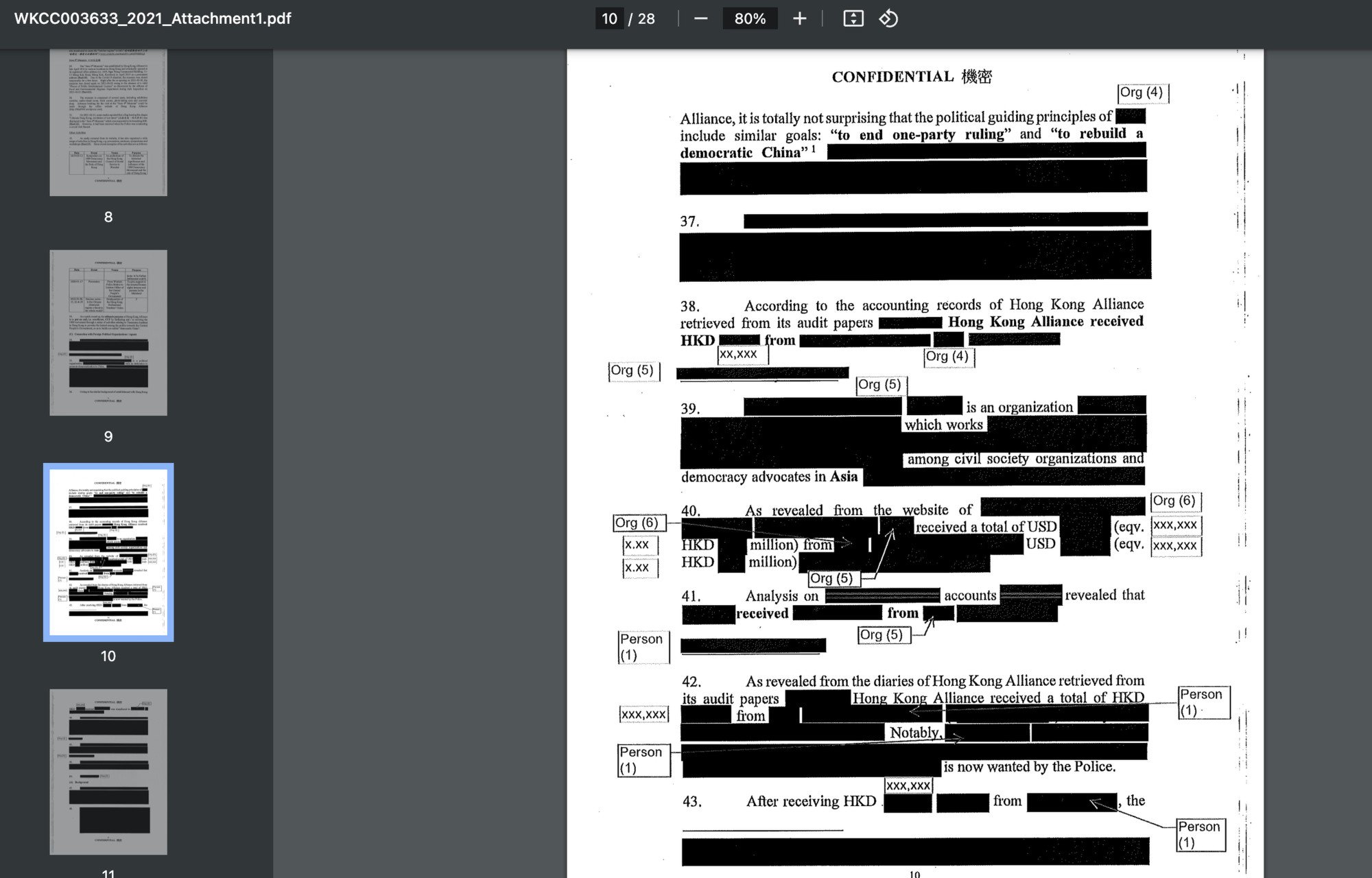
Lee said: “It is quite challenging, as we [he and Justice Chan] also do not know the text being covered. Madam Justice Lai said the content was unrelated to you personally, but you are making assumptions that it is.”
Chow replied: “This is exactly the predicament we find ourselves in.”
She added that it was difficult for the defence to determine if Lai would be impartial given that the judge had seen allegations police used against her and the other defendants.
Deputy Director of Public Prosecutions William Tam Yiu-ho, for the prosecution, said a professional judge – who had taken the judicial oath – should be capable of “putting allegations behind her” if she found the police findings were irrelevant to Chow’s future trial.
The written ruling of Chow’s application will be handed down on July 5.