HONG KONG–(BUSINESS WIRE)–Jul 15, 2024–
CSOP Huatai-PineBridge CSI 300 ETF (3133.HK) will list on the Hong Kong Stock Exchange on July 16, 2024. In seeking to achieve its investment objective, 3133.HK will invest at least 90% of its NAV in the Huatai-PineBridge CSI 300 Exchange-traded Open-end Index Securities Investment Fund (the “Master ETF”) via the QFI status granted to the Manager and/or the Shanghai-Hong Kong Stock Connect. With listing price of approximately HKD 7.8 per unit, board lot of 100 units, 3133.HK has received an initial investment of RMB 51.1 million.
This press release features multimedia. View the full release here: https://www.businesswire.com/news/home/20240715285738/en/
At the beginning of 2024, a slew of foreign financial institutions are bullish on Chinese stock market and have upgraded their ratings 1. Meanwhile, the northbound fund flows have been positive for three months in a row since February, hit a new record high in April, indicating strong overseas investment interest in A-share 2. Analysis suggests that China’s stock market is benefiting from four major tailwind factors: the “national team” purchasing A-share ETFs to boost funds and confidence; the introduction of the once-in-a-decade new ‘Nine Guidelines for Capital Market’ policy, and the A-share buybacks and dividends continue to accumulate; quarterly GDP growth in China has beat expectations, with steady earnings recovery; the price-earnings ratio of the CSI 300 index is lower than its 20-year historical average, making A-share highly attractive for investment 3.
Since late 2023, state-owned financial firms led by Central Huijin and China Securities Finance Corp have been investing heavily in A-share ETFs, especially CSI 300 ETFs 3. The policy-driven funds of the “national team” have often intervened to support the capital market, which is seen as a sign to stabilize the stock market. According to UBS estimates, since 2024, policy-driven funds have injected more than RMB 410 billion (around USD 57 billion) into A-share, 75% of which went to CSI 300 ETFs 4. The Master ETF’s quarterly report reveals that Central Huijin added 26.356 billion shares in the first quarter of 2024, amounting to approximately RMB 88.8 billion 5.
The CSI 300 Index (the “Index”) serves as a benchmark for China’s A-share stock market, tracking 300 largest and most liquid companies in China’s A-share stock market to comprehensively reflect overall market performance. The median return on equity (ROE) range of the Index has consistently exceeded 10% over an extended period 6. Since 2020, the Index has incorporated new stocks from the SSE’s STAR Market and relaxed listing year requirements for SZSE’s ChiNext Market stocks. Currently, the Index constituents are well-balanced across cyclical industries, technology, large financials, and consumer sectors. The Master ETF, the world’s largest CSI 300 ETF, manages over RMB 190 billion and sees an average daily turnover exceeding RMB 4.6 billion this year 7.
Ms. Ding Chen, CEO of CSOP Asset Management, stated, “As a widely recognized fund management company, we are delighted to offer Hong Kong investors the opportunity to invest in top-quality assets in China. CSOP Huatai-PineBridge CSI 300 ETF, which tracks the world’s largest CSI 300 ETF, is the optimal solution for investing in China A-share. CSOP is dedicated to continuous innovation and remains committed to providing our clients with valuable and distinctive ETF products.”
About CSOP
CSOP is a leading ETF issuer in Hong Kong SAR, with a wide range of product offerings across equity, fixed income, leveraged and inverse, thematic, money market, and virtual assets. In Q1 2024, 5 out of 10 of the most traded ETFs on the Hong Kong Stock Exchange are CSOP-issued products*. Innovation and leadership are deeply rooted in CSOP’s DNA as we strive to bring first-of-its-kind products to the market, educate investors about ETF trading, and never stop looking for ways to improve trading efficiencies.
CSOP’s commitment to cross-border initiatives and collaborations is unwavering. We are the only product issuer participating in all the ETF connectivity programs between mainland China and Hong Kong SAR, capturing an 69.08% market share of the aggregate southbound AUM**, as well as the first issuer to participate in the China – Singapore Cross-border ETF Link Scheme.
* Source: 2024/01/01-2024/03/28, Bloomberg.
** Source: HKEX, SZSE, SSE, Bloomberg, as of 2024/06/28.
Disclaimer
This document is for general information only and do not constitute investment or any other kind of advice in any way and shall not be considered as an offer or solicitation to deal in any investment products. Investment involves risk. Investors should refer to the Prospectus and the Product Key Facts Statement for further details, including product features and risk factors. Investors should not base on this document alone to make investment decisions. Investors should consult their own advisors before engaging in any transaction. CSOP which prepared this document believes that information in this document is based upon sources that are believed to be accurate, complete and reliable. However, CSOP does not warrant the accuracy or completeness. This document is not legally binding, and CSOP shall not be liable for any loss, damage or expense incurred. This document is not directed to, intended for distribution to, or use by, any person or entity in any jurisdiction or country where such distribution, availability or use would be contrary to local law or regulations, or which would subject CSOP to any registration or licensing or other requirement, or penalty for contravention of such requirements within such jurisdiction. For the Index Provider Disclaimer, please refer to the Product’s offering document. This document is prepared by CSOP and has not been reviewed by the SFC in Hong Kong.
Issuer: CSOP Asset Management Limited
1 Source: Collation of research and media reports.
2 Source: iFinD, as of 2024/4/26.
3 Source: Collation of research and media reports.
4 Source: UBS, Caixin.
5 Source: Huatai-PineBridge CSI 300 Exchange-traded Open-end Index Securities Investment Fund quarterly report.
6 Source: Wind, as of 2023/11/30.
7 Source: Wind, as of 2023/04/26.

CSOP Huatai-PineBridge CSI 300 ETF (3133.HK) (Graphic: Business Wire)
KATHMANDU, Nepal (AP) — Nepal’s newly appointed prime minister took the oath of office Monday at a ceremony in Kathmandu.
Khadga Prasad Oli, the leader of Nepal’s largest communist party, was named prime minister on Sunday following the collapse of a previous coalition government.
Oli, 72, will be leading a coalition government made up of his Communist Party of Nepal (Unified Marxist Leninist) and the Nepali Congress party, the two largest parties in Nepal. This is his fourth time serving as prime minister of the Himalayan nation.
Two deputy prime ministers and 19 ministers appointed by him also took the oath of office. He is expected to further expand the Cabinet, including members from coalition partner parties.
The last government headed by Pushpa Kamal Dahal collapsed on Friday after Oli’s party, which had been part of the coalition, withdrew its support to join the new partnership.
Oli will have to seek a vote of confidence in parliament within a month to continue in office. The two parties in the new alliance have more than half the members in parliament, giving them enough votes to pass a vote of confidence.
Oli’s biggest challenge as prime minister will be balancing Nepal’s relationship with its giant neighbors India and China, as both seek to wield influence over the small nation. Landlocked Nepal is surrounded by India on three sides and imports all of its oil and most supplies from India. It also shares a border with China.
“Among other challenges, the new government has the task to re-establish Nepal’s diplomatic credibility and balance between the powers in the north (China) and south (India),” said Bhoj raj Pokhrel, an independent analyst.
Relations between Nepal and India had sunk to their lowest level during Oli’s first term as prime minister in 2015, when India was unhappy with a new constitution adopted by Nepal.
India imposed an unofficial economic blockade on Nepal, blocking supplies of oil, medicine and other goods that created severe shortages in the country. But relations calmed after Oli visited New Delhi in February 2016.
Oli was credited with opening doors with China and boosting trade and joint infrastructure projects including a highway through the mountains. Oli’s relations with China have annoyed New Delhi.
Oli was born in a village in east Nepal and has been involved in politics since he was young.
He worked his way up the ranks of the communist party and was jailed a total of 14 years for opposing the autocratic rule of Nepal’s monarchs. The royals banned political parties until 1990, when street protests forced then-King Birendra to hold free elections that turned Nepal into a constitutional monarchy, which was formally abolished in 2008.
Oli has had two kidney transplants.
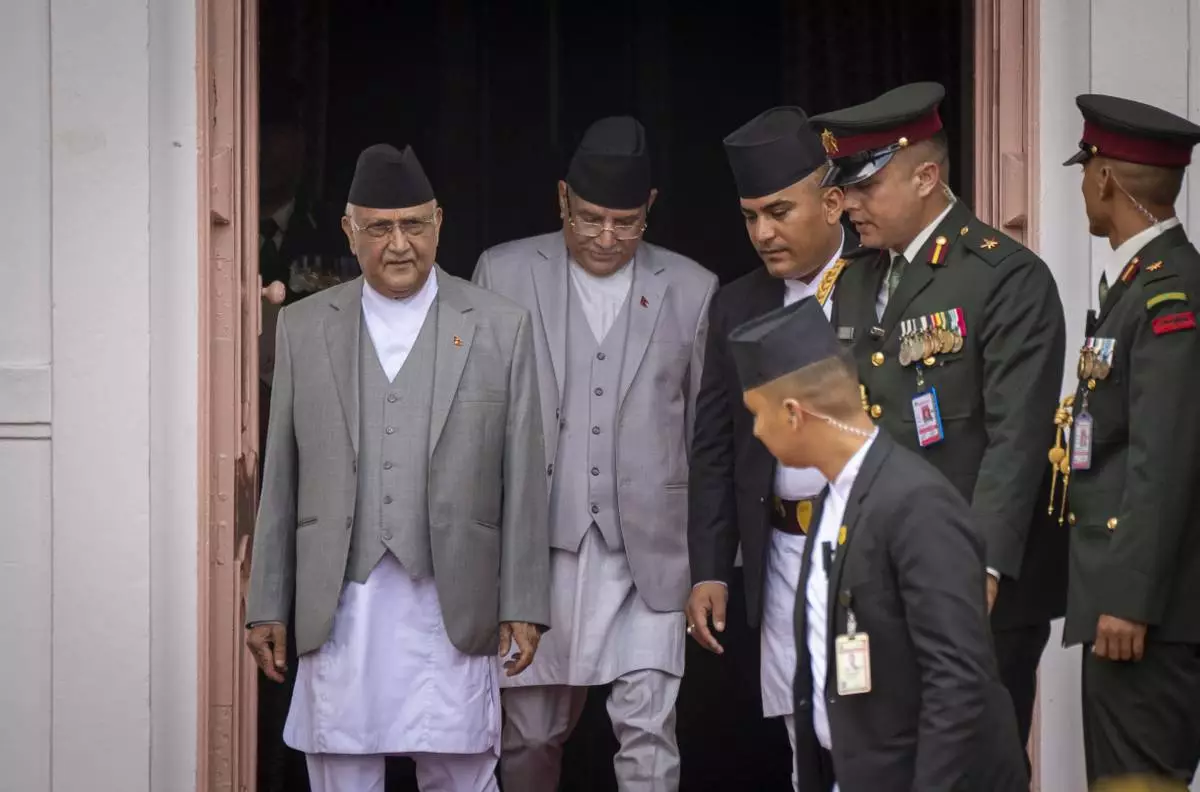
Nepal’s newly elected Prime Minister Khadga Prasad Oli, left, and outgoing Prime Minister Pushpa Kamal Dahal, center, arrive for the oath of office in the Presidential residence in Kathmandu, Nepal, Monday, July 15, 2024. Oli, the leader of Nepal’s largest communist party, was named prime minister on Sunday following the collapse of a previous coalition government. (AP Photo/Niranjan Shrestha)
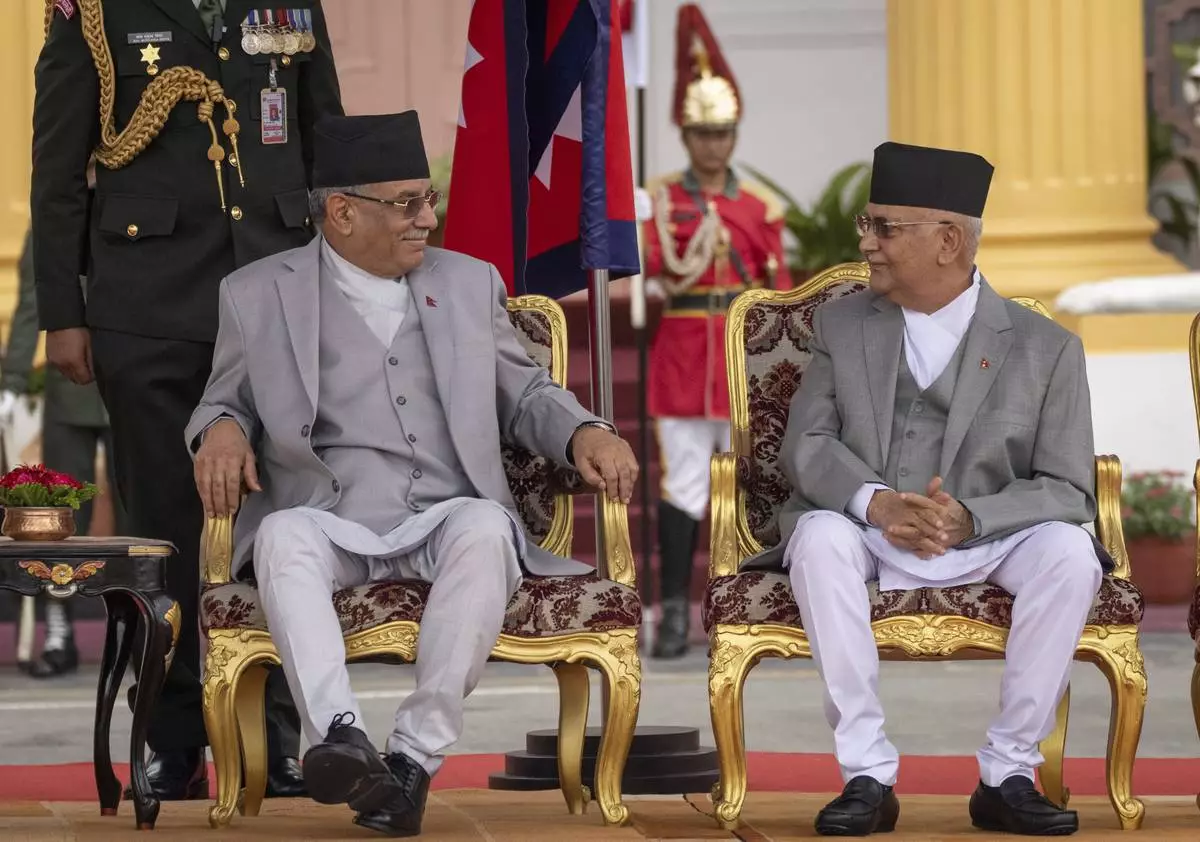
Nepal’s newly elected Prime Minister Khadga Prasad Oli, right, and outgoing Prime Minister Pushpa Kamal Dahal, left, talk before the oath of office in the Presidential residence in Kathmandu, Nepal, Monday, July 15, 2024. Oli, the leader of Nepal’s largest communist party, was named prime minister on Sunday following the collapse of a previous coalition government. (AP Photo/Niranjan Shrestha)
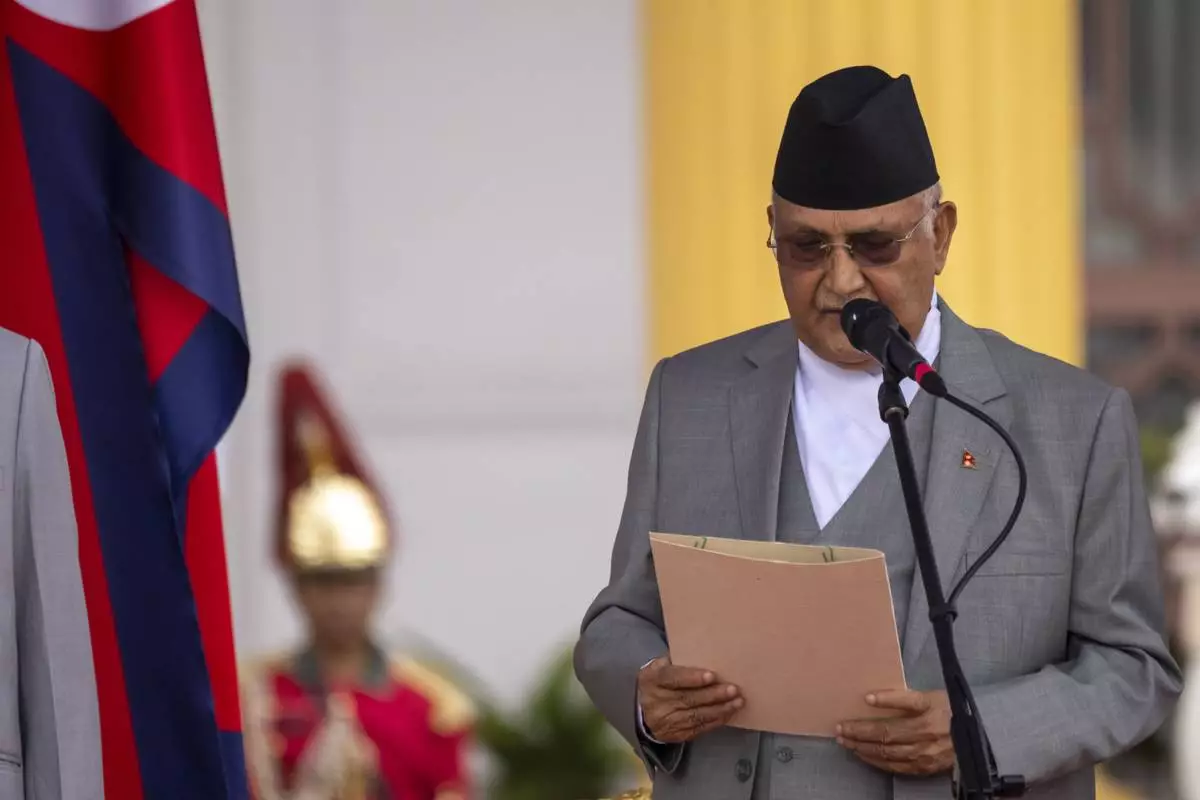
Newly elected Prime Minister Khadga Prassad Oli is being sworn by president Ram Prassad Poudel, unseen, at the Presidential residence in Kathmandu, Nepal, Monday, July 15, 2024. Khadga Prasad Oli, the leader of Nepal’s largest communist party, was named prime minister on Sunday following the collapse of a previous coalition government.(AP Photo/Niranjan Shrestha)

Khadga Prasad Oli, the chairman of the Communist Party of Nepal leaves his residence to meet his supporters after being appointed Prime Minister, in Kathmandu, Nepal, Sunday, July 14, 2024. The leader of the Nepal’s largest communist party, Khadga Prasad Oli, was named the Himalayan nation’s new prime minister on Sunday following the collapse of a previous coalition government. (AP Photo/Niranjan Shrestha)
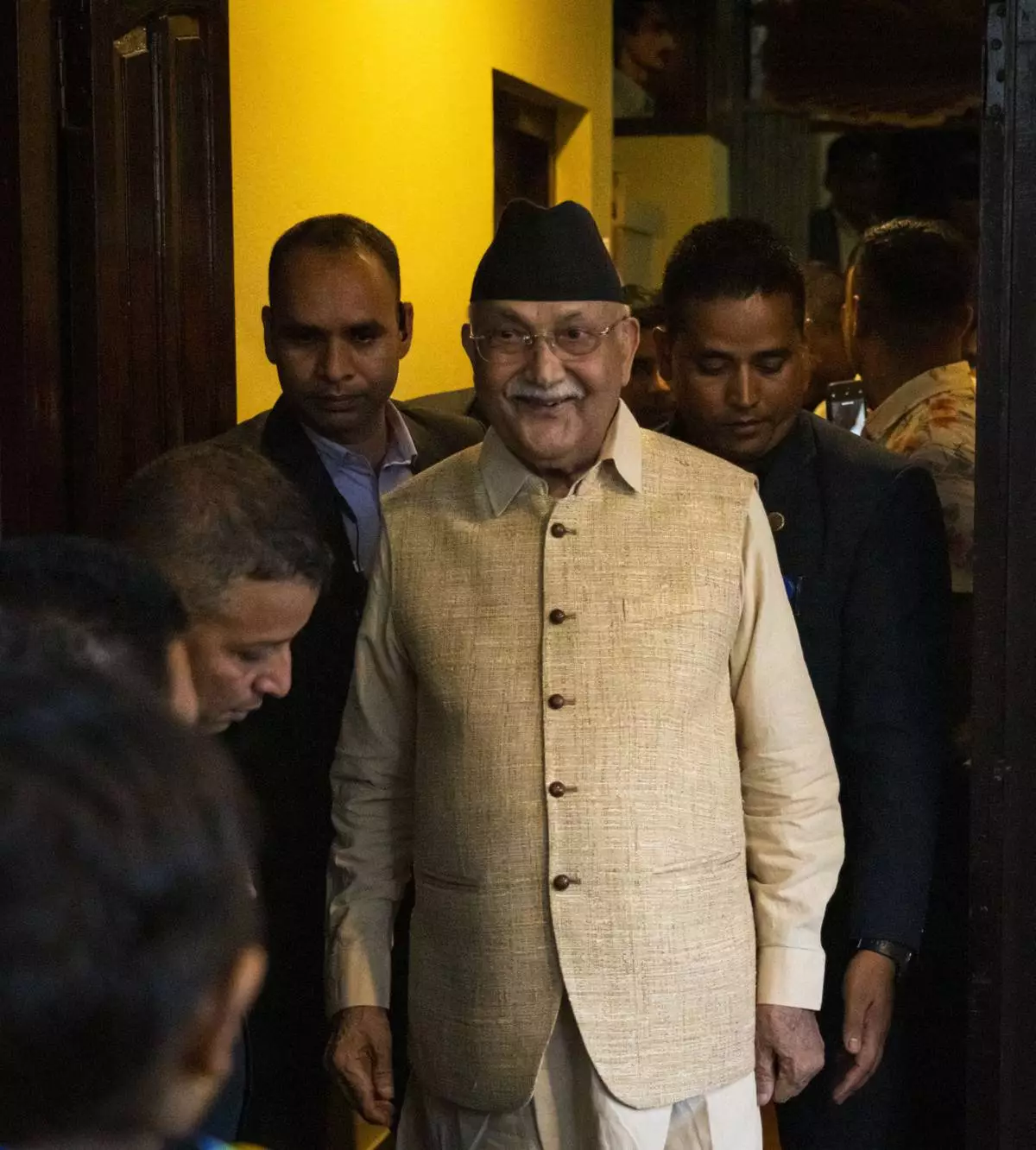
Khadga Prasad Oli, the chairman of the Communist Party of Nepal leaves his residence to meet his supporters after being appointed Prime Minister, in Kathmandu, Nepal, Sunday, July 14, 2024. The leader of the Nepal’s largest communist party, Khadga Prasad Oli, was named the Himalayan nation’s new prime minister on Sunday following the collapse of a previous coalition government. (AP Photo/Niranjan Shrestha)
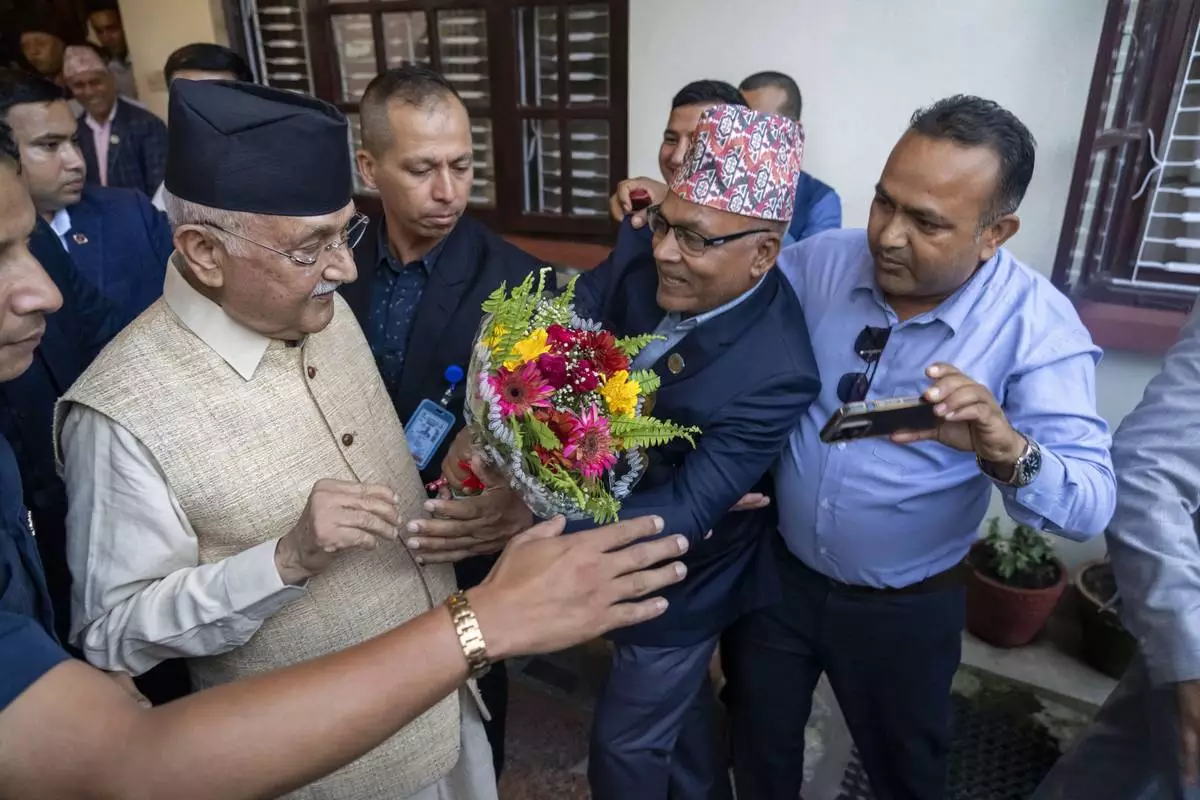
Khadga Prasad Oli, left, the chairman of the Communist Party of Nepal leaves his residence to meet his supporters after being appointed as Prime Minister, in Kathmandu, Nepal, Sunday, July 14, 2024. The leader of the Nepal’s largest communist party, Khadga Prasad Oli, was named the Himalayan nation’s new prime minister on Sunday following the collapse of a previous coalition government. (AP Photo/Niranjan Shrestha)
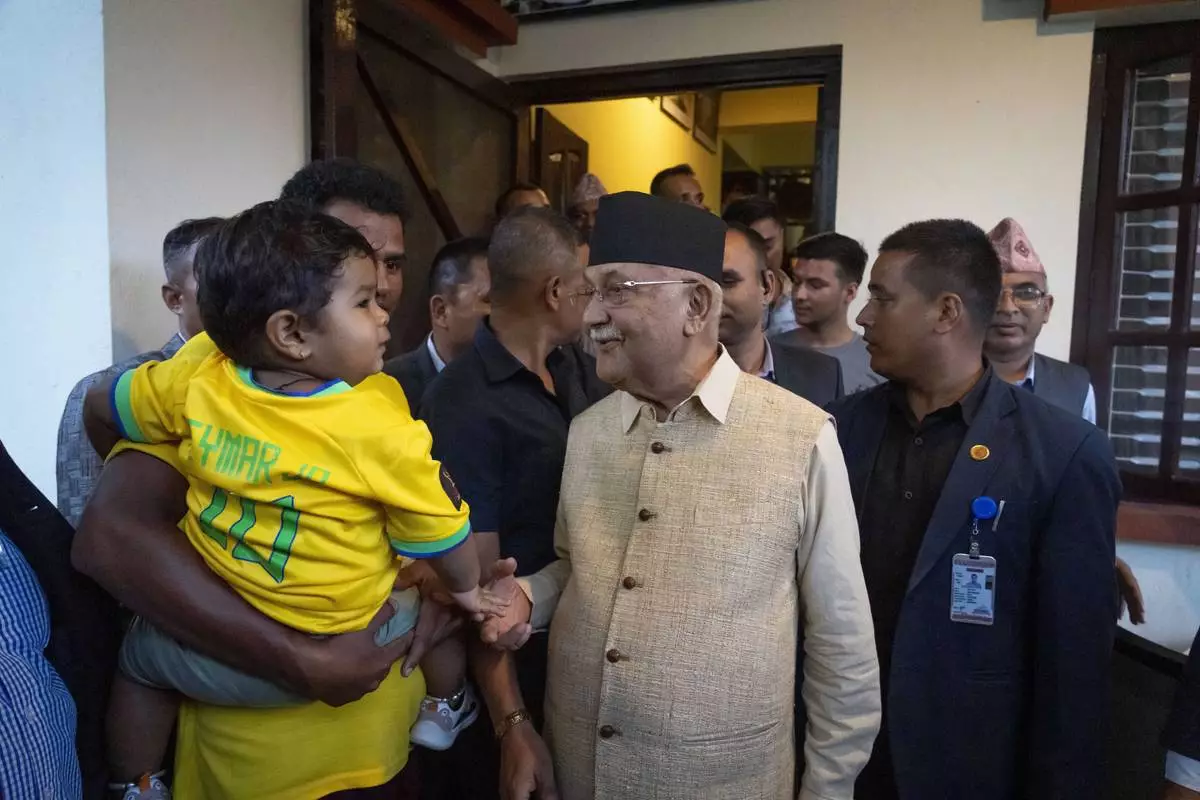
Khadga Prasad Oli, centre, the chairman of the Communist Party of Nepal leaves his residence to meet his supporters after being appointed as Prime Minister, in Kathmandu, Nepal, Sunday, July 14, 2024. The leader of the Nepal’s largest communist party, Khadga Prasad Oli, was named the Himalayan nation’s new prime minister on Sunday following the collapse of a previous coalition government. (AP Photo/Niranjan Shrestha)