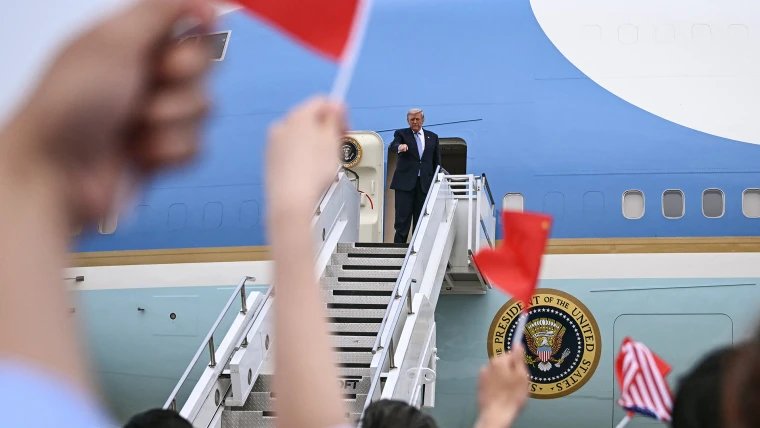
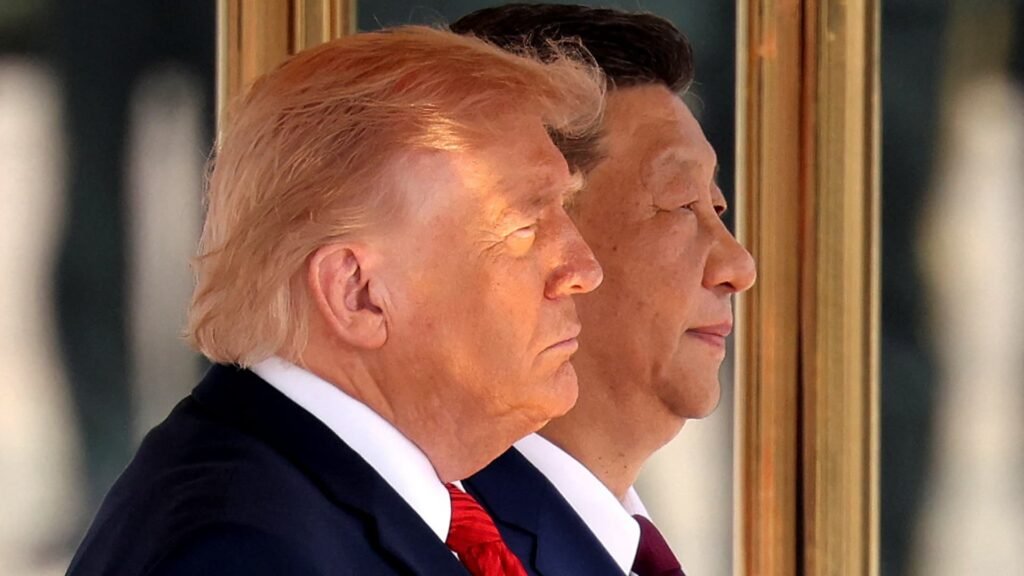
Despite the hype surrounding China’s artificial intelligence capabilities, progress remains heavily dependent on theft and smuggling. The Chinese Communist party (CCP), meanwhile, is determined to maintain tight control. That has become increasingly clear ahead of this week’s Beijing summit between Donald Trump and Xi Jinping. The Chinese leader is determined to lead the world in what he terms an ‘epoch-defining technology’. He appears confident that Trump, preoccupied by his war against Iran, has limited options to counter Beijing’s increasingly brazen activities.
Last month, the White House accused Beijing of ‘industrial-scale’ theft of know-how from American AI labs. Meanwhile, US prosecutors claim to have busted an international smuggling ring that funnelled advanced chips worth billions of dollars to China in defiance of sanctions. The CCP is also stepping up efforts to protect China’s own AI innovation, blocking a $2 billion (£1.5 billion) takeover by Meta of a Chinese AI start-up called Manus. For good measure, the authorities prevented Manus’s two founders from leaving the country.
The accusations of theft refer to a process called ‘distillation’, whereby China is accused of illicitly training its smaller AI models on the output of larger (and expensively developed) US models. A leaked internal memo written by Michael Kratsios, director of the White House Office of Science and Technology Policy, said:
Security and control are overwhelming priorities for Xi
The US government has information indicating that foreign entities, principally based in China, are engaged in deliberate, industrial-scale campaigns to distill US frontier AI systems.
Distillation involves the creation of thousands of fake accounts for the targeted AI chatbot or tool, with the accounts working together to extract information. The US AI company Anthropic said it had detected 24,000 fraudulent accounts, which had generated more than 16 million exchanges with its powerful Claude chatbot. It accused leading Chinese labs of being behind the campaign in order to acquire powerful capabilities ‘in a fraction of the time, and at a fraction of the cost’. The company also warned that ‘distilled’ apps would carry none of the safeguards of the original against using AI for such activities as developing bioweapons or carrying out destructive cyberattacks and thereby ‘creating significant national security risks’.
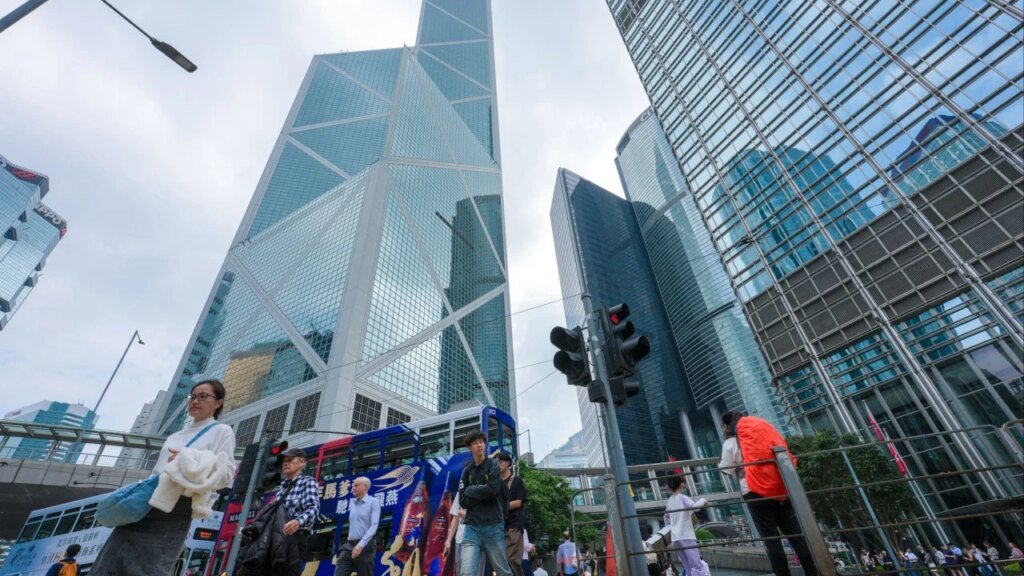
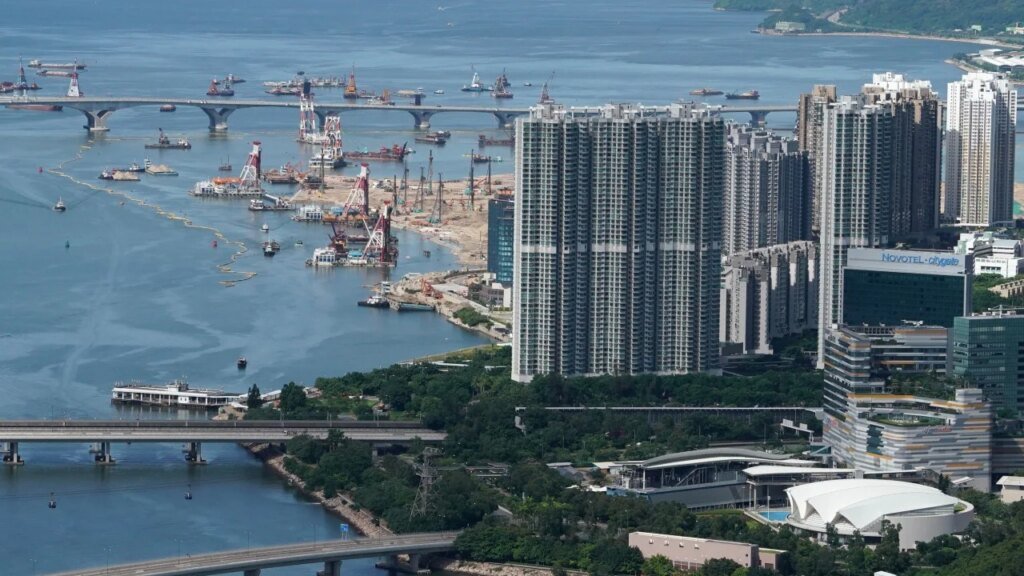
Beijing also appears to have established an extensive and lavishly funded smuggling network to get round US restrictions on the sale of the top-end Nvidia chips used for training AI models. In a series of indictments against Chinese nationals, federal prosecutors describe how servers containing ‘billions of dollars’ of restricted chips were shipped to front companies in southeast Asia before being repackaged and diverted to Hong Kong and mainland China. One surveillance video showed a defendant using a hair dryer to swap around sticky labels and serial number tags. It was a bizarrely low-tech image compared to the high-tech and high-stakes smuggling he was engaged in – facilitating what Xi has characterised as ‘a race to the top’.
The indictments were characterised as the tip of a chip-smuggling iceberg, with the struggle for AI supremacy seen not just as a question of economic competition, but a battle that will define the future balance of global power. Xi is not only determined that China will win that race but also that AI will remain firmly under the control of the CCP – as Mark Zuckerberg has now found out to his cost.
The Meta boss thought his takeover of Manus was a done deal, and Manus employees had already moved into Meta’s Singapore office. The Chinese start-up is an AI agent, which means that rather than creating a chatbot to answer questions, it carries out AI-enabled tasks for users – acting as a sort of autonomous personal assistant for functions ranging from product launches to stock market analyses and travel plans.
The Chinese authorities did not say which laws or regulations the deal violates, but it seems designed as a warning to upstart Chinese AI start-ups against taking their technology outside China. ‘Beijing effectively drew a bright red line that Chinese AI talent and technology are not for sale to American companies, full stop,’ Han Shen Lin, Shanghai-based China country director at US consultancy firm The Asia Group, told Reuters.
In torpedoing the deal, the CCP effectively killed the practice of ‘Singapore washing’. Manus was one of a string of Chinese tech companies (which include Shein and TikTok) to shift their headquarters to the city state in an effort, in part, to appear less Chinese. All Chinese companies are required by law to assist Beijing’s intelligence and security agencies and have sought to convince clients and investors that by basing themselves in Singapore they are no longer beholden to the CCP. This was always fanciful, but the party has demonstrated that no company of Chinese origin can escape its roots and obligations.
Last week, a hearing organised by the US-China Economic and Security Review Commission, which monitors and reports to Congress on national security issues, was warned that China was harvesting US data in order to build ‘AI-enabled intelligence and targeting architecture for economic competition, political coercion and wartime advantage’. Yet while there is strong bipartisan support in Congress for aggressive export controls on technology, Trump is sounding far more dovish.
At this week’s summit, delayed from March because of the Iran war, Xi will be calculating that Trump has limited options and little appetite for a return to trade hostilities that could result in further global economic disruption. Last year, Trump scaled back tariffs and abandoned other restrictions on Chinese companies after Beijing weaponised rare earths. They threatened to restrict access to these critical minerals, which are crucial to global high-tech industries, and over which China has a near monopoly.
Xi is also riding a wave of what has been dubbed ‘Chinamaxxing’
Even as evidence of AI-related theft and smuggling has grown, Trump has sent mixed messages. He eased controls on some Nvidia chips, and in spite of security concerns over Chinese electric vehicles, he has suggested he is open to Chinese car makers building vehicles in the US. In addition, his harsh words for long-established allies are in stark contrast with his more friendly approach to Xi. He has played down reports that Beijing might be providing material support to Iran, writing on Truth Social:
They have agreed not to send weapons to Iran. President Xi will give me a big, fat, hug when I get there … We are working together smartly, and very well! Doesn’t that beat fighting.
By the end of last year, around a third of AI models downloaded worldwide were Chinese. Xi is also riding a wave of what has been dubbed ‘Chinamaxxing’. At its heart is an online infatuation with Chinese technology, much of it driven by Western influencers, who have been courted by the CCP. The themes of China’s innovation prowess and a supposed greater societal acceptance of AI are also widely peddled by more credulous Western analysts.
The reality is more nuanced – and not only because of Beijing’s continued reliance on large-scale theft. Take DeepSeek, the Chinese company that startled the world last year with AI models that performed almost as well as the best Western ones, but at a fraction of the cost. Last week, its latest release was met with a collective shrug. Not only was this one more expensive to build, but was reportedly subject to far more CCP meddling. It was delayed by CCP pressure for it to be trained on Chinese chips, but fell back on Nvidia’s when those made by Huawei proved inadequate.
Humanoid robots are another much-hyped tech – performing kung fu at a Chinese New Year celebration, and competing in the recent Beijing marathon. They certainly had entertainment value, but experts are sceptical about their real world applications. They are also the result of an extravagantly wasteful state-led programme – something of a metaphor for Chinese innovation more broadly.
Security and control are overwhelming priorities for Xi. While he has unleashed his spies to harvest know-how and chips, Chinese-developed algorithms must sing to the party’s tune. The CPP has also begun to fret about safety, cyber security and the possible negative impact on jobs. The recent and sudden freezing of 200 robotaxis, gumming up the streets of Wuhan, provided one wake-up call. Meanwhile, a recent report from a state think-tank suggesting that Chinese workers are becoming increasingly worried about the impact on their jobs provided another. ‘We must act early and decisively: anticipating and preventing problems with prudence and caution,’ according to Xi.
Young people are already struggling to find jobs – with youth unemployment hovering around 17 per cent, according to official figures. The CCP frets about an epidemic of tangping (‘lying flat’), whereby young people drop out of a high pressure and unrewarding jobs market to opt for a simpler life. Last month, China’s main spy agency, the Ministry of State Security, declared that tangping was a foreign conspiracy designed to undermine Chinese youth and society. While the AI race might be hotting up, the CCP’s basic instincts remain chillingly familiar.