China and Russia are conducting a joint naval exercise in a southern Chinese province facing the contested South China Sea, as the two sides deepen their “comprehensive strategic partnership.”
The quasi-allies started the exercise named Joint Sea-2024 in the waters and airspace near Zhanjiang earlier this month, according to Zhang Xiaogang, a Chinese Defense Ministry spokesperson. The announcement was made at a news briefing in Beijing on Friday.

Xu Wei/Xinhua via AP
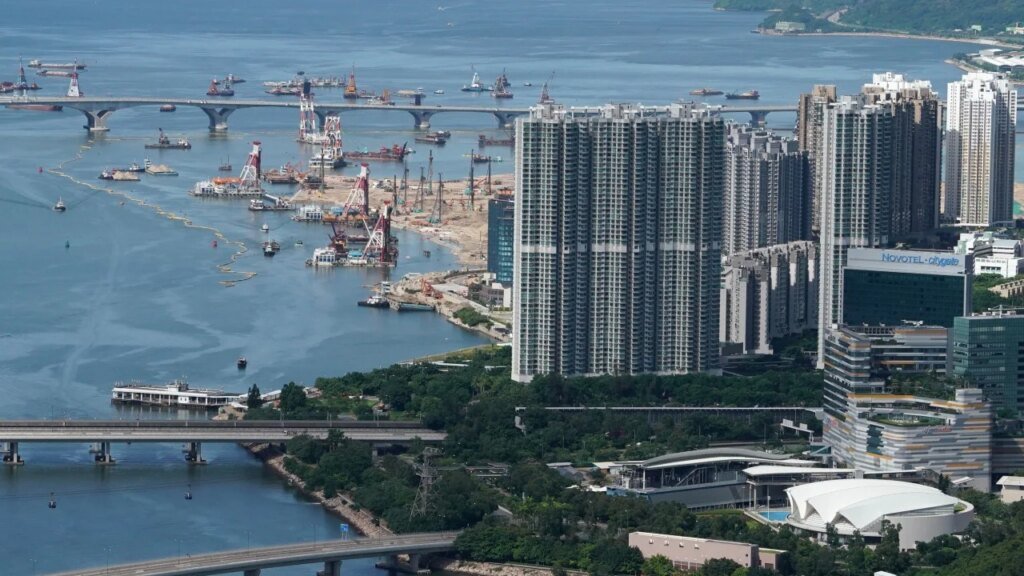
Zhanjiang is a city in Guangdong province of southern China. It serves as the headquarters of the Chinese naval forces assigned to the Southern Theater Command. The South China Sea is the major area of responsibility for the so-called China’s South Sea Fleet.
The ongoing exercise is carried out according to China-Russia annual military engagement plan and bilateral agreement, Zhang added. The objective is to demonstrate the “resolve and capabilities of the two sides in jointly addressing maritime security threats.”
Joint Sea-2024 is scheduled to conclude around the middle of this month; however, it was not immediately clear which naval units from the two countries are taking part in the drills.
Newsweek has reached out to Russia‘s Ministry of Defense via email for comment.
The military maneuver in China is the latest in a series of joint activities between the Chinese and the Russian military in recent days.
Russia’s corvette Sovershennyy left its homeport of Vladivostok in the Far East and joined a Chinese naval task group in the East China Sea, the Russian Pacific Fleet reported on July 4.
It commenced the fourth round of joint maritime patrolling in the Asia-Pacific region, according to the Fleet’s statement, without revealing the exact location.
The Chinese vessels participated in the joint patrol, Type 052D destroyer Yinchuan, Type 054A frigate Hengshui, and Type 903 replenishment ship Weishanhu, are all assigned to the South Sea Fleet.
The Sovershennyy and the Chinese naval ships later conducted training to inspect a suspicious vessel in the Philippine Sea, Russia’s state news agency Tass reported on Tuesday, citing the Pacific Fleet.
The Philippine Sea borders the so-called first island chain to the west, a strategic chokepoint connecting the United States allies and partners including Japan, Taiwan, and the Philippines.
Another two Russian corvettes assigned to the Pacific Fleet, the Gromkiy and the Rezkiy, transited southward in waters near Yonaguni, Japan’s westernmost inhabited island, on Tuesday and Wednesday. They were detected by the Japan Maritime Self-Defense Force.
The China-Russia naval drills come as rising tensions in the South China Sea. The coast guard vessels of China and the Philippines have repeatedly clashed, with the Chinese side deploying water cannons, in the contested waters.
The U.S. Navy deploys its aircraft carriers regularly in the South China Sea; however, there are no carriers currently available for tasking in the Western Pacific, according to USNI News, run by the U.S. Naval Institute.

Mass Communication Specialist 2nd Class Ikia Walker/U.S. Navy
As of Monday, the Middle East-bound USS Theodore Roosevelt operated in the Indian Ocean after leaving the South China Sea. Its former Japan-based sister ship, the USS Ronald Reagan, is underway in the Eastern Pacific and is heading to Washington state for repair.
Meanwhile, the USS Carl Vinson is taking part in the Rim of the Pacific (RIMPAC) exercises in Hawaii, a U.S. military-led and the world’s largest international maritime exercise.
Uncommon Knowledge
Newsweek is committed to challenging conventional wisdom and finding connections in the search for common ground.
Newsweek is committed to challenging conventional wisdom and finding connections in the search for common ground.