(JTA) – Before a student presentation at Friday’s board meeting of the University of Minnesota regents, the chair reminded the crowd, “Our role as a university is to educate, support and create forums for constructive dialogue and mutual understanding.”
Minutes later, dialogue commenced on one of the most inflammatory issues facing universities across the country: whether they should divest from Israel.
“An educational institution should not be funding crimes against humanity,” a speaker identified as Lucia Santos Stern — who self-identified as an “Afro-Caribbean Jewish student” — told the board. Stern was the sole Jewish representative among the four speakers from the UMN Divest Coalition, and insisted that “anti-Zionist Jewish student leaders” should be involved in any divestment discussions. Representatives of Hillel then took the floor.
Following the divestment coalition’s presentation, which also included a representative from Students for Justice in Palestine, one regent thanked them “for being here and for the work that you’re doing and for being brave and courageous.”
Board chair Janie Mayeron told them, “We have heard your message loud and clear.”
Minnesota appears to be the first U.S. school with a major Jewish population to hold a debate on divestment in response to the demands of students protesting Israel’s conduct in the war in Gaza. That debate has raged on quads, in student newspapers and at student government meetings for years.
Now, in Minnesota, it had been brought directly to the group with the power to adjudicate such a request: the school’s regents. The meeting served as a preview of the direction such divestment discussions could soon take at other schools — a direction mainstream Jewish groups find deeply concerning.
“The University’s capitulation sends a message that students who violate UofM policy, openly celebrate violence, and shut down campus are rewarded with time before the Regents and ‘regular meetings moving forward’ with the President’s office,” the Jewish Community Relations Council of Minnesota & the Dakotas said in an earlier statement condemning the Minnesota agreement. “By contrast, students targeted by antisemitism are apparently supposed to suffer silently, while their University appeases those very same activists who demonize Jews and Israelis.”
The local JCRC characterized the encampment’s participants as largely antisemitic, calling them “pro-Hamas,” and said the university was allowing them to menace Jewish students with impunity. It was an echo of how other Jewish groups, including the Anti-Defamation League and various Jewish campus alumni groups, have defined the encampment movement. These voices have largely warned universities to more forcefully discipline the protesters, not make deals with them.
Yet the deals have come. Over the past week, Brown University and several other schools including Northwestern, Rutgers and, more recently, Middlebury College and the University of California, Riverside have convinced their encampments to pack up peacefully in exchange for some form of public debate or review on the question of divestment, in addition to other concessions.
In New York, the board of trustees of the Union Theological Seminary, a progressive Christian institution affiliated with Columbia University and across the street from the flagship Conservative Jewish seminary, endorsed a plan to divest from “companies profiting from war in Palestine/Israel” on Thursday — a notable step given Columbia’s position at the epicenter of the student pro-Palestinian protest movement.
Amid such negotiations, some university leaders have taken Jewish concerns into account: This week the president of Vassar College, after striking a deal with protesters, privately emailed a group of Jewish alumni to assure them the college had not endorsed any movement to boycott Israel.
Divestment campaigns have already met success overseas: Trinity College in Dublin, Ireland, this week made a specific promise to its encampment to divest from Israeli companies, while the University of Barcelona in Spain also voted to advance a similar divestment request.
Minnesota’s agreement was the quickest payoff for stateside student protesters. While Brown promised a formal vote on divestment, that vote won’t occur until October.
In Minneapolis, by contrast, student representatives from the UMN Divest Coalition were allowed to make a formal presentation at Friday’s regents’ meeting in exchange for peacefully dismantling their pro-Palestinian encampment on campus last week.
But while Brown will hold a vote, Minnesota’s regents did not actually weigh a divestment proposal Friday, and did not give a firm date for when such a vote would happen, if ever. In its disclosure forms, Minnesota claimed that less than 1% of its endowment is invested in companies tied to Israel.
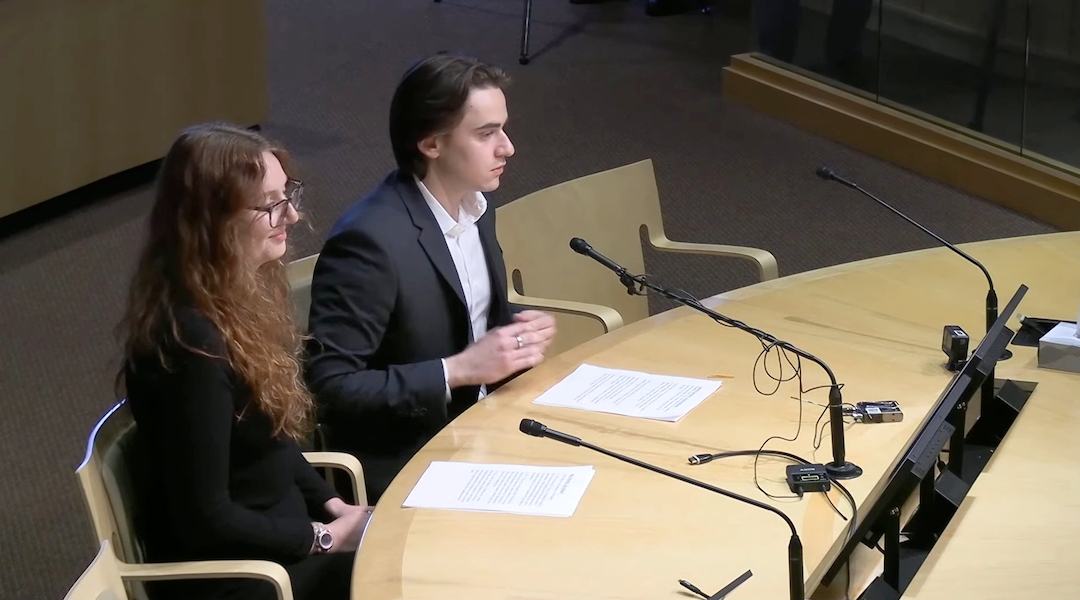
MN Hillel student leaders Alex Stewart and Charlie Mahoney speak in opposition to a coalition demanding divestment from Israel during a meeting of the University of Minnesota Board of Regents in Minneapolis, Minnesota, May 10, 2024. (Screenshot)
The deals with protesters are one of several strategies university administrations have employed to stem the encampment movement. Other stateside university presidents, including Ben Sasse, the former Republican senator who now heads the University of Florida, have flat-out rejected the possibility of negotiating. At Harvard on Friday, protesters still in their encampments were reportedly placed on an involuntary leave of absence.
Many other colleges have asked local law enforcement to intervene, a strategy that has led to more than 2,500 arrests to date, including nine from Minnesota’s encampment prior to the agreement. Dozens more protesters were arrested Friday morning at the Massachusetts Institute of Technology and the University of Pennsylvania, whose encampments were both raided by police while the UMN regents were meeting (the MIT Jewish Alliance, an alumni group formed after Oct. 7, praised the arrests in a statement to JTA).
Such arrests have faced massive public blowback outside the Jewish community. On Thursday, Pulitzer Prize-winning author Colson Whitehead announced he had withdrawn as the University of Massachusetts-Amherst’s commencement speaker over his objections to the arrests of protesters on that campus.
The agreements are generally framed as an attempt to resolve the issue more peaceably. Yet those who make agreements have also faced blowback. Northwestern’s Jewish president Michael Schill was pilloried by Jewish communal leaders who have called for an end to the encampments, including the ADL’s CEO Jonathan Greenblatt, for making a deal at all Schill’s campus antisemitism taskforce also disbanded after its Jewish members complained that they weren’t consulted on the deal.
That criticism has also come in Minnesota, where Jews pointed out that the encampments had visible chalk messages reading “Victory To Al-Aqsa Flood” (a reference to Hamas’ name for the Oct. 7 attacks) and “Globalize the Intifada.”
The JCRC encouraged supporters of Israel to attend Friday’s meeting. However, during the initial public comment period preceding the formal presentations, only supporters of divestment spoke — including other self-identified anti-Zionist Jews, as well as a faculty member who has previously denied that Hamas committed rape during its Oct. 7 attacks.
Jeff Ettinger, UMN’s interim president, said during the meeting that negotiations with the encampment were conducted in good faith and “grounded in listening, learning and respect, and that was instrumental in reaching this mutual understanding.”
He added that he had also met with the leaders of four Jewish campus groups — Hillel, Chabad and the Jewish fraternities Alpha Epsilon Pi and Sigma Alpha Mu — before concluding that “there is far more work for us to do” and condemning both antisemitism and Islamophobia on campus.
However, representatives from those Jewish groups had told TC Jewfolk, a local Jewish news site, that they were disappointed in their meetings with the administration. At the regents meeting, the pro-divestment presentations were immediately followed by two student leaders from Hillel. One of them, incoming Hillel student president Charlie Mahoney, urged the board, “Investing in Israelis and Palestinians can be more potent than divesting.”
After the divestment coalition spoke Friday, the Hillel leaders’ remarks largely focused on what they said was a “scary” campus atmosphere for Jews and a history of campus pro-Palestinian groups calling for divestment from Israel while harassing Jewish students and not engaging in meaningful dialogue.
“UMN Divest has done little more than inflame our campus, pit minority groups and friends against one another, and create a toxic environment that no longer feels safe for many students,” Alex Stewart, MN Hillel’s current student president, said. She added that Jewish students have felt “marginalized.”
“We didn’t want to fight,” Mahoney told the regents. “We didn’t want to defend our identities for an audience. We didn’t want to have to explain the Jewish connection to Israel and how singling out Israel for condemnation feels antisemitic. And we didn’t want to give other groups on campus further reason to hate or fear Jews.”
Mayeron reminded the crowd that the regents would not be making any decisions on divestment that day, and would instead continue to seek input from “a variety of stakeholders.”
But the mere appearance of a formal debate on the topic already represented a huge shift from how the vast majority of American universities have dealt with divestment requests in the past.
And it wasn’t the only issue of concern to Jews that came up at the meeting. Immediately following the divestment presentations, the regents discussed whether to rename a university building that bears the name of an antisemite, ultimately deciding to wait until June to hold a formal vote on the renaming.
“We approach issues passionately,” Mayeron stated at one point. “But we can do it with respect and civility.”