In the days after the US and Israel first bombed Iran, financial markets bet the economic fallout from Donald Trump’s “little excursion” in the Middle East would be short-lived.
“There are risks from higher oil prices longer term. But this is a tail risk,” one US-based fund manger said after the airstrike killing Iran’s supreme leader, Ayatollah Ali Khamenei. “History has shown time and time again that geopolitical flare-ups like this tend to be short-lived. This one should prove to be no exception.’’
Goldman Sachs told clients it expected temporary disruption. “Oil prices to decline throughout the year. But risks are skewed to the upside,” its analysts wrote. UniCredit suggested crude would be capped at about $80 a barrel. “Given its struggle for survival, the Iranian regime has an incentive to keep its response measured”.
Three weeks later, the prospect of a drawn-out war is causing mounting economic problems. Oil prices have soared above $100 a barrel, European gas prices have doubled, volatility stalks financial markets, and consumers worldwide are bracing for a surge in living costs. Central banks, including the US Federal Reserve, Bank of England and European Central Bank, warn the war could have a material impact on inflation and dent global growth.
“Market wisdom still holds that the war will end quickly, with the strait of Hormuz soon to reopen,” said Albert Edwards, a senior analyst at Société Générale. “Maybe the market is right, but in my opinion the risks are asymmetric that stagflation bursts the complacency bubble.”
With each day, more problems are emerging. From the soaring price of petrol and diesel for motorists, to cancelled flights and the worst travel disruption since the Covid pandemic.
European heavy industry – still reeling from the 2022 energy price shock after the Russian invasion of Ukraine – are feeling the pinch in particular. Huntsman told the Guardian its Teesside plant in the north-east of England is at risk, Germany’s BASF, the world’s largest chemicals firm, is putting up prices. The cost of fertiliser – an important byproduct of the petroleum industry – is rising sharply, hurting farmers worldwide and laying the groundwork for a sharp rise in food prices.
Iran has threatened to send oil to $200 a barrel through its fightback, targeting shipping through the narrow seaborne passage between its southern shore and Oman, as well as refineries and pipelines across the Middle East. Iranian missiles hit Ras Laffan, an important Qatari liquefied natural gas (LNG) processing facility, leading analysts to warn that energy markets are now on the road to a “doomsday” scenario.
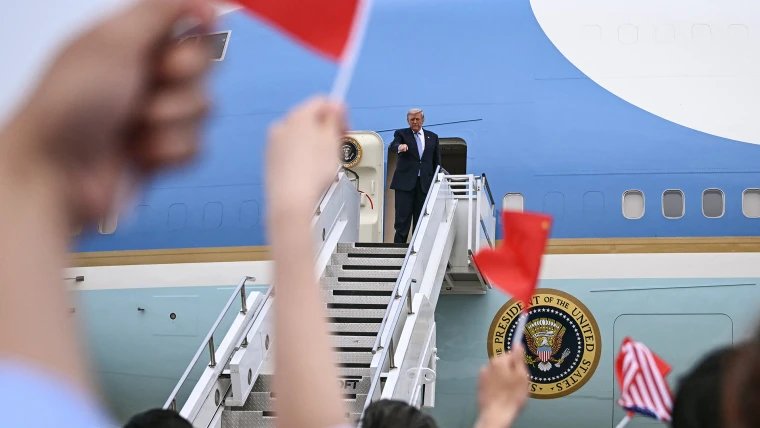
In Washington DC, the message has been mixed. Trump has declared the war “won”, while also saying it could end “soon”, or might need to go “further” – adding a layer of uncertainty for global markets and the world economy that contrasts with the situation on the ground.
Against this backdrop, businesses and investors are increasingly at a loss how to respond. Barclays compared the president’s comments to a 19th century-style “fog of war”, fuelling violent market swings. “A dense fog has been induced by the communication about the war: its objectives, its duration, its potential expansion and/or its off-ramps,” its analysts wrote.
Forecasters say a prolonged conflict could resemble past global economic crises. “Surging oil and gas prices are harbingers of economic trouble,” said Ian Stewart, the chief economist in the UK at the accountancy firm Deloitte. “Higher energy prices, triggered by war or revolution in the Middle East, were important factors in western recessions in 1973, 1979 and 1990.
“The surge in energy prices in the wake of Russia’s invasion of Ukraine collapsed Europe’s growth rate in 2023.”
The clearest parallels, however, are with the 1980s. Back then, Ronald Reagan sent US warships to Hormuz to protect merchant shipping during the Iran-Iraq war. In an episode that became known as the “tanker war”, Washington dispatched the largest naval convoy since the second world war to keep oil and gas exports flowing.
Four decades ago Tehran and Baghdad knew that targeting Hormuz would draw US involvement. By threatening western economic interests, they sought to gain leverage. In a case of history repeating itself, naval escorts are being mooted, after an apparent miscalculation by the Trump White House that this time would be different.
About a fifth of global oil supplies pass through the 126km-long waterway, which provides the only seaborne route for vessels leaving the Gulf to the open seas beyond. Saudi Arabia, an important US ally, exports the most through the tiny passage, followed by the United Arab Emirates.
The record release of 400m barrels of oil stockpiled by International Energy Agency member states’ has helped calm fears over shortages. But experts say supply constraints will soon bubble up, hitting crude refineries and downstream fossil fuel products worldwide.
“There is an increasing shortage in refined products,” said Mark Dowding, a fund manager at RBC BlueBay. “China has issued an export ban on refined products as it seeks to protect domestic consumption. Other countries, including South Korea, are considering similar steps and we would not be surprised if the US follows suit.”
In a lengthy conflict, energy supply constraints are expected to hit fossil fuel byproducts such as fertiliser. The Gulf is home to some of the world’s biggest plants, as a linchpin region for farming worldwide. About half of all global exports of urea, a commonly used fertiliser, and sulphur, a critical fertiliser ingredient, are sourced from the Middle East.
Before the critical spring planting season in the northern hemisphere, analysts warn rising fertiliser costs will hit crop yields and drive up food prices – hurting low-income countries and poor households globally.
Plastics, chemicals and pharmaceuticals are also being hit. Supplies of helium – critical to microchip production and MRI machines – have been hit by Qatar shutting down production. The Gulf state accounts for a third of global supply, as an important byproduct of LNG. Analysts say global manufacturing supply chains could be hit as a consequence – from the production of cars to electronics.
“Fossil fuels and petrochemical feedstocks run through the deep plumbing of the modern economy,” analysts at Société Générale wrote in a note to clients. “The stakes of this conflict are enormous for the global economy.
“If the strait of Hormuz remains effectively blocked for months, disruptions to supply chains beyond energy – from food to semiconductors – will become so critical that the risk of a scenario akin to the Covid plus Russia-Ukraine shock would be hard to rule out.”
Alongside higher inflation, economic growth is expected to be dragged down worldwide. Households have little room to stomach higher prices, while businesses were already laying-off workers in several countries before the Iran war began.
Barclays estimates in a scenario of oil prices averaging $100 in 2026 – as was the case in 2022 – global growth would be 0.2 percentage points lower, at 2.8% this year, while headline inflation would be 0.7 percentage points higher, at 3.8%, than would otherwise have been the case.
Some economists warn a prolonged war could drive oil prices above $170 a barrel, triggering a global recession. The UK, the eurozone and Japan are on watch. Experts warn a sharper sell-off in global markets could amplify the worsening outlook – exposing fractures in the financial system. Fears are growing over opaque private credit markets, while the bursting of an AI-fuelled bubble in tech valuations could spell disaster.
Governments are exploring emergency energy support for consumers already battered by a cost of living crisis. But amid expectations for central banks to drive up interest rates in response to the inflation shock, borrowing costs are rising – potentially hitting their capacity to respond.
There are hopes the fallout can still be contained. Despite being rattled, the fall in global financial markets remains relatively muted. Trump’s tariff threats in April last year had a much bigger impact.
Part of the reason is the context of the latest energy price shock. Conditions are different to 2022. Back then, the oil and gas price spikes amid Russia’s war in Ukraine added to the inflationary effects of the post-Covid economic restart. Pent-up consumers had a voracious appetite for goods and services. Governments and central banks were pushing to stimulate activity, and labour markets were tight.
“The result today in the case of a protracted war would be an intense supply shock that runs up against much weaker demand growth,” said Kallum Pickering, the chief economist at Peel Hunt.
After the shale gas boom, the US is largely energy-independent. Less than a tenth of its oil supplies travel through Hormuz. China has amassed vast oil stockpiles. European countries – most are net energy importers – are likely to be hit hardest by the fallout, but have pushed to diversify supplies since 2022. Renewable energy capacity has also increased.
While there are clear parallels to the 1970s energy shocks, the world economy in 2026 has reduced its reliance on fossil fuels. Some estimates suggest energy intensity – consumption of energy per unit of economic output – has fallen by about 70% since the mid-1970s.
Unlike after the Kremlin’s invasion of Ukraine, when western nations pushed to permanently cut Russian energy out of their supply chains, analysts see an end to the war in Iran allowing for a recovery.
“The key difference is that current supply disruptions are temporary. Yes, there is plenty of uncertainty about the duration of the disruption, but ultimately, supply will return,” said Warren Patterson, the head of commodities energy strategy at the Dutch bank ING.
However, long-term consequences are still likely.
The world economy is more interconnected than in the 1970s. With the march of globalisation and just-in-time supply chains, global trade in goods and services has swelled from 42% of world GDP in 1980 to more than 60% by the mid-2000s. But an interdependent world, in an age of rising conflict and geopolitical tensions is a riskier one; and no basis for a sustainable economic model.
In response, “nearshoring” and “friendshoring” have become buzzwords for multinational companies, as companies direct supply chains towards politically aligned and neighbouring countries to bolster their resilience.
Running up to the Iran conflict, this imperative had been underscored by the bottlenecks in supply after the easing of Covid lockdowns; disruption from the Ever Given blocking the Suez canal, and Houthi rebel attacks on Red Sea shipping after the Israeli invasion of Gaza. Rising geopolitical tensions and Trump’s tariff wars have accelerated things further.
Economists say the fragmentation of the global economy could add permanent additional costs, with potential to stoke inflation in the short term, while weighing on growth in the long term.
Wei Yao, an economist at Société Générale, said the conflict had put the world’s central banks “at the mercy of war”. “There are moments when one must come near the edge to remember why one must not go over it. We may be at one of those moments.”