What air pollution does to the human body

I grew up in rural Colorado, deep in the mountains, and I can still remember the first time I visited Denver in the early 2000s. The city sits on the plain, skyscrapers rising and buildings extending far into the distance. Except, as we drove out of the mountains, I could barely see the city – the entire plain was covered in a brown, hazy cloud.

That brown, hazy cloud was mostly made of ozone, a lung-irritating gas that causes decreases in lung function, inflammation, respiratory symptoms like coughing, and can trigger asthma attacks.

Denver still has air pollution problems, due in part to its geography, which creates temperature inversions that can hold pollution near the ground. But since 1990, ozone has decreased 18% across the U.S., reducing the smog that choked many cities in the 1960s and 1970s. The concentration of tiny dustlike particles of air pollution called PM2.5 has also decreased, by 37% since 2000.

These decreases occurred largely because of one of the most successful public health policies ever implemented by the United States: the Clean Air Act, first passed in 1970. The Clean Air Act regulates air pollution emissions and authorizes the Environmental Protection Agency to set air quality standards for the nation.

For years, when the Environmental Protection Agency assessed the economic impact of new regulations, it weighed both the health costs for Americans and the compliance costs for businesses. The Trump administration is now planning to drop half of that calculation – the monetary health benefits of reducing both ozone and PM2.5 – when weighing the economic impact of regulating sources of air pollution.

I am an environmental epidemiologist, and one of the things I study is people’s exposure to air pollution and how it affects health. Measuring the impact of air quality policies – including quantifying how much money is saved in health care costs when people are exposed to less air pollution – is important because it helps policymakers determine if the benefits of a regulation are worth the costs.

What air pollution does to your body

Breathing in air pollution like ozone and PM2.5 harms nearly every major system in the human body.

It is particularly hard on the cardiovascular, respiratory and neurological systems. Numerous studies have found that PM2.5 exposure is associated with increased death from cardiovascular diseases like coronary heart disease. Even short-term exposure to either PM2.5 or ozone can increase hospitalizations for heart attacks and strokes.

What’s in the air you breathe?

In the respiratory system, PM2.5 exposure is associated with a 10% increased risk for respiratory diseases and symptoms such as wheezing and bronchitis in children. More recent evidence suggests that PM2.5 exposure can increase the risk of Alzheimer’s disease and other cognitive disorders. In addition, the International Agency for Research on Cancer has designated PM2.5 as a carcinogen, or cancer-causing agent.

Reducing air pollution has been proven to save lives, reduce health care costs and improve quality of life.

For example, a study led by scientists at the EPA estimated that a 39% nationwide decrease in airborne PM2.5 from 1990 to 2010 corresponded to a 54% drop in deaths from ischemic heart disease, chronic obstructive pulmonary disease, lung cancer and stroke.

In the same period, the study found that a 9% decline in ozone corresponded to a 13% drop in deaths from chronic respiratory disease. All of these illnesses are costly for the patients and the public, both in the treatment costs that raise insurance prices and the economic losses when people are too ill to work.

Smog defined Los Angeles for years, including in December 1956. The photo was taken looking down Grand Avenue.
Bettmann via Getty Images

Yet another study found that nationally, an increase of 1 microgram per square meter in weekly PM2.5 exposure was associated with a 0.82% increase in asthma inhaler use. The authors calculated that decreasing PM2.5 by that amount would mean US$350 million in annual economic benefits.

Especially for people with lung diseases like asthma or sarcoidosis, increased PM2.5 concentrations can reduce quality of life by worsening lung function.

Uncertainty doesn’t mean ignore it

The process of calculating precisely how much money is saved by a policy has uncertainty. That was a reason the Trump administration stated for not including health costs in its cost-benefit analyses in 2026 for a plan to change air pollution standards for power plant combustion turbines.

Uncertainty is something we all deal with on a daily basis. Think of the weather. Forecasts have varying degrees of accuracy. The high temperature might not get quite as high as the prediction, or might be a bit hotter. That is uncertainty.
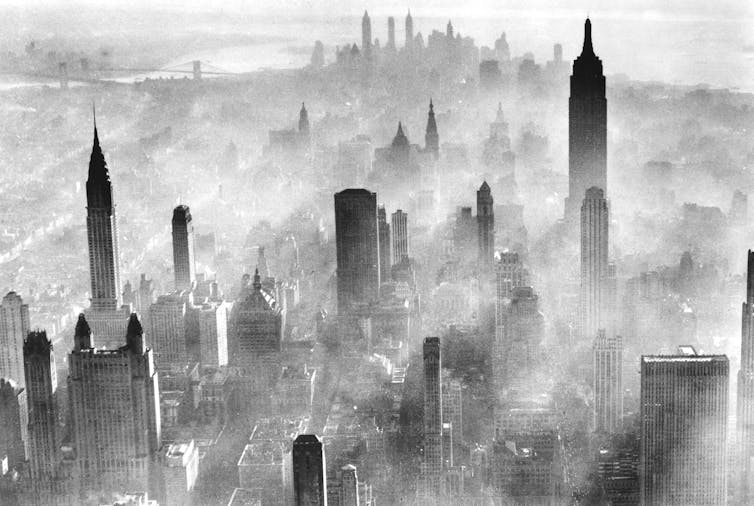
An aerial view of New York City, with only the tops of buildings clearly visible through the smog.
Smog often obscured views of the New York skyline in the 1930s and 1940s.
PhotoQuest/Getty Images

The EPA wrote in a notice dated Jan. 9, 2026, that its historical practice of providing estimates of the monetized impact of reducing pollution leads the public to believe that the EPA has a clearer understanding of these monetary benefits than it actually does.

Therefore, the EPA wrote, the agency will stop estimating monetary benefits from reducing pollution until it is “confident enough in the modeling to properly monetize those impacts.”

This is like ignoring weather forecasts because they might not be perfect. Even though there is uncertainty, the estimate is still useful.

Estimates of the monetary costs and benefits of regulating pollution sources are used to understand if the regulation is worth its cost. Without considering the health costs and benefits, it may be easier for infrastructure that emits high levels of air pollution to be built and operated.

A woman wears a face mask to filter the air while standing on a subway platform.

On days with poor air quality, like this one in New York in June 2025, more cities are issuing alerts, and more people are wearing face masks to reduce their exposure to harmful particles.
Selcuk Acar/Anadolu via Getty Images

What the evidence shows

Several studies have shown the impact of pollution sources like power plants on health.

For example, the retirement of coal and oil power plants has been connected with a reduction in preterm birth to mothers living near the power plants. Scientists studied 57,000 births in California and found the percentage of babies born preterm to mothers living within 3.1 miles (5 kilometers) of a coal- or oil-fueled power plant fell from 7% to 5.1% after the power plant was retired.

Another study in the Louisville, Kentucky, area found that four coal-fired power plants either retiring or installing pollution-reduction technologies such as flue-gas desulfurization systems coincided with a drop in hospitalizations and emergency department visits for asthma and reduced asthma-medication use.

Reducing preterm birth, hospitalizations, emergency department visits and medication use saves money by preventing expensive health care for treatment, hospital stays and medications. For example, researchers estimated that for children born in 2016, the lifetime cost of preterm birth, including medical and delivery care, special education interventions and lost productivity due to disability in adulthood, was in excess of $25.2 billion.

Circling back to Denver: The region is a fast-growing data center hub, and utilities are expecting power demand to skyrocket over the next 15 years. That means more power plants will be needed, and with the EPA’s changes, they may be held to lower pollution standards.


Source link

Visited 1 times, 1 visit(s) today

Related Article

Nvidia’s trillion-dollar run puts pressure on the bulls

BEIJING, CHINA – MAY 14: Nvidia CEO Jensen Huang (C) gestures as he prepares to depart following a welcome ceremony at the Great Hall of the People on May 14, 2026 in Beijing, China. President Trump is meeting with President Xi Jinping in Beijing to address the Iran conflict, trade imbalances, and the Taiwan situation

Permutations in Europe: What’s still at stake in final weeks of season?

There’s still plenty to play for across Europe as we head into the final matches of the club season. Here are all the title races, Champions League fights, and relegation battles left to be decided in the top leagues this month. This story will be updated until the end of the campaign. 👉 Jump to:EPL

Brewing a Better Half-Gallon Batch

Today I finally ran an experiment I’ve wanted to try for a long time. If you’re a professional barista—or you run a busy café—this may save you some time. Most coffee shops use 1–1.5 gallon batch brewers (Bunn, Curtis, Fetco, etc.). When I opened Short Sleeves Coffee, I intentionally avoided brewing full 1-gallon batches. I

5 Frozen Breakfasts Chefs Say Keep You Full All Morning

Chef-approved frozen breakfasts with more protein and better ingredients. Eating a healthy breakfast every morning is a great way to start the day, but most people don’t have time to cook. Whether you’re rushing out the door in the morning for work, taking the kids to school or both, there’s usually not much time in

CA scales back plan to ban student use of cell phones

By Carolyn Jones, CalMatters This story was originally published by CalMatters. Sign up for their newsletters. Until last month, California was poised to join nearly a dozen other states that ban cell phones in K-12 schools. But under pressure from school boards and administrators, lawmakers scaled back a bill that would have required such a

BulkQuant Launches AI Trading Bot for Crypto, Forex, and Stock Markets

BulkQuant Launches AI Trading Bot for Crypto, Forex, and Stock Markets

London, United Kingdom, May 15, 2026 (GLOBE NEWSWIRE) — BulkQuant has officially launched its AI trading bot platform designed for crypto, forex, and stock market traders seeking a simpler way to automate trading strategies across multiple financial markets. The platform combines AI-powered quantitative analysis, automated trade execution, portfolio monitoring, and adaptive risk management into a

IMF lauds resilient Hong Kong economy but warns of risks linked to Middle East war

IMF lauds resilient Hong Kong economy but warns of risks linked to Middle East war

The International Monetary Fund (IMF) has lauded the resilience of Hong Kong’s economy, noting a sustained recovery despite economic activity having yet to return to pre-Covid levels, while warning of downside risks stemming from escalating geopolitical tensions. It also urged Hong Kong to pursue medium-term financial reforms, including the introduction of a goods and services

Smithsonian Presidents Exhibit Reopens With Low-Key Trump Impeachment Mention

For the past year, the Smithsonian Institution has found itself in the awkward position of telling the nation’s story while being supported in part by a government that wants to narrow how that story is told. In December, the White House threatened to revoke funding to the institution if it did not hand over a

Marvel’s Daredevil Follow-up Is Already Dominating on Streaming

A follow-up to Daredevil: Born Again Season 2 on Disney+ has become a massive streaming success within days of its launch. The Punisher: One Last Kill has quickly climbed to the top of multiple charts, beating out other titles on the platform. The MCU television special follows the gun-toting vigilante, who finds himself targeted by

Is Now a Bad Time to Invest?

The market has been on a roll lately, with the S&P 500 (SNPINDEX: ^GSPC) setting new highs throughout May. If you think you missed your opportunity when the market bottomed in late March, don’t fret. The market hitting new all-time highs is not particularly rare and should not change your investment strategy. And if you

6 bids for Hong Kong land sale signal renewed confidence despite market caution

6 bids for Hong Kong land sale signal renewed confidence despite market caution

The Hong Kong government’s first land sale in the current financial year has drawn six bids, according to the Development Bureau, including those from the city’s largest developers, suggesting a more confident outlook for the residential property market. At the close of tender for Tung Chung Town Lot No 54 at Area 106A on Friday

Each Premier League team reranked: Man City rise; Chelsea, Liverpool collapse

Ryan O’Hanlon Close Ryan O’Hanlon ESPN.com writer Ryan O’Hanlon is a staff writer for ESPN.com. He’s also the author of “Net Gains: Inside the Beautiful Game’s Analytics Revolution.”  and  Bill Connelly Close Bill Connelly ESPN Staff Writer Bill Connelly is a writer for ESPN. He covers college football, soccer and tennis. He has been at

Trump departs China after two-day summit

Trump departs China after two-day summit

IE 11 is not supported. For an optimal experience visit our site on another browser. Trump Wraps China Summit With Xi Jinping: What Are the Results? 05:41 Xi gives Trump rare tour of secret garden at heart of Chinese government 01:04 Now Playing Trump departs China after two-day summit 01:01 UP NEXT Special Report: Trump

Carol Chow was facing a bankruptcy petition by five people over unspecified debts at the time of her death. Photo: Dickson Lee

Embattled Hong Kong developer sued for HK$130 million, days after founder’s death

A Hong Kong property developer has been sued for HK$130 million (US$16.6 million) over allegedly breaching guarantor obligations in two bond subscription agreements, becoming the latest lawsuit to implicate the embattled company and following its founder’s sudden death earlier this week. Lofter Group, known for its urban renewal projects across the city’s core districts, and

Trump’s China visit left chip export issue unresolved

This report is from this week’s The Tech Download newsletter. Like what you see? You can subscribe here. One look at the roster of U.S. execs that cozied up to U.S. President Donald Trump on the 20+ hours flight from Alaska to China on Wednesday and you get a sense of the American delegation’s key focus

Why the Cerebras IPO matters for the AI race with China

Why the Cerebras IPO matters for the AI race with China

Cerebras, an AI chipmaker, saw its shares nearly double on Nasdaq, closing up 70% with a $95B market cap. Cerebras’s powerful chips are key in the US-China AI tech race. Chris Buskirk, co-founder and chief investment officer of 1789 Capital, a key Cerebras investor, says the company’s IPO is geopolitically significant. On Thursday, shares of

Fitbit Air vs Whoop Strap Comparison: Price, Features and AI

The Google Fitbit Air is very much the talk of the fitness tracking town right now, not only because it’s the first new Fitbit device that we’ve had in years, but it’s also one of the first big brands to go head-to-head with the established Whoop Strap (if you don’t count the Polar Loop and

0
Would love your thoughts, please comment.x
()
x