Town cashing-in on China’s billion-dollar appetite for luxury durian

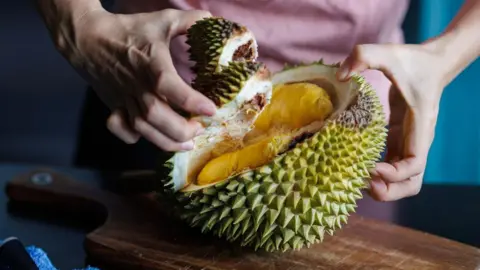
Getty Images Close up of a durian fruit being held in two hands.Getty Images

China’s surging demand for durians is shaping South East Asia’s farming towns

Driving around Raub, a small town in Malaysia, it’s impossible to miss the prickly fruit that powers its economy.

You can smell it from the steady stream of trucks winding through mountain roads, leaving a faint fragrance on their trails.

You can see it too: the green spikes of a giant sculpture, murals painted fondly on low walls and road signs that proclaim: “Welcome to the home of Musang King durians.”

A gold mining town in the 19th Century, Raub has seen its economy take on a new hue of yellow in recent years. Today it’s better known as the land of the Musang King — a buttery, bittersweet variety that the Chinese have dubbed the “Hermès of durians”, as prized as the French fashion house.

Raub is one of many South East Asian towns that sit at the heart of a global durian rush, pumped by China’s growing demand. In 2024, China imported a record $7bn (£5.2bn) worth of durians — a three-fold increase from 2020. This is where more than 90% of the world’s durian exports are now headed.

“Even if only 2% of Chinese people want to buy durians, that’s more than enough business,” says Chee Seng Wong, factory manager of Fresco Green, a durian exporter in Raub.

Wong recalls how farmers cut down durian trees to make room for oil palms, the country’s main cash crop, during an economic downturn in the 1990s.

“Now it’s the other way round. They’re chopping oil palms to grow durians again.”
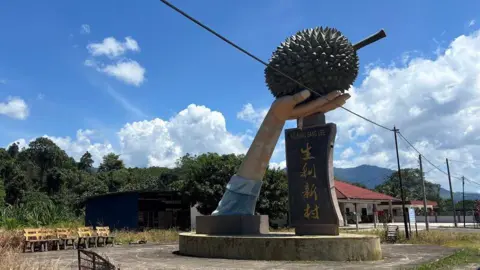
BBC/Koh Ewe A giant statue of a hand holding up a durian, against sunny blue skies in the background.BBC/Koh Ewe

Durians are the pride of Raub

A very hungry China

With an aroma that has been likened to cabbage, sulphur and sewers — depending on who the nose belongs to — the durian packs a pungence so divisive that it’s banned on some public transport and hotels. It has been maligned for gas leaks, and was the reason a plane was grounded after passengers remonstrated against the smell wafting from the cargo hold.

Fans from the region have christened it the “King of fruits”, but on the internet it has earned a less flattering tag — the world’s smelliest fruit — as tourists unused to its odour seek it out with squeamish curiosity.

Yet it has found a growing fanbase in China: as an exotic gift exchanged among the affluent; a status symbol to be unboxed on social media; and the star of culinary heresies from durian chicken hotpot to durian pizza.

Thailand and Vietnam are the top durian suppliers to China, accounting for nearly all of its imports. Malaysia’s share of the market is sprouting fast, having earned a reputation with premium varieties such as the Musang King.

The average price of durian starts at less than $2 (£1.4) in South East Asia, where they are grown in abundance. But luxe versions like the Musang King could cost anywhere from $14 (£10) to $100 (£74) a pop, depending on their quality and the season’s harvest.

“Once I ate Malaysian durian, my first thought was, ‘Wow, this is delicious. I have to find a way to bring it to China’,” says Xu Xin, who has been sampling durians at a shop in Raub. The 33-year-old sells the fruit back home in northeastern China, and is on the hunt for the best durians to import.
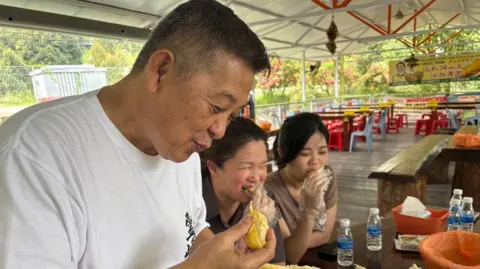
BBC/Koh Ewe Side view of a middle-aged man in a white T-shirt holding a slice of durian in one hand and a yellow glob of durian in the other hand. Behind him are two women sitting at a table eating durians with plastic gloves.BBC/Koh Ewe

Visitors to Raub are delighted with its durians

With her are two durian exporters from southern China, one of whom says business has been booming. The other expects it to continue: “There are so many people who haven’t eaten it yet. The market potential is huge.”

It’s easy to see why they’re so confident. Seated nearby is a large Chinese tour group — one of many that have been flocking to rural Malaysia for a bite of the fruit.

Eagerly they dig into platters of durian, carefully arranged from the mildest to the richest. If eaten in the right order, locals say, fresh notes should emerge with each glob on the flight: caramel, custard and finally, an almost alcoholic bitterness heralding the Musang King.

Such pedantry is perhaps why Malaysian durians have earned a special place on the Chinese table.

“Maybe in the beginning we only liked durians that were sweet. But now we look for things like fragrance, richness and nuanced flavours,” Xu says. “Nowadays there are more customers who walk into the shop and ask, ‘Are there any bitter ones in this batch?'”
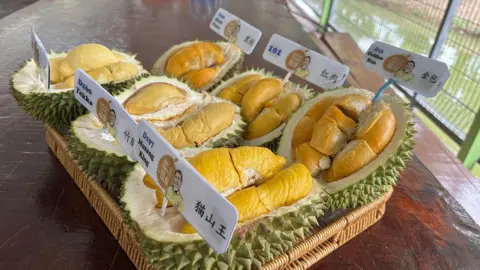
BBC/Koh Ewe Six slices of durians arranged neatly on a brown tray. Stuck on each durian is a label printed with the name of a durian variety, such as Tekka and Musang King.BBC/Koh Ewe

Durians arranged from mildest (top left) to richest, ending with the Musang King (bottom right)

Raub’s durian dynasties

Just hours before the durians ended up on Xu’s plate, they were painstakingly harvested at a nearby farm owned by Lu Yuee Thing.

Uncle Thing, as he’s known in town, owns the durian shop, along with several farms. He is one of many success stories in Raub, where durians have made millionaires out of farmers. In family businesses like his, sons often help with transporting durians while daughters handle accounting and the finances.

“Durian has contributed a lot to the economy here,” Uncle Thing says.

Driving to his farm one morning, there is quiet pride in his voice as he points out the Japanese pickup trucks that have replaced the rickety jeeps he used to rely on for transporting crates of his fruit.
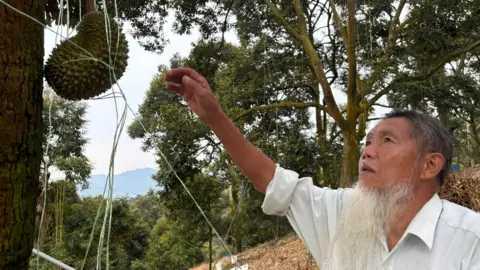
BBC/Koh Ewe Uncle Thing who has a long white beard is wearing a white shirt. He is reaching up to a durian dangling from a tree.BBC/Koh Ewe

Uncle Thing is one of Raub’s big durian success stories

Still, farming is hard work. At 72, Uncle Thing wakes up at dawn every day and weaves around his hilly farm to collect ripened durians, either dangling from trees or nestling on nets close to the ground. A couple of years ago, a falling durian landed on his shoulder, leaving him with a throbbing pain that acts up now and then.

“It looks like farmers make easy money. But it’s not easy,” he says.

Once harvested, the durians are brought to Uncle Thing’s shop, where they are sorted into baskets ranging from Grade A, for the large and round ones, to Grade C, the small and odd-shaped.

Sitting in the middle of the sorting floor is a lone basket reserved for Grade AA durians, the handsomest of the lot.

Those will soon be flown to China.
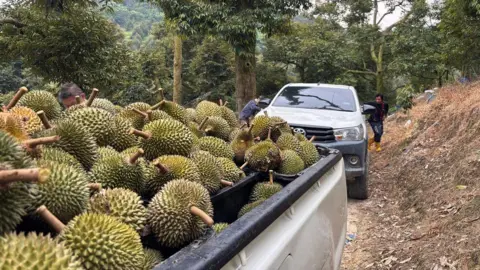
BBC/Koh Ewe Durians piled in the back of a pick-up truck parked in a durian farm. Workers are piling more durians to the back of another white pick-up truck, parked behind.BBC/Koh Ewe

The daily haul at Uncle Thing’s farm

A durian coup?

China’s insatiable appetite for durians has shaped up to be a nifty diplomatic tool.

Beijing has signed a flurry of durian trade agreements, touting them as a celebration of bilateral ties — not just with major producers like Thailand, Vietnam and Malaysia, but also budding suppliers like Cambodia, Indonesia, Philippines and Laos.

“In this durian competition, everyone’s a winner,” declared a state media article in 2024.

The deals also dovetail with China’s investments in infrastructure in the region. The China-Laos Railway, launched in 2021, now transports more than 2,000 tonnes of fruit every day, most of them Thai durians.

But this clamour to keep up with China’s appetite comes at a cost.

Food safety concerns about Thai durians erupted last year, after Chinese authorities found in them a carcinogenic chemical dye believed to make the durians more yellow.

In Vietnam, many coffee farmers pivoted to durians, driving up global coffee prices that were already affected by severe weather.

And in Raub, a turf war has broken out. Authorities felled thousands of durian trees they said were planted illegally on state land. Farmers say they have been using the land for decades without any issue, and allege they are now being forced to pay a lease to continue farming there, or face eviction.
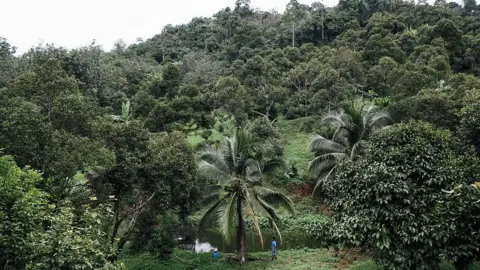
Getty Images Wide shot of green durian trees and palms planted on hilly terrainGetty Images

Durian trees and oil palms dominate Raub’s landscape

Meanwhile, a coup may be on the way in China’s island province of Hainan, where years of trial and error are bearing fruit. Its durian harvest for 2025 was expected to reach 2,000 tonnes.

Like in so many industries, from renewables to AI, China has long pushed to be self-sufficient in food too.

Even as it reaps the fruits of this durian diplomacy, it is eyeing what state media calls “durian freedom”.

“For one thing, we won’t have to rely on Thai and Vietnamese vendors when buying durians anymore!” proclaimed an article in August.
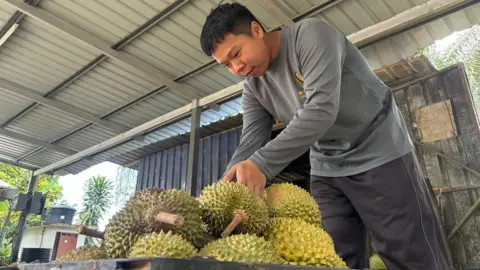
BBC/Koh Ewe  A young man in a grey sweatshirt and grey pants handles a pile of durians.  BBC/Koh Ewe

Can Hainan unseat Raub in the durian supply chain?

That is still a distant dream. Hainan’s first home-grown durians hit the market with much fanfare in 2023, but accounted for less than 1% of China’s durian consumption that year.

But the way Uncle Thing sees it, “Hainan has already succeeded in its experiment… If they have their own supply and start importing less, our market will be affected.”

He shrugs it off for now: “That is not something we can worry about. All that we can do is take good care of our farms and boost yields.”

Ask anyone else in Raub about Hainan’s quest, and your question will be swatted away with a smug comeback: they are still no match for Malaysian durians.

And yet, as China chases “durian freedom”, it’s hard to ignore the fact that the Musang King sits on an ever shakier throne.


Source link

Visited 1 times, 1 visit(s) today

Related Article

China applies to put 200,000 satellites in space after calling Starlink a crash risk

China applies to put 200,000 satellites in space after calling Starlink a crash risk

Chinese firms have signalled plans to launch more than 200,000 internet satellites, filing submissions with a UN agency just as Beijing accused Elon Musk’s SpaceX of crowding shared orbital resources. A dozen or so submissions from various Chinese satellite players were filed with the International Telecommunication Union (ITU) at the end of last month. The

Record trips underscore Greater Bay Area connectivity deepening

Record trips underscore Greater Bay Area connectivity deepening

A drone photo shows vehicles waiting to be inspected at the Zhuhai port of the Hong Kong-Zhuhai-Macao Bridge in Zhuhai, south China’s Guangdong Province, Jan. 6, 2026. (Xinhua/Deng Hua) The Zhuhai land port of the Hong Kong-Zhuhai-Macao Bridge has handled over 100 million inbound and outbound passenger trips as of Tuesday since it opened to

the Transformation of China’s Fashion Industry Via AI

the Transformation of China’s Fashion Industry Via AI

From initial hype to tangible industrial momentum, the 2025 China Apparel Industry AI Technology Application Summit emerged as a key battleground where fashion companies demonstrated their technological advancements. In early 2025, the AI upheaval sparked by DeepSeek not only rattled U.S. stock markets but also ignited widespread enthusiasm across various Chinese industries, including fashion, which

Expanded drone utilization boosts low-altitude economy in China's Greater Bay Area

Expanded drone utilization boosts low-altitude economy in China’s Greater Bay Area

China’s Guangdong–Hong Kong–Macao Greater Bay Area (GBA) is experiencing a boom in its low-altitude economy as companies continue to expand the range of applications for drones. One very popular use of drones in recent years is drone-performed light shows. At a drone show company in Shenzhen City, south China’s Guangdong Province, formation designers are working

China's Greater Bay Area attracts int'l enterprises, forging new tech hub

China’s Greater Bay Area attracts int’l enterprises, forging new tech hub

A growing number of international enterprises have launched operations at the Hong Kong Park of the Hetao Shenzhen-Hong Kong Science and Technology Innovation Cooperation Zone, positioning it as a global technology hub just one month after its official launch. The park was set up on December 22, 2025 and established under the vision of “one

Chinese supply ship Taihu (Hull 889) moored in False Bay near Simon’s Town ahead of the Will For Peace 2026 drills with BRICS Plus navies. (Source: Getty Images)

China Leads Warships From Russia and Iran in Show of Force Near South Africa’s Key Trade Route — UNITED24 Media

Naval forces from China, Russia, Iran, and South Africa have launched a multinational maritime exercise near one of the world’s key shipping corridors, signaling a coordinated demonstration of naval capability outside of traditional Western-led frameworks. According to Army Recognition on January 10, the China-led exercise, named Will for Peace 2026, is being held from January 9 to 16 in South African territorial waters, particularly around Simon’s Town

Michael Martina

With Venezuela raid, US tells China to keep away from the Americas

Beijing bet big on relations with Caracas American operation deals blow to Chinese strategy in the Americas Trump’s China policy includes both concessions and assertive new stances WASHINGTON, Jan 11 (Reuters) – Among the many goals of last week’s U.S. military operation that captured Venezuelan President Nicolas Maduro was to send China a message: stay

Nvidia CEO Jensen Huang to the US and China: World wants you two to figure out your relationship, the idea that..

Nvidia CEO Jensen Huang to the US and China: World wants you two to figure out your relationship, the idea that..

Nvidia CEO Jensen Huang urged Washington and Beijing to resolve their differences, deeming economic decoupling “naive.” He believes the US-China relationship is crucial for global stability, advocating for technological independence alongside economic interdependence. Huang is optimistic about resuming sales of advanced chips in China, a market worth billions, despite geopolitical complexities. Nvidia CEO Jensen Huang

Venezuela-style strike on Taiwan’s leader could prove tricky for China

Questions linger on combat showing of China’s latest weaponry Taiwan readied for years to fend off ‘decapitation’ attacks on leaders Maduro capture inspires some online Chinese users HONG KONG/TAIPEI, Jan 9 (Reuters) – (This Jan 9 story has been corrected to say Democratic Progressive Party, not Democratic People’s Party in paragraph 4) Some Chinese online

South Africa's strained ties with US face new test

South Africa’s strained ties with US face new test

Mayeni JonesAfrica correspondent, Johannesburg SA National Defence Force The participation of warships from China, Iran and Russia in military exercises hosted by South Africa could further strain the country’s relationship with the US, which are already at an all-time low. A News24 report suggesting South Africa is hoping to persuade Iran to become an observer

The team of engineers deployed a second shield tunnelling machine to excavate from the opposite direction underneath the Yangtze for a mid-river docking. Photo: Handout

How China turned a mega-project failure into a defining moment in modern engineering

China has pulled off a daring underground feat, using a multimillion-dollar tunnel boring machine (TBM) to recover its stranded twin beneath the country’s largest river. The rendezvous between the TBMs was achieved with just 2mm (0.078 inch) of vertical error and no horizontal deviation under the Yangtze’s riverbed, setting a benchmark for precision in deep

Integrated supply chains propel Greater Bay Area's low-altitude economy growth

Integrated supply chains propel Greater Bay Area’s low-altitude economy growth

The Guangdong–Hong Kong–Macao Greater Bay Area (GBA) is emerging as a key engine for China’s fast-growing low-altitude economy by leveraging its dense industrial networks, efficient logistics systems, and rapid innovation capacity. From logistics and manufacturing to urban services, the region is building an integrated industrial chain that allows low-altitude industries to scale up at unprecedented

share

China closing the technological gap with the US

Despite facing challenges in chip manufacturing, Chinese artificial intelligence (AI) researchers are optimistic about narrowing the technological gap with the United States, driven by an increasing culture of risk-taking and innovation. At an AI conference in Beijing on Saturday, key industry leaders discussed the growing confidence within China’s AI sector, with particular focus on the

Denmark Greenland Trump

Security fears and dreams of minerals behind Trump’s push to ‘own’ Greenland, experts say

To hear President Donald Trump tell it, a push to take control of Greenland is a “national security” necessity, critical to reinforcing control of the Arctic against possible threats from Russia and China. For America’s allies and Greenlanders themselves, however, Trump’s threats to seize the semi-autonomous Danish territory cut much deeper, and threaten to shatter

Tim Cocks

China, Russia, Iran start ‘BRICS Plus’ naval exercises in South African waters

Item 1 of 4 A Russian vessel arrives at the Simon’s Town Naval base ahead of the BRICS Plus countries which include China, Russia and Iran for a joint naval exercises in South Africa’s, in Cape Town, South Africa, January 9, 2026. REUTERS/Esa Alexander [1/4]A Russian vessel arrives at the Simon’s Town Naval base ahead

Robert Scammell, Senior Tech Editor, Business Insider.

China’s Probe Into Meta’s Manus Deal Is a Warning About ‘Singapore Washing’

China has a message for US tech firms: Hands off our AI talent and tech. That’s what Beijing is signalling by announcing a probe into Meta’s acquisition of Manus, analysts told Business Insider. The probe, confirmed by China’s Ministry of Commerce in a Thursday press conference, will investigate whether the acquisition complies with the country’s

Cyber Intrusions Against Taiwanese Critical Infrastructure Networks, 2023 to 2025

China & Taiwan Update, January 9, 2026

Toplines The PRC is using the US capture of former Venezuelan President Nicolas Maduro to portray the United States as a hypocritical rogue actor and elevate its own global image. PRC Ministry of Foreign Affairs (MFA) spokesperson Lin Jian condemned the US operation and called it a violation of international law on January 5.[1] PRC

Is China’s technology export control really the only thing Manus should be worried about?

Is China’s technology export control really the only thing Manus should be worried about?

On Chinese social media, a wide range of speculation has emerged over how China might investigate the Meta–Manus transaction. Commentators from different quarters have offered various interpretations of whether the deal complies with Chinese law, with many arguing that Chinese regulators have ample legal grounds to investigate and assert jurisdiction over the transaction. The matter

0
Would love your thoughts, please comment.x
()
x