Smart Agents are emerging as AI-native, goal-driven interfaces that act on behalf of consumers across many merchants and platforms. In doing so, they challenge the core premise of the Super App: a single, vertically integrated digital front door controlled, governed and monetized by one platform.
For more than a decade, Big Tech, Big Retail, and Big Finance have chased the same idea. Build an app that does everything. Messaging, shopping, payments, financial services, healthcare, mobility, daily life. Simplify the complexity of the consumer’s world by pulling it inside a single ecosystem and curating what the consumer sees, chooses and buys.
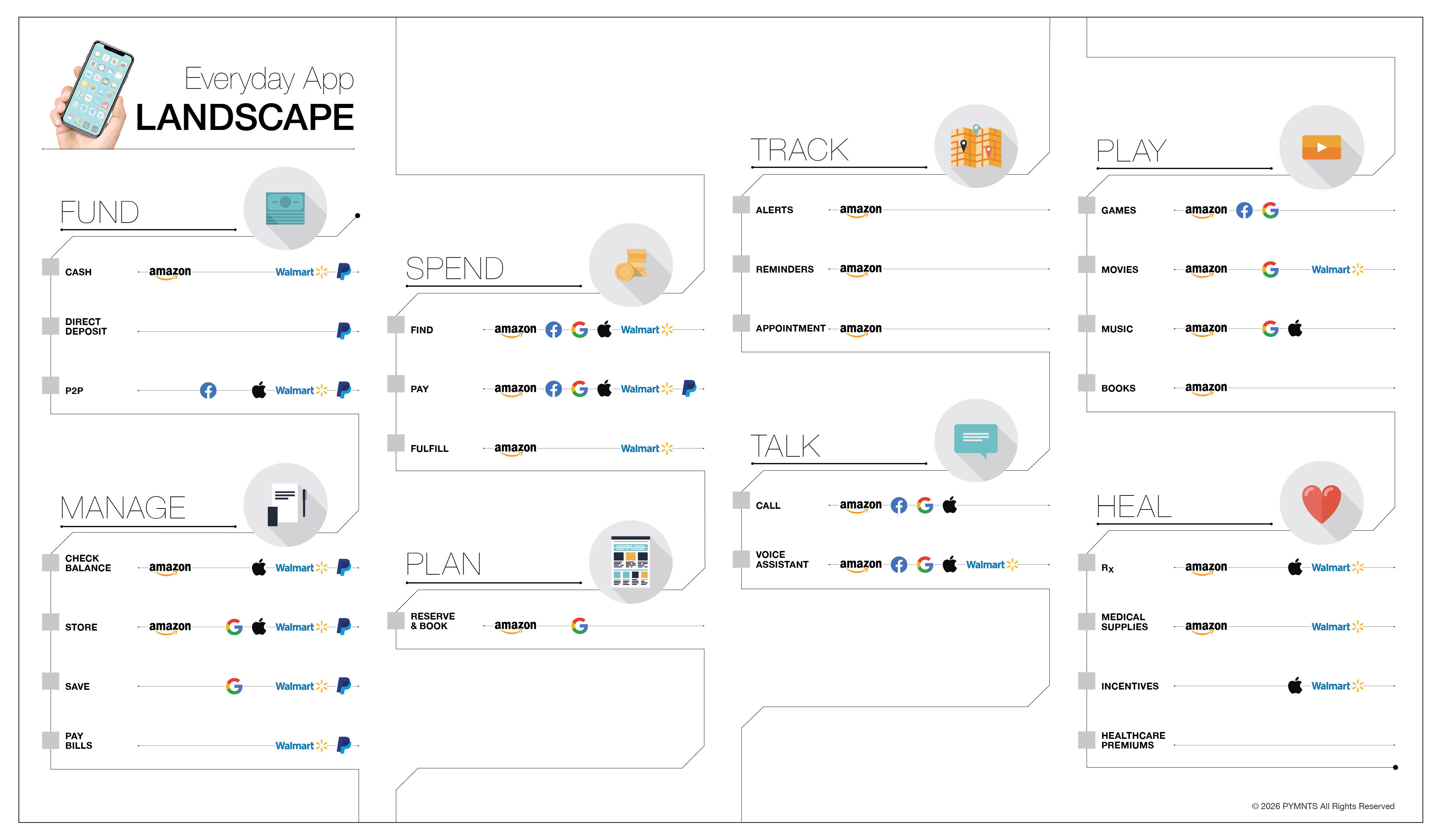
In 2019, I reframed that ambition as the “Everyday App,” an organizing construct for how platforms were trying to aggregate daily use cases and where the major players fit along that spectrum. At the time, the logic was clear. A single front door would reduce friction for consumers and create powerful advantages for the platforms that owned it.
Six years later, agents and AI are turning that logic inside out.
Knocking on Digital’s Front Door
The dream of being the front door has not disappeared. What has changed is who does the knocking, and who does the opening.
In the Super App era, the consumer opened the door and stepped into a larger ecosystem filled with curated options they were expected to navigate. In the agentic era, the consumer does not enter the ecosystem at all. Instead, they send someone else inside to look on their behalf.
Their smart agent.
The Super App model centralized consumer choice inside a platform that the operator controlled and monetized. Discovery, identity, wallet, personalization and the rules of engagement all belonged to the platform. Merchants competed, and paid, for placement inside someone else’s environment in order to be seen, chosen and converted.
Smart Agents reverse that dynamic.
They take the work of searching, comparing, and deciding out of the consumer’s hands and give it to software instructed to act in the consumer’s interest. That changes everything: how retailers compete, how platforms monetize, and how buying decisions are made.
From Super App to Smart Agent
The Super App story almost always begins with WeChat. What started as messaging expanded into social, then payments, then a dense ecosystem of mini programs that allowed consumers to do nearly everything without leaving Tencent’s walls.
Others followed. Uber layered food, groceries, mobility and payments on top of ride-hailing. Grab and Gojek combined transportation, payments and commerce across Southeast Asia. Amazon and Walmart expanded horizontally into food, media, healthcare, prescriptions, delivery and beyond. Banks, wallets and retailers built their own versions, stitching together loyalty, offers, payments and third-party sellers to keep their credentials top-of-wallet.
Across all of these models, the promise to the consumer was convenience. The benefit to the Super App operator was control.
Smart Agents break that compact.
Agents operate across many merchants and platforms at once. The organizing principle is no longer the platform’s ecosystem. It is the consumer’s intent.
In a Super App world, discovery is shaped by the platform’s priorities, pricing transparency is limited, and switching costs are high. In an agentic world, the agent’s job is to search broadly, compare honestly, and execute efficiently on the user’s behalf. And it’s all guided by preferences and constraints set by the consumer, not by a single platform’s business model.
That makes the Super Agent the new front door.
Consumers tell the agent what they want. The agent interprets the request, searches across merchants and services, evaluates tradeoffs and assembles the outcome. Smart Agents don’t need to own the ecosystem; they just need access to all of them.
How Super Agents Actually Work
The mechanics matter because they explain why this shift is both inevitable and durable.
Let’s say a consumer asks her Smart Agent to plan a long weekend in Miami for under $1,500, leaving from Boston, with direct flights and a boutique hotel on the beach. The agent translates that request into goals and constraints, then orchestrates API calls to airlines, hotels, transportation providers and ancillary services.
It weighs price, timing, loyalty preferences, cancellation policies and risk tolerance. It offers options that fit the brief. If the consumer stated a preference for a hotel or airline brand, that is considered as part of the search. Once approved, it executes bookings, handles payments and identity verification using stored or tokenized credentials, and stays engaged to manage changes, delays or disputes.
Under the hood, this looks very different from a Super App.
There is an intent layer that turns natural language into structured objectives. A data layer that pulls availability and pricing from multiple merchants. A scoring layer that balances user preferences, historical behavior, and guardrails designed to keep user optimization primary. And an execution layer that handles payment, identity, fraud, fulfillment, and post-purchase workflows.
In a Super App, that same journey would be constrained to a single ecosystem’s partners and inventory, shaped by paid placement, revenue share or owned supply. And managed step by step by step by step by step by step by the consumer herself.
Incentives, Trust and the Fork in the Road
All that said, Smart Agents face their own defining choice.
On one path, they operate as true consumer fiduciaries, optimizing for outcomes the user cares about and being paid in ways that keep incentives aligned. Or they become a different version of the Super App, funded primarily by merchant incentives, ad or revenue shares or pay-to-play placement.
For Smart Agents to replace Super Apps as the dominant interface for commerce, trust has to be earned and maintained. That means transparency around how recommendations are funded, clear separation between optimization and monetization, and user-controlled preferences that actually govern outcomes.
The platforms that get this right will be designed for auditability, override controls and clear records of what tradeoffs were made. The ones that do not will invite backlash that could slow adoption for everyone.
Regulation may play a role here. As agents handle autonomous payments and binding commitments, existing consumer protection and disclosure frameworks are likely to follow. It’s also not clear whether agents that move money may be held to standards closer to brokers or advisors.
What This Means for Merchants and Platforms
Retail has lived through many transitions: from department stores to malls, from stores to websites, from websites to marketplaces, and then to social and direct-to-consumer models. In each phase, merchants have retained some control, either through their own channels or by paying for placement and influence.
The shift to Smart Agents is different.
For the first time, consumers gain access to the same optimization tools retailers have used for years. Agents will continuously test offers, fulfillment performance, pricing and service quality across merchants, updating their models of which sellers perform best along the dimensions the user cares about.
For merchants, this changes the game. Winning no longer means being the loudest brand or the biggest advertiser inside a platform. It means being the best option when an agent evaluates price, availability, reliability, service and post-purchase experience on behalf of a customer.
That requires becoming agent-ready. Structured product data. Reliable APIs. Machine-readable policies. Transparent service levels. Post-purchase signals agents can observe and learn from.
Publishers are already learning this lesson. Those who treat AI and agents as new distribution layers and optimize content for them are finding new paths to growth. Those who fight them risk being bypassed. The same dynamic will play out in commerce.
Early signals suggest consumers are ready. PYMNTS Intelligence research shows that 57% of U.S. consumers have used AI platforms for personal tasks. This is higher for younger and higher-income individuals.
In addition, a growing share already rely on AI for shopping research, especially in categories where comparison is complex.
Personal Uses of Prompt-Based AI
Smart Agents may not eliminate Super Apps overnight. But they eliminate the assumption that demand must flow through platforms that control discovery and choice.
Find more observations and insights from Karen Webster about what may lie ahead: