Seoul Correspondent

 BBC/Hosu Lee
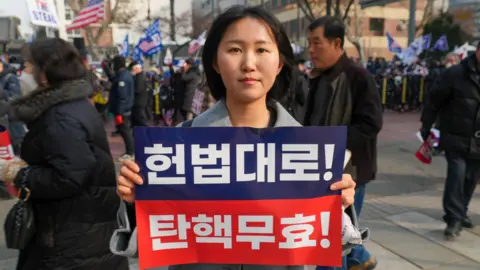
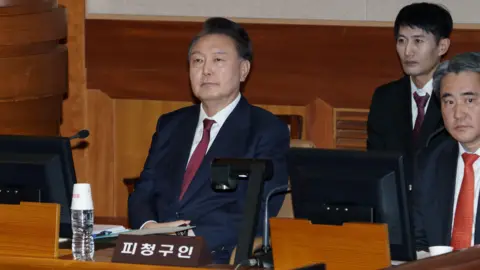
On a cold January afternoon, a young pharmacy student, Shin Jeong-min, waited restlessly outside South Korea’s Constitutional Court, as the country’s suspended president arrived to fight his impeachment.
While Yoon Suk Yeol testified, she chanted along with hundreds of his incensed and worried supporters, who have rallied around him ever since his failed attempt to impose martial law. “Release him now. Cancel his impeachment,” they shouted.
“If the president is impeached and the opposition leader is elected, our country will become one with North Korea and Kim Jong Un,” Jeong-min said, citing a theory popular among President Yoon’s most fanatical followers: that the left-leaning opposition party wants to unify with the North and turn South Korea into a communist country.
At 22 years old, Jeong-min stands out from the legion of elderly Koreans who have always feared and despised the North, and make up the bulk of those who hold these far-right conspiratorial beliefs.
That generation of Koreans, now in its 60s and 70s, lived through the Cold War and remembers bitterly the devastating aftermath of North Korea’s invasion in the 1950s.
When Yoon declared martial law in early December, he played on these fears to justify his power grab.
Without citing evidence, he claimed that “North Korean communist forces” had infiltrated the opposition party and were trying to overthrow the country. They needed to be “eradicated”, he said, as he moved swiftly to ban political activity and put the army in charge.
Two months on from his failed coup, an anti-communist frenzy is gripping Yoon’s supporters, young and old.
Even some who had never given North Korea or communism much thought are now convinced their dynamic democracy is on the brink of being turned into a leftist dictatorship – and that their leader had no choice but to remove people’s democratic rights in order to protect them from both Pyongyang and Beijing.
“This a war between communism and democracy,” said one office worker in his 40s, who had slipped out of work to join the protest at the court.
Another man, in his 30s, adamantly argued the president had to be returned to office as soon as possible. “He’s going to arrest all the North Korean spies,” he said.
Such threats were once very real. During the 1960s and 70s, spies would regularly attempt to infiltrate the government.
In 1968, a group of North Korean commandos crawled across the border and tried to assassinate then President Park Chung-hee. A tree atop Seoul’s Bugak mountain still bears the bullet marks from the intense gun battles that raged for nearly two weeks.
In the 1980s, during the final years of South Korea’s violent military dictatorship, a radical far-left student movement began to praise Pyongyang for its “superior” political system. They were labelled regime “sympathisers”.
It was also common for authoritarian leaders to accuse their political adversaries of being North Korean conspirators.
 BBC/Hosu Lee
“Anti-communism became the dominant ideology of South Korea’s military dictators, who used it to control society and justify restricting people’s freedom,” said Shin Jin-wook, a sociology professor at Chungang University.
Today, these threats have dissipated. Pyongyang’s nuclear weapons and advanced cyber-hacking abilities pose the greater risk, and you would struggle to find anyone in South Korea who wants to emulate life in the North. The political left and right are merely divided over how to deal with their troublesome neighbour.
While the approach of Yoon’s conservative People Power Party has been to try to threaten the North into submission with military superiority, the left-leaning Democratic Party prefers to engage with Pyongyang, believing the two countries can peacefully co-exist.
The president has been accused of exploiting people’s historic fears. “Yoon’s rhetoric almost completely matches that of past dictators, and he is the first president to use this anti-communist ideology so blatantly since Korea became a democracy in 1987,” said Mr Shin.
Not only has Yoon accused the parliament, led by the opposition Democratic Party, of being riddled with Pyongyang sympathisers, but he has dangled the idea that North Korea, with help from China, rigged last year’s parliamentary election.
“This is fake news cooked up by Yoon to demonise the opposition and justify his completely undemocratic move,” one Democratic Party lawmaker, Wi Sung-lac, told the BBC.
“We have a long history of fighting for democracy and freedom in Korea. We are the ones who managed to thwart Yoon’s attempt to destroy Korea’s democracy,” he said, referring to the opposition politicians who pushed past troops and climbed over the parliament’s walls during martial law to vote down the motion.
Such ideas were previously pedalled by extreme conservative groups, said Lee Sangsin, a polling expert at the Korea Institute for National Unification.
“These groups were isolated. People didn’t take much notice,” he explained. “But because Yoon is the president, his words carry weight, and many people have accepted what he said.”
This was evident at one of the pro-Yoon weekend rallies we attended last month. Far from being die-hard conspiracy theorists, nearly everyone we spoke to said Yoon had changed their thinking.
“At first I didn’t support Yoon, but martial law opened my eyes,” said Oh Jung-hyuk, a 57-year-old musician, there with his wife. “We can see how deeply embedded leftist forces are in our society.” One woman in her 40s told us she previously had doubts about Chinese vote rigging but had researched the issue after martial law and “realised it was true”.
 Getty Images
Yoon’s supporters often point to real events – how the previous Democratic Party President, Moon Jae-in, met Kim Jong Un to try to orchestrate a peace deal; that the current Democratic leader, Lee Jae-myung, is being investigated for helping to send millions of dollars to North Korea – then use these as evidence of a greater plot.
“This far-fetched conspiracy theory that China rigged the election is becoming more and more accepted,” said the sociology professor Mr Shin. “One of the most basic consensuses in a democracy is the premise of fair and free elections, and now we have people distrusting that. This is very extreme.”
As Yoon’s unsubstantiated claims have taken root, his support seems to have grown. Although the majority of people in South Korea still want him permanently removed from office, the number has fallen. Last week it stood at 57%, compared to 75% in the week after the martial law declaration.
Through his anti-communist rhetoric, Yoon has also effectively tapped into a simmering distrust of China. To fear North Korea now means to be wary of China too.
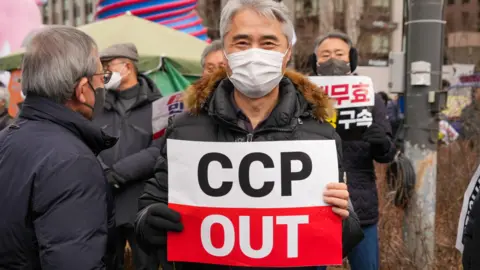
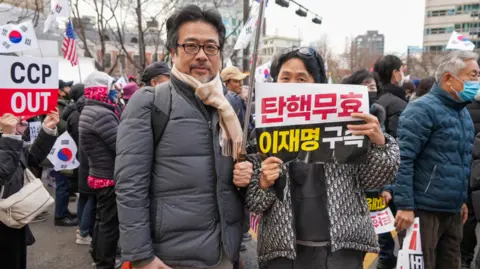
At a recent weekend rally in Seoul, many supporters had swapped their trademark “Stop the Steal” election fraud placards for ones that read “Chinese Communist Party OUT”.
“I believe China is interfering in all South Korea’s political affairs. It’s pulling the strings behind the scenes,” said 66-year-old Jo Yeon-deok, who was holding one of the signs.
According to the polling expert, Mr Lee, “a growing portion of the public now believes China wants to turn South Korea into some kind of vassal state”.
 BBC/Hosu Lee
For those in their 20s and 30s who have never experienced real danger from North Korea, China is a more believable threat. Last year the Pew Research Centre found that South Korea and Hungary were the only two countries where the young had a more negative view of China than the old.
But contrary to the information they are being fed, young people’s fears have nothing to do with communism, said Cho Jin-man, a political scientist at Duksung Women’s University.
Until recently South Koreans felt their country was superior to China, Mr Cho explained – but as Beijing has become stronger and more assertive they have started to see it as a threat, especially since the US started treating it as such.
On top of that, young people have a lot of grievances: they’re struggling to find work or afford a home, and feel resentful when they see their universities catering to Chinese students.
Communism, Mr Cho believes, is being used as a convenient catch-all bogeyman to stir up fear and hate. This message is amplified by far-right YouTube channels, particularly popular with young men.
“North Korea and China are my biggest concerns,” said Kim Gyung-joo, a 30-year-old IT developer, who came alone to one of the rallies. He used to be left-wing like his friends, he said, and was initially very critical of the president’s martial law order. But after researching the issue on YouTube he realised martial law was “unavoidable”.
“If I’d been in the president’s position, I’d have declared it too,” he said.
Nonetheless, Wi Sung-lac the opposition politician is not concerned about his party losing support. “Even though these extreme views are spreading, they will be limited,” he said. “Most people understand who we really are, and they are yearning for a return to normality.”
Polling expert Lee Sang-sin is less sanguine, likening Yoon’s supporters to “a fast-growing cult”. The president’s move was “very divisive”, he said.
“It is going to have a lasting effect on Korean society”.
Additional reporting by Hosu Lee and Leehyun Choi