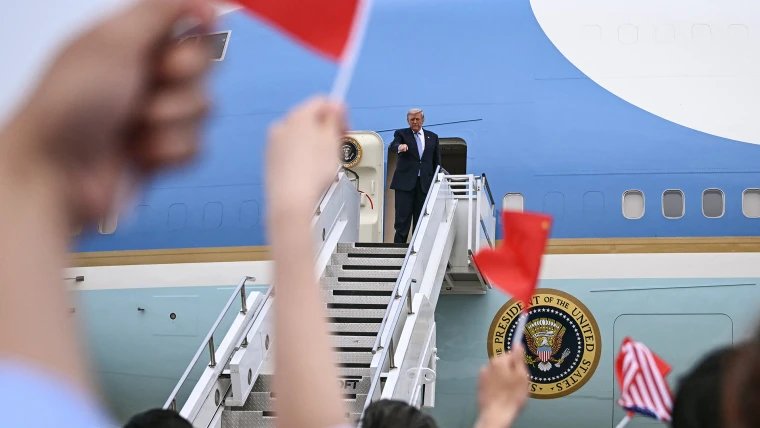
As Donald Trump visits Butler, Pa., today for the first time since he narrowly survived an assassination attempt there, current and former Secret Service agents fear another security lapse.
A dozen current and former US Secret Service agents told NBC News that an increased workload and a lack of sufficient staffing have brought the agency to “a breaking point” and “a state of crisis” that is contributing to errors, a relaxing of protocols, and low morale that could lead to another catastrophic failure.
The concerns come as the agency is under enormous pressure to protect Trump two months after agency security lapses allowed a 20-year-old gunman to fire eight shots at the former president and wound him in the ear.
Two U.S. officials told NBC News that the visit coincides with the Secret Service “redlining,” meaning that staff are pushed to maximum levels and agents are working excessive hours.
“The US Secret Service is killing their people, and worse they are supposed to have a zero-fail protective mission on zero rest/sleep,” said one former agent. “I love my agency but they are setting themselves up for another incident.”
The current agents asked not to be identified because they were not authorized to speak to the media. The former agents said they wished to remain anonymous so they could speak candidly about what they see as a major inflection point for the agency.
The challenges at the Secret Service are well-known throughout federal law enforcement. One law enforcement official told NBC News that the Secret Service is “stretched virtually to the breaking point.”
“I hate to say it, they are going to hit rock bottom fast” said one former Secret Service agent. “This is systemic,” said another.
A senior US Secret Service Official acknowledged the level of concern about the agency and told NBC News, “We are doing everything in our power we can to make sure another security incident does not happen again.”
Anthony Guglielmi, US Secret Service’s chief spokesman, acknowledged the challenges.
“The increasing demand placed on the agency during this dynamic threat environment has resulted in our people being pushed to the limit,” he said in a statement. “We recognize that this is not sustainable, and we cannot risk another mission failure.”
The Secret Service increased its workforce in fiscal 2024 — hiring 1,099 employees, almost double the number of new hires in the two previous fiscal years. A net increase of 186 Special Agents in Fiscal year 2024 reversed two years of net losses.
But the new hires are not enough to stabilize the agency because they need year of training before they can take on high-stakes assignments.
Attrition is also a major issue in the agency and part of a broader trend across law enforcement agencies in the United States.
“Attrition is an epidemic in law enforcement right now at every level,” said one U.S. official.
The combination of higher number of protectees, heightened threat levels, and high levels of attrition has left a workforce that is overextended.
The pressure on the agency has “never been at the magnitude of what they have right now” one former Secret Service leader with decades of service told NBC News.
Paul Eckloff, a former Assistant Special Agent in Charge who oversaw the protection details of President Obama and President Trump, participated in a 2014 panel that examined staffing issues at the Secret Service.
Eckloff said that it found that each protective detail was hundreds of agents short of optimal staffing levels. He shared that he once fell asleep driving home from Camp David after an exhausting work period and feels lucky to be alive.
“I do not place the blame on Secret Service management, because agents and officers have always accepted fatigue is part of the personal sacrifice necessitated by the mission,” he said. “The nature of the job and the mission is such that it will always exist at the bleeding edge of human endurance and capability.”
Guglielmi said that Acting Director Ron Rowe has developed a plan for an agency-wide paradigm shift, “which focuses on increasing and retaining the agency’s personnel, modernizing our technology, and building a training plan that is sustainable.”
Falling asleep
Agents said they had personally witnessed or were aware of agents falling asleep while on the job in recent months and they believed that this reflected dangerous fatigue levels. Other agents said they had not seen or heard accounts of agents falling asleep on duty.
Agents said that they are working excessively long hours and going weeks or even months without a day off. Multiple agents described being “at the end of their ropes,” physically and mentally, including one agent who said they had been going to work sick for several weeks but had not found time to visit a doctor.
“There are mistakes being made,” said a former Secret Service agent who now works with the agency for large events in a private capacity.
At a recent event attended by former President Barack Obama and his detail, the former agent said, it was clear the lack of staffing was taking its toll.
“One member of the former President’s detail said to me, ‘Thank God you are here. You get it,’” the former agent recalled. “I see it, they don’t have the manpower they need. They are short…they don’t have people to do the basics.”
Some agents described crucial paperwork mistakes that have been caught at the last minute. Or agents making wrong movements or second-guessing themselves while on protective duty.
“Tensions are high and lapses of judgment are becoming more frequent,” one agent said. “If something goes wrong, you don’t have time to second guess. Everyone is so tired that you can see it’s taking time to process things and react accordingly.”
Agents retaining lawyers
The awareness of mistakes and potential risk has prompted some agents to retain attorneys on their own. Others are applying for jobs in other law enforcement agencies.
“The smart agents are documenting security issues just to cover themselves,” one former supervisor told NBC News.
Another current agent said they had recently taken out additional personal liability insurance in case they were involved in a security incident. “Everyone’s covering their butts,” said another former agent.
The strain was apparent last month during the United Nations General Assembly in New York, during which the Secret Service provides security for dozens of foreign dignitaries in addition to its own American protectees.
Some current and former agents expressed alarm that standard protocols were being relaxed or not fully followed due to a lack of staffing. Some said they were concerned that names were not being consistently checked against a database of visitors to foreign dignitaries who were considered low-risk.
“It’s a major vulnerability. Best case scenario we let someone close to a dignitary who has a checkered past and that country is embarrassed,” said one former agent. “But could be a disaster.”
The lack of staffing has at times also impacted the staffing of command posts. Agents described being assigned duties that typically would involve multiple people performing specific roles such as security, communications, and backups.
One agent described how a lack of staffing in recent weeks resulted in a single secret service agent handling multiple jobs themselves at a command post.
In other instances, the agency has relied on other law enforcement agencies with significantly less training and experience — such as Homeland Security Investigations —to backfill roles and sometimes entire posts.

Ramping up
As the presidential campaign has ramped up in the final months before the election, the Secret Service has had to provide increased levels of protection to even more individuals. As a result, the typical number of days to prepare in advance has dropped to at best a few days.
“There is a huge security risk because you already have agents that are burnt out, exhausted now having even less time to make a solid security plan and get all assets in order,” one current agent told NBC News, and that has led to “holes” in security plans.
One former Secret Service official said the agency’s failures at Butler reflect an organization that is expected to perform at a level similar to U.S. Navy SEALs. But elite military or law enforcement specialists spend the vast majority of their time training, not on daily active duty.
“The Secret Service is upside down on that, maybe operational 99% and 1% training,” the former official said. “And you do that because you don’t have enough people.”
U.S. officials told NBC News that the threat assessment levels for Trump and Vice President Kamala Harris are at unprecedented highs—from both domestic actors and sophisticated foreign adversaries.
Current and former agents told NBC News that they are also increasingly concerned about the potential for agent compromise, or an insider threat.
“[Leadership] are even more concerned about compromise of an agent — the overwork, the international targeting, it’s just opening pandora’s box,” said one former Secret Service official. “They need to have a serious come to Jesus, war room conversation. They really do.”
Agents said the overwork and fatigue are also creating a resentment toward the agency that could be taken advantage of by foreign intelligence agencies or other adversaries.
“Any morale that may have existed in this agency is just absolutely down the drain; people are really starting to despise this agency,” an agent said. “Unfortunately, I truly wouldn’t be surprised with the state we’re in that agents could become compromised or sell information.”
Current and former officials are also concerned about a mass exodus of Secret Service personnel over the next 18 months. “It is one of the top fears” for leadership, another person familiar with the internal discussions said.
The focus of a new surge hiring task force, according to officials, is to hire and train more “gun carriers,” including special agents, uniformed officers, and other specialized technical units. The Secret Service said it has also dedicated resources to studying emerging technologies to help mitigate staffing needs.
U.S. officials say that the challenges at the Secret Service will require a range of changes to ensure long-term stability.
“When you’re dying on the vine, and you add a little more, you’re still dying on the vine,” said one law enforcement official.