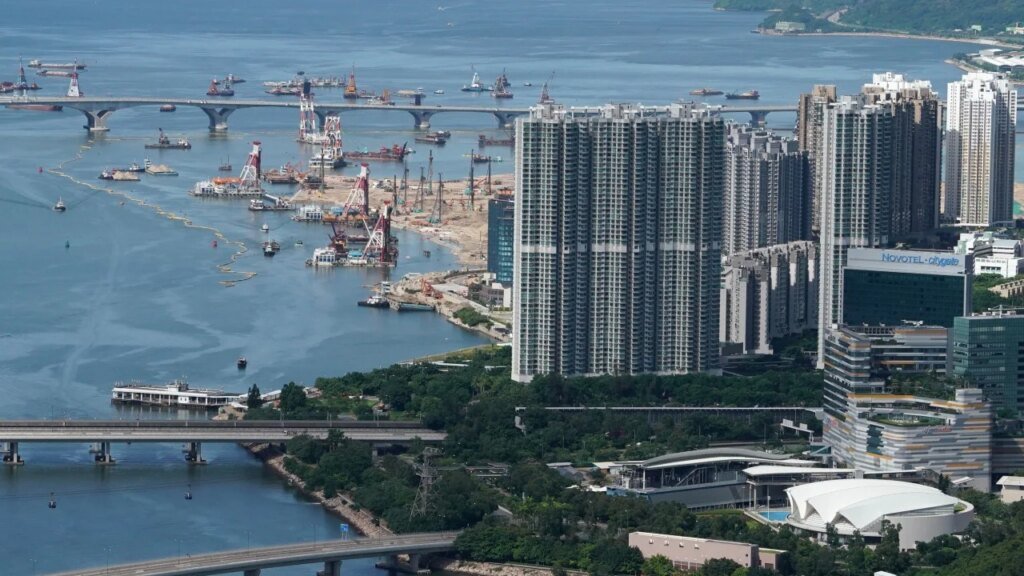
Companies wanting to set up shop in Hong Kong’s proposed innovation hub near the border with mainland China will not be asked to submit detailed design plans to the Town Planning Board for approval, according to a government official who has argued such requirements would reduce the project’s attractiveness.
But a board member on Wednesday questioned the appropriateness of bypassing the statutory body, with green groups also urging the government to improve environmental designs in the 600-hectare (1,483-acre) San Tin Technopole to protect a native otter species categorised as “near threatened” by the International Union for Conservation of Nature (IUCN).
At a public hearing held by the board, Planning Department official Ng Kim-wai said the government could only impose restrictions on sites after it had confirmed which specific companies would set up in the project, half of which has been earmarked for the innovation and technology (I&T) sector.
He said the government would “consult” the board on its “planning and design brief” which lists details of individual sites that corporations should follow in their building designs, but board approval would not be required for the companies to develop their facilities.
“The I&T companies do not specialise in development issues. If we request them to follow [too] many town planning and design restrictions to realise their development, it will reduce the project’s attractiveness,” said Ng, a district planner.
He added the arrangement could provide flexibility and speed up the development process of the I&T facilities, while stressing that a cross-departmental task force would “review” the detailed design of each facility, but that approval by the board should not be a requirement.
But board member Ben Lui Sau-shun questioned if this was an “appropriate procedure” as it could lead to the statutory body being “clueless” about the potential impact of companies’ specific design features.
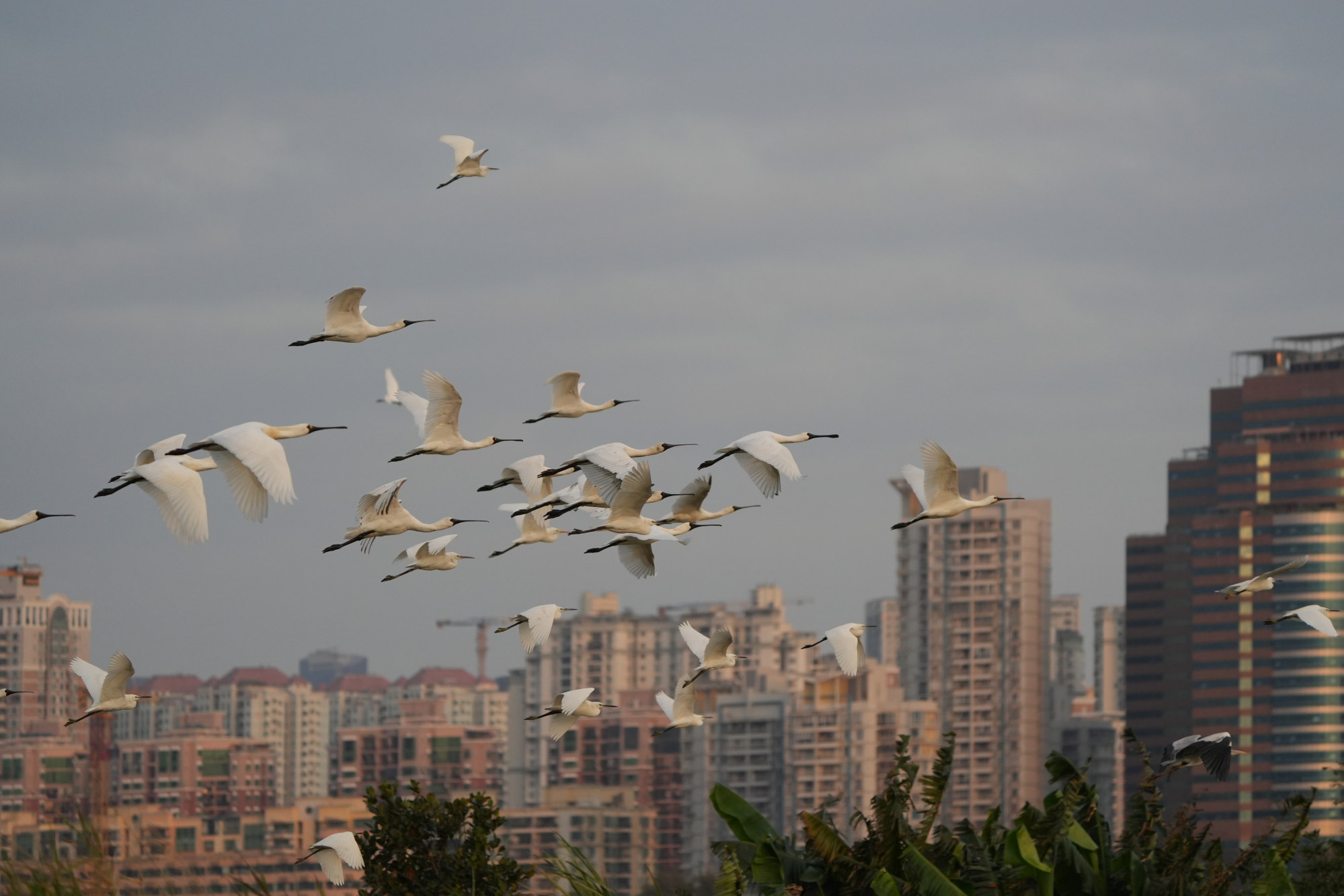
“What if the corporations build many pencil buildings?” Lui asked, referring to tall buildings that could affect air traffic or the flight of wild birds.
The board would be blamed by the public if such plans were allowed to proceed without proper oversight, he argued.
Veteran planner Iris Tam Siu-ying was also dissatisfied with the proposed plan as it only stated the maximum building height and areas where construction was prohibited, without stipulating the parameters of individual sites, such as their maximum gross floor area and greenery coverage.
“[The plan] should provide clear directions, certainty and transparency to all stakeholders, and not just rely on the government’s internal control,” she said.
Tam, a former managing director of the Urban Renewal Authority who now works in the private sector, said such parameters would be crucial to achieving a unique and world-class tech hub, as San Tin also contained features such as wetlands, mountains and rural villages.
Tony Nip, a representative from the Kadoorie Farm and Botanic Garden, raised concerns about the government’s measures to compensate for the environmental loss brought by the project as the plan involved rezoning current wetland areas and filling 90 hectares of fish ponds.
He deemed the 10-metre-wide ecological corridor that would be built to serve as a natural path for wildlife too narrow for Eurasian otters, which are categorised as “near threatened” on the IUCN’s red list.
“If we build a wildlife corridor, let’s do it properly,” he said, noting that it should be 20 metres wide.
Bosco Chan, director of conservation at WWF-Hong Kong, also expressed concerns that a poorly designed corridor would force otters to travel along roads.
He suggested building a 570-metre-long “eco-aqueduct”, an uninterrupted artificial river that would allow otters to avoid roads and swim under traffic intersections.
But Tony Cheung Ka-leung, a project manager in the civil engineering department’s North Development Office, rejected the environmentalists’ ideas.
Given the city’s scarce land resources, the proposed 10-metre-wide corridor was “luxurious”, he said, while the administration was taking additional protective measures by building a fence around it to minimise disturbance to wildlife.
He also dismissed the suggestion of an aqueduct, saying it would cost “billions of dollars” and be too expensive.