US and China hold first informal nuclear talks in 5 years, eyeing Taiwan

The United States and China resumed semi-official nuclear arms talks in March for the first time in five years, with Beijing’s representatives telling U.S. counterparts that they would not resort to atomic threats over Taiwan, according to two American delegates who attended.

The Chinese representatives offered reassurances after their U.S. interlocutors raised concerns that China might use, or threaten to use, nuclear weapons if it faced defeat in a conflict over Taiwan. Beijing views the democratically governed island as its territory, a claim rejected by the government in Taipei.

“They told the U.S. side that they were absolutely convinced that they are able to prevail in a conventional fight over Taiwan without using nuclear weapons,” said scholar David Santoro, the U.S. organizer of the Track Two talks, the details of which are being reported by Reuters for the first time.

Participants in Track Two talks are generally former officials and academics who can speak with authority on their government’s position, even if they are not directly involved with setting it. Government-to-government negotiations are known as Track One.

Washington was represented by about half a dozen delegates, including former officials and scholars at the two-day discussions, which took place in a Shanghai hotel conference room.

Beijing sent a delegation of scholars and analysts, which included several former People’s Liberation Army officers.
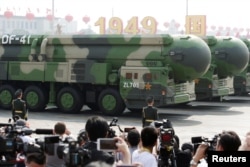
FILE - Military vehicles carrying DF-41 intercontinental ballistic missiles travel past Tiananmen Square during the military parade, Beijing, China, Oct. 1, 2019.

FILE – Military vehicles carrying DF-41 intercontinental ballistic missiles travel past Tiananmen Square during the military parade, Beijing, China, Oct. 1, 2019.

A State Department spokesperson said in response to Reuters’ questions that Track Two talks could be “beneficial.” The department did not participate in the March meeting though it was aware of it, the spokesperson said.

Such discussions cannot replace formal negotiations “that require participants to speak authoritatively on issues that are often highly compartmentalized within (Chinese) government circles,” the spokesperson said.

Members of the Chinese delegation and Beijing’s defense ministry did not respond to requests for comment.

The informal discussions between the nuclear-armed powers took place with the U.S. and China at odds over major economic and geopolitical issues, with leaders in Washington and Beijing accusing each other of dealing in bad faith.

The two countries briefly resumed Track One talks over nuclear arms in November but those negotiations have since stalled, with a top U.S. official publicly expressing frustration at China’s responsiveness.

The Pentagon, which estimates that Beijing’s nuclear arsenal increased by more than 20% between 2021 and 2023, said in October that China “would also consider nuclear use to restore deterrence if a conventional military defeat in Taiwan” threatened CCP rule.

China has never renounced the use of force to bring Taiwan under its control and has over the past four years stepped up military activity around the island.

The Track Two talks are part of a two-decade nuclear weapons and posture dialog that stalled after the Trump administration pulled funding in 2019.

After the COVID-19 pandemic, semi-official discussions resumed on broader security and energy issues, but only the Shanghai meeting dealt in detail with nuclear weapons and posture.

Santoro, who runs the Hawaii-based Pacific Forum think-tank, described “frustrations” on both sides during the latest discussions but said the two delegations saw reason to continue talking. More discussions were being planned in 2025, he said.

Nuclear policy analyst William Alberque of the Henry Stimson Centre think-tank, who was not involved in the March discussions, said the Track Two negotiations were useful at a time of glacial U.S.-Chinese relations.

“It’s important to continue talking with China with absolutely no expectations,” he said, when nuclear arms are at issue.

No first-use?

The U.S. Department of Defense estimated last year that Beijing has 500 operational nuclear warheads and will probably field more than 1,000 by 2030.

That compares to 1,770 and 1,710 operational warheads deployed by the U.S. and Russia respectively. The Pentagon said that by 2030, much of Beijing’s weapons will likely be held at higher readiness levels.

Since 2020, China has also modernized its arsenal, starting production of its next-generation ballistic missile submarine, testing hypersonic glide vehicle warheads and conducting regular nuclear-armed sea patrols.

Weapons on land, in the air and at sea give China the “nuclear triad” – a hallmark of a major nuclear power.

A key point the U.S. side wanted to discuss, according to Santoro, was whether China still stood by its no-first-use and minimal deterrence policies, which date from the creation of its first nuclear bomb in the early 1960s.

Minimal deterrence refers to having just enough atomic weapons to dissuade adversaries.

China is also one of two nuclear powers – the other being India – to have pledged not to initiate a nuclear exchange. Chinese military analysts have speculated that the no-first-use policy is conditional – and that nuclear arms could be used against Taiwan’s allies – but it remains Beijing’s stated stance.

Santoro said the Chinese delegates told U.S. representatives that Beijing maintained these policies and that “‘we are not interested in reaching nuclear parity with you, let alone superiority.'”

“‘Nothing has changed, business as usual, you guys are exaggerating’,” Santoro said in summarizing Beijing’s position.

His description of the discussions was corroborated by fellow U.S. delegate Lyle Morris, a security scholar at the Asia Society Policy Institute.

A report on the discussions is being prepared for the U.S. government but would not be made public, Santoro said.

Risk and Opacity

Top U.S. arms control official Bonnie Jenkins told Congress in May that China had not responded to nuclear-weapons risk reduction proposals that Washington raised during last year’s formal talks.

China has yet to agree to further government-to-government meetings.

Bejing’s “refusal to substantively engage” in discussions over its nuclear build-up raises questions around its “already ambiguous stated “no-first-use” policy and its nuclear doctrine more broadly,” the State Department spokesperson told Reuters.

China’s Track Two delegation did not discuss specifics about Beijing’s modernization effort, Santoro and Morris said.

Alberque of the Henry Stimson Centre said that China relied heavily on “risk and opacity” to mitigate U.S. nuclear superiority and there was “no imperative” for Beijing to have constructive discussions.

China’s expanded arsenal – which includes anti-ship cruise missiles, bombers, intercontinental ballistic missiles and submarines – exceeded the needs of a state with a minimal deterrence and no-first-use policy, Alberque said.

Chinese talking points revolved around the “survivability” of Beijing’s nuclear weapons if it suffered a first strike, said Morris.

The U.S. delegates said the Chinese described their efforts as a deterrence-based modernization program to cope with developments such as improved U.S. missile defenses, better surveillance capabilities, and strengthened alliances.

The U.S., Britain and Australia last year signed a deal to share nuclear submarine technology and develop a new class of boats, while Washington is now working with Seoul to coordinate responses to a potential atomic attack.

Washington’s policy on nuclear weapons includes the possibility of using them if deterrence fails, though the Pentagon says it would only consider that in extreme circumstances. It did not provide specifics.

One Chinese delegate “pointed to studies that said Chinese nuclear weapons were still vulnerable to U.S. strikes – their second-strike capability was not enough,” said Morris.


Source link

Visited 1 times, 1 visit(s) today

Related Article

Nvidia’s trillion-dollar run puts pressure on the bulls

BEIJING, CHINA – MAY 14: Nvidia CEO Jensen Huang (C) gestures as he prepares to depart following a welcome ceremony at the Great Hall of the People on May 14, 2026 in Beijing, China. President Trump is meeting with President Xi Jinping in Beijing to address the Iran conflict, trade imbalances, and the Taiwan situation

Permutations in Europe: What’s still at stake in final weeks of season?

There’s still plenty to play for across Europe as we head into the final matches of the club season. Here are all the title races, Champions League fights, and relegation battles left to be decided in the top leagues this month. This story will be updated until the end of the campaign. 👉 Jump to:EPL

Brewing a Better Half-Gallon Batch

Today I finally ran an experiment I’ve wanted to try for a long time. If you’re a professional barista—or you run a busy café—this may save you some time. Most coffee shops use 1–1.5 gallon batch brewers (Bunn, Curtis, Fetco, etc.). When I opened Short Sleeves Coffee, I intentionally avoided brewing full 1-gallon batches. I

5 Frozen Breakfasts Chefs Say Keep You Full All Morning

Chef-approved frozen breakfasts with more protein and better ingredients. Eating a healthy breakfast every morning is a great way to start the day, but most people don’t have time to cook. Whether you’re rushing out the door in the morning for work, taking the kids to school or both, there’s usually not much time in

CA scales back plan to ban student use of cell phones

By Carolyn Jones, CalMatters This story was originally published by CalMatters. Sign up for their newsletters. Until last month, California was poised to join nearly a dozen other states that ban cell phones in K-12 schools. But under pressure from school boards and administrators, lawmakers scaled back a bill that would have required such a

BulkQuant Launches AI Trading Bot for Crypto, Forex, and Stock Markets

BulkQuant Launches AI Trading Bot for Crypto, Forex, and Stock Markets

London, United Kingdom, May 15, 2026 (GLOBE NEWSWIRE) — BulkQuant has officially launched its AI trading bot platform designed for crypto, forex, and stock market traders seeking a simpler way to automate trading strategies across multiple financial markets. The platform combines AI-powered quantitative analysis, automated trade execution, portfolio monitoring, and adaptive risk management into a

IMF lauds resilient Hong Kong economy but warns of risks linked to Middle East war

IMF lauds resilient Hong Kong economy but warns of risks linked to Middle East war

The International Monetary Fund (IMF) has lauded the resilience of Hong Kong’s economy, noting a sustained recovery despite economic activity having yet to return to pre-Covid levels, while warning of downside risks stemming from escalating geopolitical tensions. It also urged Hong Kong to pursue medium-term financial reforms, including the introduction of a goods and services

Smithsonian Presidents Exhibit Reopens With Low-Key Trump Impeachment Mention

For the past year, the Smithsonian Institution has found itself in the awkward position of telling the nation’s story while being supported in part by a government that wants to narrow how that story is told. In December, the White House threatened to revoke funding to the institution if it did not hand over a

Marvel’s Daredevil Follow-up Is Already Dominating on Streaming

A follow-up to Daredevil: Born Again Season 2 on Disney+ has become a massive streaming success within days of its launch. The Punisher: One Last Kill has quickly climbed to the top of multiple charts, beating out other titles on the platform. The MCU television special follows the gun-toting vigilante, who finds himself targeted by

Is Now a Bad Time to Invest?

The market has been on a roll lately, with the S&P 500 (SNPINDEX: ^GSPC) setting new highs throughout May. If you think you missed your opportunity when the market bottomed in late March, don’t fret. The market hitting new all-time highs is not particularly rare and should not change your investment strategy. And if you

6 bids for Hong Kong land sale signal renewed confidence despite market caution

6 bids for Hong Kong land sale signal renewed confidence despite market caution

The Hong Kong government’s first land sale in the current financial year has drawn six bids, according to the Development Bureau, including those from the city’s largest developers, suggesting a more confident outlook for the residential property market. At the close of tender for Tung Chung Town Lot No 54 at Area 106A on Friday

Each Premier League team reranked: Man City rise; Chelsea, Liverpool collapse

Ryan O’Hanlon Close Ryan O’Hanlon ESPN.com writer Ryan O’Hanlon is a staff writer for ESPN.com. He’s also the author of “Net Gains: Inside the Beautiful Game’s Analytics Revolution.”  and  Bill Connelly Close Bill Connelly ESPN Staff Writer Bill Connelly is a writer for ESPN. He covers college football, soccer and tennis. He has been at

Trump departs China after two-day summit

Trump departs China after two-day summit

IE 11 is not supported. For an optimal experience visit our site on another browser. Trump Wraps China Summit With Xi Jinping: What Are the Results? 05:41 Xi gives Trump rare tour of secret garden at heart of Chinese government 01:04 Now Playing Trump departs China after two-day summit 01:01 UP NEXT Special Report: Trump

Carol Chow was facing a bankruptcy petition by five people over unspecified debts at the time of her death. Photo: Dickson Lee

Embattled Hong Kong developer sued for HK$130 million, days after founder’s death

A Hong Kong property developer has been sued for HK$130 million (US$16.6 million) over allegedly breaching guarantor obligations in two bond subscription agreements, becoming the latest lawsuit to implicate the embattled company and following its founder’s sudden death earlier this week. Lofter Group, known for its urban renewal projects across the city’s core districts, and

Trump’s China visit left chip export issue unresolved

This report is from this week’s The Tech Download newsletter. Like what you see? You can subscribe here. One look at the roster of U.S. execs that cozied up to U.S. President Donald Trump on the 20+ hours flight from Alaska to China on Wednesday and you get a sense of the American delegation’s key focus

Why the Cerebras IPO matters for the AI race with China

Why the Cerebras IPO matters for the AI race with China

Cerebras, an AI chipmaker, saw its shares nearly double on Nasdaq, closing up 70% with a $95B market cap. Cerebras’s powerful chips are key in the US-China AI tech race. Chris Buskirk, co-founder and chief investment officer of 1789 Capital, a key Cerebras investor, says the company’s IPO is geopolitically significant. On Thursday, shares of

Fitbit Air vs Whoop Strap Comparison: Price, Features and AI

The Google Fitbit Air is very much the talk of the fitness tracking town right now, not only because it’s the first new Fitbit device that we’ve had in years, but it’s also one of the first big brands to go head-to-head with the established Whoop Strap (if you don’t count the Polar Loop and

0
Would love your thoughts, please comment.x
()
x