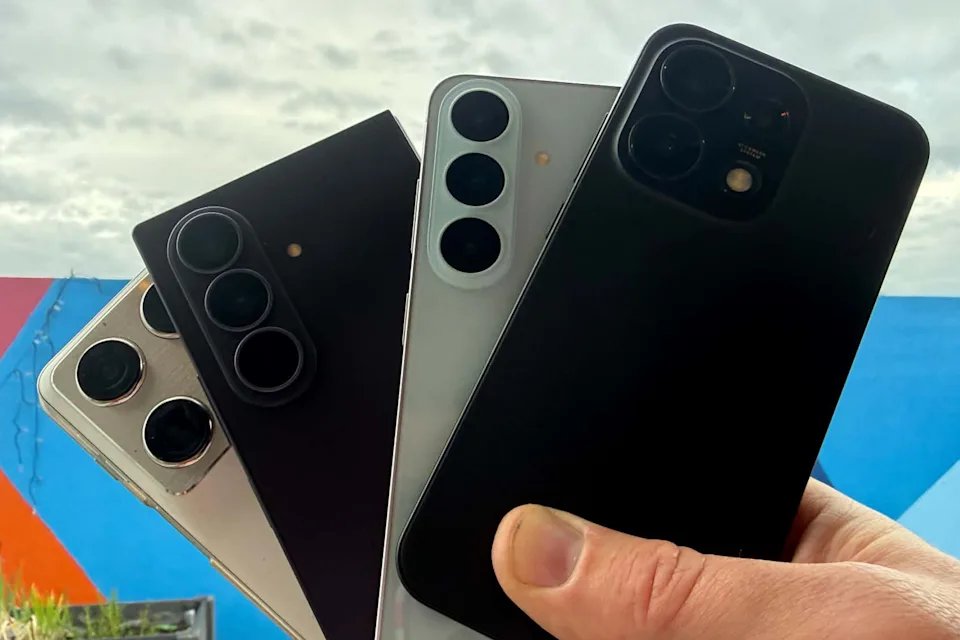
Apple iPhone 18 Pro & iPhone 18 Pro Max
Our verdict
The iPhone 18 Pro and iPhone 18 Pro Max’s new camera features make them a fun upgrade for shutterbugs, but the higher price and otherwise incremental updates mean others might be better served by a cheaper device.
From $2,099 RRP
What we love
- Fun camera upgrades
- Excellent battery life
What could be improved
- More expensive
- Heavier than previous models
The essentials
As snappy as you’d hope for phones this expensive.
Excellent. Expect as much as seven hours of screen time on the iPhone 18 Pro and as many as ten on the iPhone 18 Pro Max.
Brilliant! No notes.
An excellent camera configuration that’s now a bit more versatile thanks to variable aperture and a bit more fun thanks to new Photographic Styles.
The iPhone 18 Pro and iPhone 18 Pro Max make a series of meaningful year-on-year improvements that end up feeling small. The new variable aperture camera will impress shutterbugs, but isn’t as meaningful as last year’s new zoom lens. 40% faster sustained performance is sick, but you’re rarely going to notice this day-on-day. I’m certainly not going to argue against even larger batteries, but they have made the iPhone 18 Pro and iPhone 18 Pro Max heavier.
While the iPhone 18 Pro and iPhone 18 Pro Max are undeniably Apple’s most accomplished devices yet, they harken back to the “S” years. More incremental updates that follow major ones. The iPhone 17 Pro and iPhone 17 Pro Max had improvements across almost every front, and introduced a new design. The iPhone 18 Pro and iPhone 18 Pro Max build on that, but don’t have the same wow factor.
Obviously most of us don’t buy an iPhone every year, and if you’re coming from an iPhone 15 or older, the iPhone 18 Pro and iPhone 18 Pro Max will still feel like a huge upgrade. But when you factor in price increases and how damn good last year’s phones were, it’s worth asking if you need the newest model.
A “pro”er camera

The most notable new feature on the iPhone 18 Pro and iPhone 18 Pro Max is variable aperture. How much you appreciate the new devices almost comes down to how much of a camera nerd you are. If you understand the phrase “variable aperture”, that’s a good start.
If you don’t, variable aperture means the main camera on iPhone 18 Pro models is much more in line with a DSLR lens. Aperture refers to how open the camera lens is, but most mobile cameras have traditionally not been able to change that. They were fixed at one aperture. The iPhone 18 Pro models can cycle between four apertures. When the lens is more open, it can let in more light for better nighttime photography and give you a nice shallow focus background. When it’s more closed, it narrows the depth of field for more consistent focus across the shot.
Out of the box, the iPhone 18 Pro and iPhone 18 Pro Max automatically select the aperture they think will work best for the situation. It isn’t something you necessarily need to think about, but it can still improve your photos. I was taking photos at a gig the other weekend, and the faster aperture led to more consistent shots from the primary camera. Since it is taking in more light, you get a faster shooting time, and as such, less chance for blur or movement to impact the shot. This helps low-light photography across the board.

You also have the option of manually setting your aperture, however. Here’s a shot with the aperture set to f/1.4, which is as wide open as it gets:

And here’s a shot with the aperture set to f/4, which is as closed as it gets:

In the first shot, you can see the speaker in the background is blurry, while it is much sharper in the second. It’s the same with the pillow behind my dog.
Dropping down to f/4 also makes lights create a nifty star effect. It does, however, make low-light photos take longer to shoot, so this risks creating motion blur, but when the shot turns out, it looks pretty cool.

On top of aperture, the iPhone 18 Pro and iPhone 18 Pro Max give you manual control over shutter speed and white balance. While apps like Halide have given iPhone users more advanced photography options for yonks now, it’s nice to see this come to the default camera app.
Shutter speed relates to how long the shutter stays open when taking a photo. A shorter shutter speed lets in less light, but captures a subject faster. A longer shutter speed lets in more light, but it takes longer to capture a photo. The iPhone 18 Pro family lets you max out the shutter speed at one second, which is long enough to experiment with light painting style effects. On the shot below, I whipped my phone up just as the one second had almost expired.

White balance isn’t quite as exciting; it’s a camera setting that ensures white looks white, even if a light source is tinting it. By default, iPhones have automatically white-balanced photos, but choosing a manual option allows for more creative control and consistency between shots.

There are also some changes on the software front; my favourite are the new texture and grain controls as part of Photographic Styles. There are three different texture options, all with an intensity slider: they let you soften skin, create a subtle glow, or add a film look. Grain controls are binary; you can either switch grain on or off. It would have been nice to adjust the amount of grain, so hopefully that’s the kind of thing Apple will add in a future software upgrade.
While the textures can be subtle, when combined with the palette styles, you can get really striking results. I’ve really enjoyed playing around with the “dramatic + film” combination. Here’s the shot with no Photographic Styles attached:

And here’s the shot with “dramatic + film” added. From a technical level, it looks worse, but it’s a much more interesting image.

I’ve also enjoyed using the “stark black and white + film” style, which has been a great way to salvage live music shots that didn’t turn out quite the way I’d hoped, like the image below.

If you shoot in Apple’s out-of-the-box HEIC format, you can also apply Photographic Style after you shoot an image, so it’s easy to play around with combinations. HEIC also lets you remove a Photographic Style if you’d prefer the base image instead. On top of Apple’s presets, you can make your own custom looks, but you’re only able to save one preset of your own. It would be nice to have a few slots to play with.
Overall, the iPhone 18 Pro and iPhone 18 Pro Max camera upgrades aren’t a day-and-night upgrade. The ultra-wide and zoom lenses are unchanged, and the new features are more about versatility and creativity rather than a pure increase in quality.
iPhone 18 Pro camera samples
Check out these camera samples taken on the iPhone 18 Pro and iPhone 18 Pro Max. Click or tap on any photo to see a larger version.
Bigger batteries, heavier phones

Apple has once again kitted the iPhone 18 Pro and iPhone 18 Pro Max out with bigger batteries.
On the iPhone 18 Pro, I was able to get between six and seven hours of screen time. That’s pretty similar to what I was getting on the iPhone 17 Pro, but still enough for a full day of moderate usage with a very comfortable buffer.
On the iPhone 18 Pro Max, I was typically getting between eight and ten hours of screen time per charge. That’s easily enough for two days of moderate usage, which is about an hour more than I was seeing on the iPhone 17 Pro Max.
While even longer battery life can almost feel like a diminishing return, with most of us charging every night anyway, it’s still nice to have for edge cases. Long flights, all-day music festivals where congested networks can impact battery life, or just days where you’re going ham on the camera.
The extra battery life on Apple’s new handsets has made them heavier, however. The iPhone 18 Pro weighs 211g, up from 204g, while the iPhone 18 Pro Max weighs 249g, up from 231g. The difference isn’t massive on the iPhone 18 Pro, but I can definitely feel the added heft on the iPhone 18 Pro Max.
The other notable physical change is a smaller Dynamic Island, which allows it to show three Live Activities at once. In over a week of testing, I didn’t end up in situations where this actually kicked in, but this could be handy if you’re a friend for Live Activities.

On the performance front, the iPhone 18 Pro and iPhone 18 Pro Max represent another increase in performance. Apple says the A20 Pro’s CPU is up to 20% faster when compared to the iPhone 17 Pro’s A19 Pro, and the GPU is up to 40% faster. Those year-on-year improvements translate to a snappier day-to-day experience. Regular apps open a fraction of a second faster, and the extra performance helps shave some load time from games.
Lastly, there’s a matter of cost. The iPhone 18 Pro and iPhone 18 Pro Max are either a little or a lot more expensive, depending on how much storage you’re after. You’re looking at a $100 price increase on the 256GB and 512GB models. For the iPhone 18 Pro, that means a $2,099 starting price. That jumps to $2,299 for the iPhone 18 Pro Max.
But if you’re looking at higher-end models, the year-on-year price increase is $500 for 1TB and $900 for 2TB. A 1TB iPhone 18 Pro Max costs $3,499, which is the same price as an iPhone Duo. A 2TB model will set you back a ludicrous $4,699. If you’re in the market for a new iPhone, there’s never been a better argument for trying to make do with 256GB or 512GB.
What’s old might be new

If you haven’t upgraded your iPhone for a few years, there are a few other iPhone 18 Pro and iPhone 18 Pro Max features worth calling out. They’re not new, but they might be new to you.
Action Button: Introduced with the iPhone 15 Pro, the Action Button replaces the old mute switch found on previous models. By default, it still works as a mute switch, but it’s a lot more flexible. Out-of-the-box options that let you use the Action Button to open the camera, start a voice memo, or toggle the torch, but you can also use it to trigger a Shortcut. If you want to go down a rabbit hole, Shortcuts on the Action Button allow for a very deep level of customisation.
USB-C: Apple moved from Lightning to USB-C with the iPhone 15 family. If you’ve got an iPhone 14 or older, this means you’ll now have to charge with a USB-C cable when you upgrade to the iPhone 18 Pro or iPhone 18 Pro Max. There is a USB-C cable in the box, however.
Camera Control: Introduced on the iPhone 17 family, Camera Control is a new “button” for taking photos. While you can click the Camera Control button, it also acts like a tiny trackpad and scrolling back and forth across it allows functionality like zoom. I’m too used to taking photos the “classic” way, and have mostly only used Camera Control by accident outside of testing, but some – like my colleague Dylan – may like a more tactile photography option.
Anti-reflective display and Ceramic Shield 2: Last year, Apple added an anti-reflective coating to the iPhone 17 Pro and iPhone 17 Pro Max. The coating prevents the sun and other bright lights from causing glare or impacting readability, and also reduces the “black mirror” effect you get when you look at your device’s screen with nothing on. This is paired with Ceramic Shield 2 protection, which Apple says makes the displays three times more scratch-resistant than the previous Ceramic Shield protection. In practice, this genuinely makes a difference. While my iPhone 16 Pro Max had a couple of micro abrasions after a year of use, my iPhone 17 Pro Max screen still looks good as new.
Centre Stage selfie camera: Every 2025 iPhone benefitted from a new “Centre Stage” selfie camera, backed by a unique 18MP square sensor. This allows you to take landscape selfies when holding the phone vertically and vice versa. It’s a neat trick and a solid camera.
iPhone 18 Pro & iPhone 18 Pro Max – Final Thoughts

The iPhone 18 Pro and iPhone 18 Pro Max are a refinement of last year’s top-end models, adding creative camera features, a bit of extra grunt, and longevity to an already excellent base. If you’re a photography nerd, you’ll appreciate the camera upgrades. Between the film-like Photographic Styles, variable aperture, and proper manual controls, I don’t think I’ve had as much fun taking and editing photos on an iPhone.
But if that doesn’t sound like you, you could consider just getting one of last year’s Pro models at a discount while they’re still available. The iPhone 17 Pro is easy to find at $1,799, which is $300 cheaper than the iPhone 18 Pro. While it’s always neat to own the latest and greatest, last year’s top devices are more than good enough that you won’t be left wanting.
Alex Choros

Read full bio