Illustration: Liu Xiangya/GT
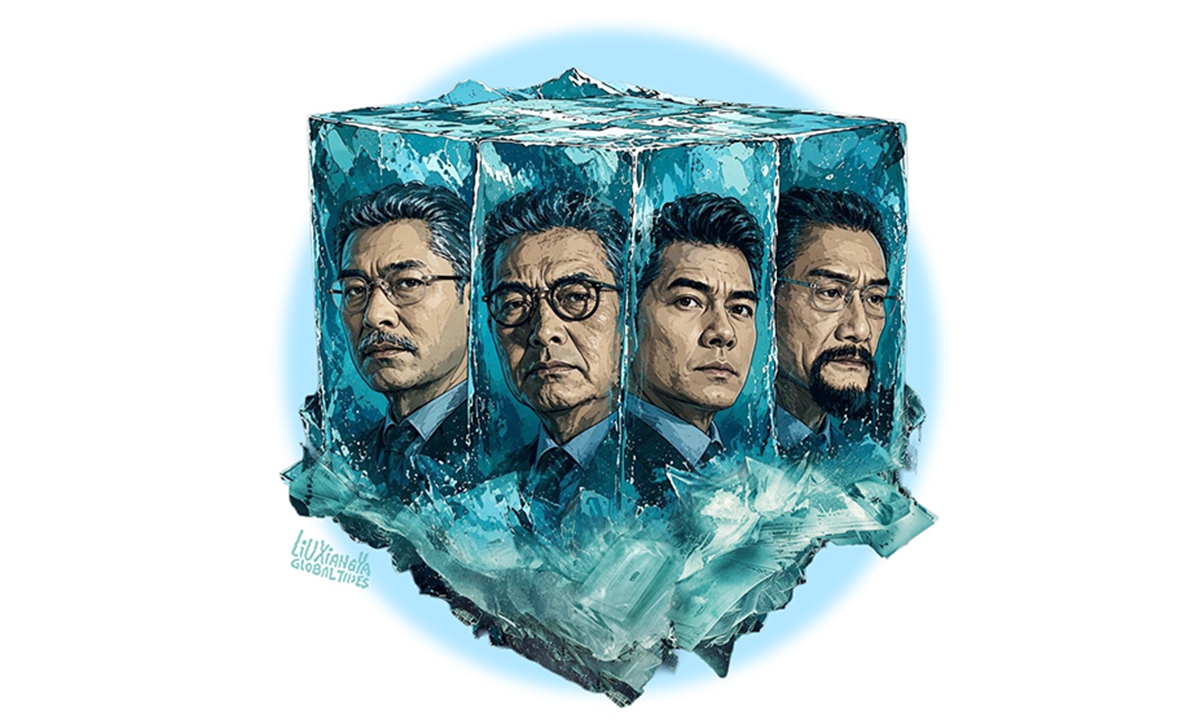
As a prequel to an iconic Hong Kong film franchise, Cold War 1994 has attracted widespread attention since its release during the May Day holidays, not merely for its star-studded cast including Daniel Wu, Tony Leung Ka Fai, Chow Yun Fat, Aaron Kwok and Louis Koo, but more for its in-depth portrayal of a critical transitional period in Hong Kong’s history.
Set in 1994, a year of political and social flux before Hong Kong’s return to China, the film uses a tycoon kidnapping case as a thread to unfold the complex power struggle among British authorities, the Hong Kong Police Force, local tycoons and entrenched triad societies, offering a window into the city’s past and reflecting its evolving fate.
In a recent interview with the Global Times, Hong Kong director Longman Leung Lok-Man shared insights into the film’s creation, emphasizing that choosing 1994 as the story’s starting point was an inevitable extension of the “Cold War” universe.
“At the end of Cold War (2012), a character mentioned a perfect undercover operation in 1995, where the Hong Kong Police dismantled a triad network, with the core figure being Lee Man-bun, played by Tony Leung Ka-fai,” he said, adding that 1994 was an indispensable starting point to tell the full story.
He noted that the first two Cold War films – Cold War (2012) and Cold War 2 (2016), established the skeleton of characters like Lee Man-bun and Choi Yuen-ki (played by Daniel Wu), while the prequel fills – Cold War 1994 and Cold War 1995 – in their flesh and blood, revealing the origins of their wisdom and struggles.
With Cold War 1995 already shot and in post-production, Leung confirmed the second part of the prequel will be released in 2026.
The film’s kidnapping plot taps into public fascination with the wave of high-profile abductions that shadowed 1990s Hong Kong, cases often shrouded in secrecy as wealthy families refused to involve authorities. The team collected volumes of lore from old tabloid reports and whispered accounts.
“We drew from multiple stories, not a real case. And the best ones were those where the parties never confirmed or denied anything,” he said, adding that silence can be a kind of truth as it leaves room for art.
Leung stressed that 1994, a year marked by security and political changes before the 1997 handover, is central to the film’s theme of “choices,” each character’s decision on the eve of a new era with no black-and-white roles, only people struggling with power, interests and faith.
He noted that Lee Man-bun, who has no specific real-life prototype, embodies an ideal man: loyal, responsible and resilient.
“Lee Man-bun is not a perfect hero. He makes mistakes, he doubts himself, and he suffers. But what makes him admirable is that he never loses his moral compass, even when everything around him is falling apart. I want audiences to see that in times of uncertainty, it’s our choices that define us,” Leung said. He added that the film’s exploration of human nature is what sets it apart from other action films.
As of Sunday, Chinese ticketing platform Maoyan shows that the film has grossed over 200 million yuan ($29 million) in the Chinese mainland, with a 7.2/10 score on Chinese review platform Douban.
After its release, many Hong Kong film buffs said they found it exhilarating, but some viewers say the perspectives are too fragmented, while the other roles feel somewhat thinly drawn.
Beyond the film itself, experts say Cold War 1994 reflects the evolution of Hong Kong’s gangster films and the city’s historical and social changes.
Dong Ming, a film critic, told the Global Times that Hong Kong’s unique gangster films originate from its distinctive history, society and culture.
“The colonial judicial system, gang grievances, bureaucratic corruption and political games provided rich materials for Hong Kong films set before the handover,” he said.
From early realistic works like Anti-Corruption (1975) reflecting social inequalities to the action-comedy explosion of the 1980s and 1990s in Hong Kong represented by Jackie Chan’s Police Story series, and then to the identity questioning of Infernal Affairs, Hong Kong gangster films have been closely linked to the city’s development.
Zheng Chuanwei from the Hong Kong Film Critics Society commented in Vogue Hong Kong that the themes of “brotherhood” and “corrupted undercover agents” in Hong Kong gangster films, which appeared in early works like PTU series and Cop on a Mission, have evolved in the Cold War series to include office struggles, parliamentary politics and even the behind-the-scenes institutions of the British colonial period. This shows the creators’ ambition and highlights the true essence of Hong Kong films.
Jeffery Chan, a guest professor at Hong Kong Commerce and Industry Associations, noted that Cold War 1994 goes beyond the traditional entertainment framework of Hong Kong gangster films such as gunfights and chases.
“With the sensitive era of the 1994 handover countdown as the narrative background, the film uses a confusing kidnapping case to uncover the political conspiracies, power struggles and interest entanglements in the late British colonial rule,” he said, adding that the film not only tells the grievances and transformations of the police characters, but also records the unique history of the transition from colonial rule to handover of China’s Hong Kong, allowing people to understand “both the power games in the film and the real fate of Hong Kong, from chaos to order and prosperity today.”
The author is a reporter with the Global Times. life@globaltimes.com.cn