For the Second Time in History, the Stock Market Sends a Rare Warning Signal and Points to Looming Trouble Ahead

The S&P 500 (^GSPC -0.10%) has been indomitably bullish for four years. Nothing has successfully slowed down this bull market: tariffs, a war, or even an interest rate hike. And yet, below the surface, warning signs are sounding from every corner.

Earlier this month, analysts at MarketWatch astutely observed that 44% of S&P 500 stocks were in bear-market territory. In other words, more than two-fifths of the S&P 500’s stocks were trading at least 20% below their 52-week high. Around 24% were down at least 30%, 8% of the index was below 40%, and 3% were down a whopping 50%.

The S&P 500, in other words, may look healthy and strong as an index, yet nearly half of its companies are struggling individually. Put differently, the market’s impressive performance is masking its weaknesses, with only a handful of stocks truly driving the rally.

This observation coincides with a valuation signal, one that has been uncannily flashing now for at least five consecutive months.

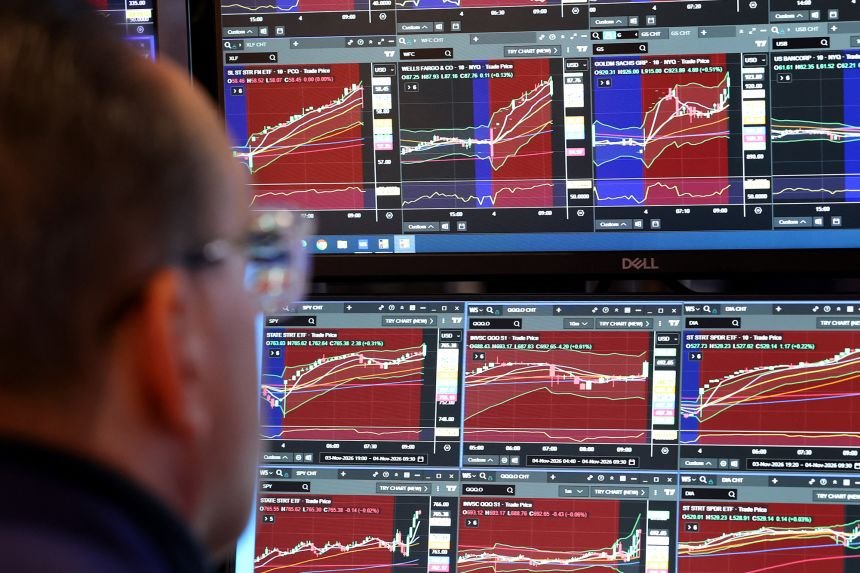
Image source: Getty Images.

Beneath the bull market’s spectacular run, a warning from history

The Shiller price-to-earnings (P/E) ratio, also known as the cyclically adjusted P/E ratio (CAPE ratio), is a valuation tool that helps us determine if stocks are expensive or cheap relative to their earnings.

Higher CAPE ratios mean the market is expensive by historical standards, while lower ones mean the opposite. The average CAPE over the last 155 years is about 18. Today, the CAPE has crossed the 40-figure line for only the second time in history.
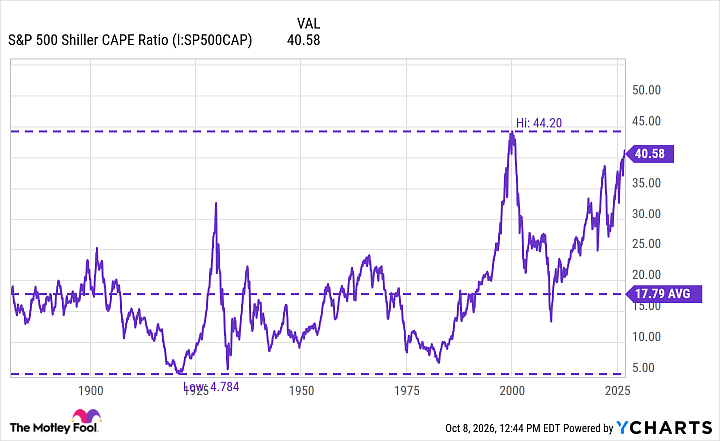
S&P 500 Shiller CAPE Ratio Chart

Data by YCharts

The CAPE doesn’t predict market crashes; it’s just a valuation metric. At the same time, it offers a pretty clear warning: When stocks become extraordinarily expensive, they tend not to stay that way for long. The last time the S&P 500’s CAPE ratio climbed above 40 (in 1999), a devastating bear market followed.

History has a reassuring message

Stock market crashes take on mythical dimensions: They can feel apocalyptic. Even bull markets can feel invincible in the moment, as though nothing could bring them to an end. But they do: No bear or bull market has ever lasted forever.

Here’s the thing: Bear markets, market corrections, and crashes are all normal parts of investing in the stock market. Since 1990, the S&P 500 has experienced at least 17 corrections and bear-market downturns, according to historical data from Charles Schwab. Some were relatively mild; others, like the dot-com crash, erased nearly half the index’s value. But like every other bear market in the history of the stock market, they eventually came to an end.

If the CAPE ratio signals the approach of another bear market, it’s best to keep a long-term perspective. Trying to predict when stocks will fall — or when they’ll rebound — is a losing game. But buying high-quality companies and holding them through ups and downs has historically been a winning strategy for most investors.

Source link

Visited 1 times, 1 visit(s) today

Related Article

Micron (MU) Stock Looks Near Fair Value Despite AI Optimism

Micron Technology has delivered a very large three year gain for shareholders, even after a sharp pullback in recent weeks. This puts the focus squarely on whether the current share price lines up with the cash the business is expected to generate. With Micron now closely tied to long term AI memory demand stories in

Prediction: Nov. 6 Will Be a Huge Day for the Stock Market

Over the last few years, the stock market has become concentrated among a relatively small cohort of technology companies. These companies have an unusually strong influence over the direction of the S&P 500 (^GSPC +1.58%), making investor sentiment toward artificial intelligence (AI) particularly important to the broader market’s performance. As of Nov. 3, a little

Why SpaceX Stock Is Down Today

Space Exploration Technologies Corp. (NASDAQ:SPCX) stock is down 5.3% as of 2:53 p.m. ET on Wednesday, Nov. 4, after Democrats swept the midterm elections that Elon Musk spent heavily trying to swing the other way. The S&P 500 and the Nasdaq Composite are both up 1.7%. Missed Nvidia in 2009? This Rare Signal Is Flashing

AMD stock flat following strong Q3 earnings beat, as data center revenue climbs 97%

AMD (AMD) stock was flat after the company reported better-than-anticipated top and bottom lines Q3 results after the Tuesday. The company said its data center revenue exploded 97% year-over-year driven by server sales. “Demand for our Instinct and EPYC products continued to strengthen, and we expect growth to accelerate further in the fourth quarter as

Daily Market Price Updates and Commentary 4th November 2026

  ICE Futures U.S. Sugar No.11 Contract Settlement (cUS$/lb) Open High Low Last Volume O/I Life High Life Low Mar27 18.47 0.14 ▲ 18.43 18.56 18.33 18.47 80,185 614,050 21.29 14.42 May27 17.91 0.11 ▲ 17.90 18.01 17.80 17.91 38,977 199,285 20.40 14.29 Jul27 17.54 0.06 ▲ 17.59 17.67 17.46 17.53 23,768 149,836 19.81 14.27

Retirement funds shouldn’t be seen as stock market boosters, U.S. pension expert says

A U.S. pension expert urges Korea to protect retirement assets from policy pressure as it pushes pooled funds and a broader system overhaul. Alicia Munnell, senior advisor at Center for Retirement Research at Boston CollegeBOSTON COLLEGE [INTERVIEW] Korea must keep retirement pension funds independent of government policy goals and resist using them to prop up

The One Thing To Settle Before Buying Eli Lilly Stock

Image from Pixabay For questions about this article or underlying research, email help@trefis.com. Eli Lilly (LLY) is selling far more of two drugs, Mounjaro and Zepbound, than it did a year ago. The price the company collects in the U.S., however, is falling. For anyone who owns the stock, the depth of that decline is

US Stock Market Today: S&P 500 Futures Edge Up On Jobs Data Inflation Test

The Morning Bull – US Market Morning Update Wednesday, Nov, 4 2026 US stocks are set for a cautiously higher open, with sentiment pulled in two directions by strong economic data and sticky cost signals. The dominant driver this morning is firm US demand that keeps inflation worries alive. Factory orders rose 1.8% in September,

Forget The Short-Term Noise: This is Where Amazon Will Be in 2028

Quick Read AMZN hit a record 14% operating margin and 39% AWS growth, yet shares have gained just 6% year to date. The consensus price target sits at $332, while the base-case model reaches $377 and a five-year path extends to $518 by 2028. Andy Jassy says Amazon may build two trillion-dollar revenue businesses within

Tech Sell-Off: 2 Growth Stocks Investors Might Regret Not Buying on the Dip

After almost tripling from its 2022 bear market low point, the technology-heavy Nasdaq-100 index is now facing a big test. Investors are increasingly concerned about the sustainability of the artificial intelligence (AI) spending boom, placing pressure on semiconductor stocks like Nvidia and Micron Technology, which are among the largest members of the index. As a

SHOP Stock Sell-Off Looks Overdone as Margins and Guidance Shine

Shopify’s NASDAQ: SHOP stock sold off following its Q3 earnings release on fears that may be overblown given the company’s fundamental strength. Ultimately, it comes down to valuation: the approximately 80x current-year consensus earnings multiple it traded at before the release was high, pricing in perfection and leaving little room for weakness. The roughly 1%

If a Stock Market Crash Is Coming, History Says SCHD’s Dividend Grew Through the Last Two Bear Markets. But Here’s the Catch I’m Watching.

With the market on edge these days, especially heading into Friday’s jobs report, a question keeps nagging income investors: What will happen to my dividends if stocks crash? The Schwab U.S. Dividend Equity ETF (SCHD -0.97%) has already endured two bear markets since its inception in 2011. The S&P 500 fell about 34% in early

The Smartest Dividend Stock to Buy With $1,000 Right Now

The market has been down over the past month as investors consider higher interest rates, inflation, and artificial intelligence (AI) spending, and now is a good time to think about defensive plays like dividend stocks. Also, $1,000 is enough to start a position in an excellent dividend stock that should pay you well forever. You

0
Would love your thoughts, please comment.x
()
x