We’re Witnessing the Stock Market Do Something for Only the 3rd Time in the Last 100 Years, and History Is Crystal Clear on What’s Next for Stocks

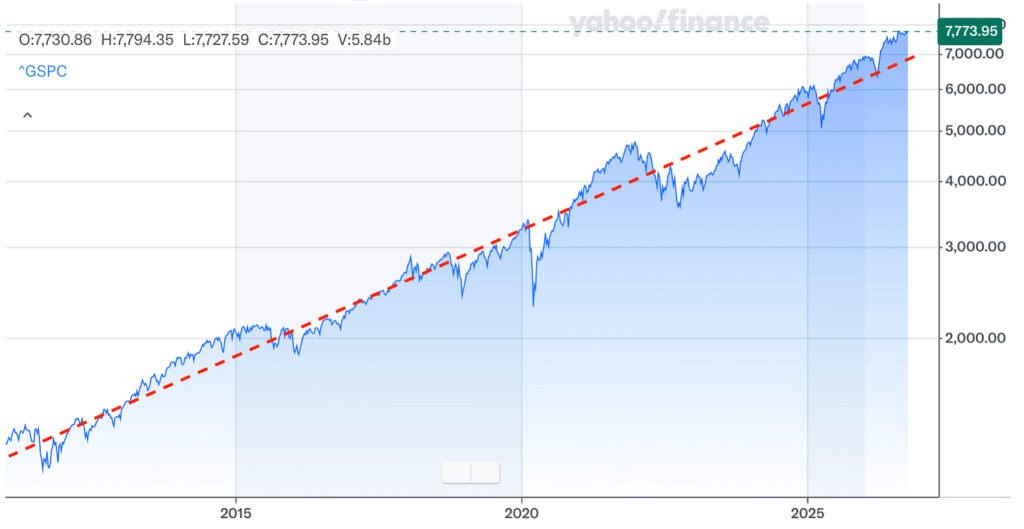
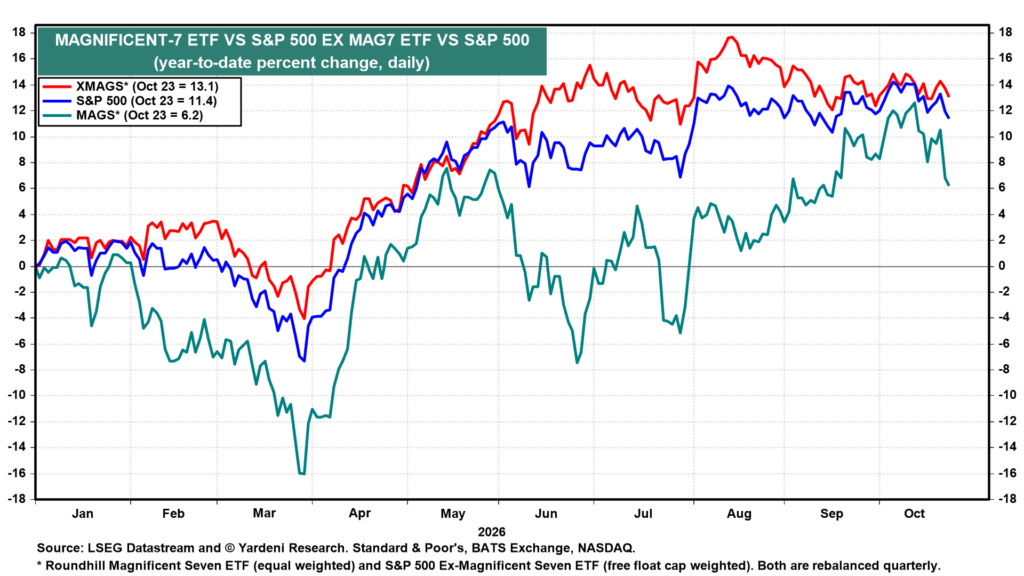
With nearly 10 months in the books, 2026 has shaped up as another stellar year for Wall Street and investors. As of the closing bell on Oct. 19, the timeless Dow Jones Industrial Average (^DJI -1.23%), benchmark S&P 500 (^GSPC -0.52%), and tech-inspired Nasdaq Composite (^IXIC -0.21%) had rallied 8.1%, 12.4%, and 13.7% year to date.

The stock market has been propelled higher by a confluence of factors, including (but not limited to):

  • The artificial intelligence (AI) infrastructure build-out
  • Considerably better-than-expected corporate earnings
  • Investor euphoria regarding record-breaking initial public offerings
  • Record S&P 500 share buyback activity

But with the S&P 500 and Nasdaq Composite more than doubling from their October 2022 bear market lows, the age-old question has to be asked: Are things too good to be true on Wall Street?

Image source: Getty Images.

While long-term data show that Wall Street’s major stock indexes rise over multiple decades, the performance of equities over shorter timelines isn’t always as rosy. Currently, we’re witnessing the stock market do something for only the third time over the last century — and the previous two occurrences proved disastrous for stocks.

Stock valuations are knocking on the door of uncharted territory

Just as the stock market has a laundry list of upside catalysts, there are always headwinds waiting in the wings to knock equities off their pedestal. Examples include rapidly rising outstanding margin debt, soaring long-duration Treasury bond yields, and persistently elevated inflation.

But there’s perhaps no greater threat to the continuity of the AI-driven bull market than premium stock valuations.

Value is one of the trickiest subjects to discuss, given that there’s no one-size-fits-all blueprint to evaluate businesses or the broader market. It’s not uncommon for emotions or subjectivity to come into play. These variables are a big reason why it’s so difficult to accurately forecast short-term directional moves in the Dow Jones Industrial Average, S&P 500, and Nasdaq Composite.

But there’s one valuation tool that’s demonstrated a true knack for cutting through subjectivity and emotion to provide investors with invaluable valuation insights: the S&P 500’s Shiller Price-to-Earnings (P/E) Ratio, also known as the Cyclically Adjusted P/E Ratio (CAPE Ratio).

Despite being introduced by economists less than four decades ago, the Shiller P/E Ratio has been backtested over 150 years. Since January 1871, it’s averaged a multiple of 17.44. As of the closing bell on Oct. 19, the S&P 500 Shiller P/E Ratio was nearing 41.

Over the last 100 years, the S&P 500’s CAPE Ratio has exceeded 40 just three times, including the present — and the prior two instances foreshadowed significant stock market declines:

  • January 1999 to September 2000: The advent and proliferation of the internet led to some eye-popping valuations, the likes of which investors had never before witnessed. In December 1999, the CAPE Ratio peaked at an all-time high of 44.19. In March 2000, the dot-com bubble burst, eventually stripping the S&P 500 and Nasdaq Composite of 49% and 78% of their respective values by October 2002.
  • January 2022: During the first week of January 2022, with fiscal stimulus checks from the COVID-19 pandemic fueling risk-taking on Wall Street, the Shiller P/E Ratio topped 40 during a continuous bull market for only the second time in a century. Over the next nine months, the 2022 bear market wiped out a fifth, a quarter, and a third of the Dow’s, S&P 500’s, and Nasdaq’s respective values.
  • May 2026 to present: Though the CAPE Ratio has reached 40 several times over the last year, it’s been consistently above 40 for five months (and counting). Thus far, it’s peaked at 42.84 on June 1.

The last 100 years of Shiller P/E Ratio data show that premium valuations aren’t tolerated over an extended period. Although this time-tested valuation tool can’t identify when the music will stop or pinpoint the catalyst that causes stocks to fall, it has a perfect track record of portending sizable stock market declines.

A businessperson is reading a financial newspaper held in their hands.

Image source: Getty Images.

Short-term pain can be a blessing in disguise for patient investors

Based solely on historical precedent, the short-term outlook for equities is somewhat dire. Though demand for AI infrastructure is off the charts, it wouldn’t take much of a disappointment to knock a stock market that’s priced for perfection off its pedestal.

At the same time, short-term pain can often be a blessing in disguise for patient investors.

To state an unpleasant but necessary point, stock market corrections and bear markets are inevitable when putting your money to work on Wall Street. They’re a normal part of the investing cycle and akin to the price of admission for access to one of the greatest wealth creators on the planet.

But stock market corrections and bear markets share another link: they’re short-lived.

In late May, analysts at Bespoke Investment Group published a data set on X (formerly Twitter) that examined the correlation between S&P 500 bull and bear markets since the start of the Great Depression in September 1929. What researchers uncovered was a stark difference between optimism and pessimism among investors.

On the one hand, the typical S&P 500 bear market over the last 97 years has reached its trough after 286 calendar days, or approximately 9.5 months. Furthermore, no bear market has lasted longer than 630 calendar days.

Meanwhile, Bespoke found that the average S&P 500 bull market endured for 1,023 calendar days, or 3.6 times longer than the typical bear market. Out of 27 bull markets since September 1929, just over half (14) have lasted longer than the aforementioned lengthiest bear market.

No matter how dire things may appear, maintaining perspective and optimism are the keys to success for long-term-minded investors.


Source link

Visited 1 times, 1 visit(s) today

Related Article

Why Carpenter Technology Stock Plunged 24.5% This Week

A quarterly revenue report that missed Wall Street expectations sent Carpenter Technology (NYSE:CRS) tumbling 22.5% this week, overshadowing an earnings beat. Carpenter Technology stock changed hands at $292.26 as of the close on Friday, Oct. 23, down 24.5% this week from Friday, Oct. 16’s close, according to data provided by S&P Global Market Intelligence. Over

Scanfil (HLSE:SCANFL) Stock Price Meets Q3 Results With Cash Questions

Scanfil Oyj stock closed at €12.0 on Friday, after a choppy week that left the share down 8.1% over seven days and 3.8% over the past month. The price suggests nerves. The fresh Q3 2026 report tells a different story. Revenue reached €252.2m with net income of €11.6m and earnings per share at €0.18. For

Elon Musk Just Delivered Spectacular News for SpaceX Stock Investors

Elon Musk founded Space Exploration Technologies (NASDAQ: SPCX) in 2002 with a simple but ambitious goal: to drive down the cost of space transportation. The company has since expanded into satellite internet connectivity and artificial intelligence (AI), unlocking significant revenue streams that paved the way for its recent initial public offering (IPO). SpaceX stock quickly

If the Stock Market Crashes, This Is the First ETF I’m Loading Up On

The stock market will crash again at some point. There have already been numerous boom-and-bust cycles throughout the stock market’s history, making the next crash more a matter of when than if. Unfortunately, nobody actually knows when it will happen. Therefore, the best way to defend against a stock market crash is to have a

History Says This ETF Could Be the Biggest Winner of the Stock Market Sell-Off

With nearly 10 months of 2026 in the books, it’s fair to say that this year hasn’t been easy for equity investors, but they’ve been rewarded for taking risks. The Nasdaq-100 and S&P 500 (^GSPC -0.52%) are up 14.6% and 11.7%, respectively, year to date, confirming market participants are being compensated for enduring equity market

Prediction: This Will Be SpaceX’s Stock Price by the End of 2030

Space infrastructure and generative artificial intelligence (AI) are two of the hottest megatrends currently taking Wall Street by storm. And Space Exploration Technologies (NASDAQ: SPCX) offers exposure to both. That said, with a market cap of $2.16 trillion, investors will naturally wonder if the company can still generate enough momentum to move the needle. Let’s

Will Altria’s Pricing Power Triumph Over Tumbling Volumes on Oct 29?

Quick Read Altria (MO) reports Q3 earnings Oct. 29, with the stock up 35% year to date on Marlboro’s pricing strength offsetting cigarette volume declines. Marlboro’s retail share slipped from 40% to 40% to 39.5% as discount cigarettes captured 34% of the market, pressuring margins heading into Q3. After back-to-back earnings-day drops of 5% and

Can Caterpillar’s $72B Backlog Save Its Stock From a 10% Slump?

Quick Read CAT’s $72 billion backlog, with 59% expected to ship within 12 months, anchors the bull case after shares fell 15% over the past month. Power generation sales surged 72% last quarter on data center demand, but $2.2 billion in full-year tariff costs remain a significant headwind. Wall Street expects Q3 EPS to jump

3 British Value Stocks Trading Up To 49% Below Fair Value

With the UK government preparing a £40b plus housing programme and fresh borrowing powers for local projects, long term cash flows are back in focus for British assets tied to the real economy. When policy leans toward bricks, mortar and infrastructure, investors often start hunting for solid cash generators that markets have priced too cautiously.

Stock-Split Watch: Is Micron Next?

With incredible gains of 350% over the past year, shares of Micron Technology (NASDAQ: MU) have easily outpaced the 68% jump in the PHLX Semiconductor Sector index. However, Micron stock has been in the doldrums of late, sliding 25% from the 52-week high it reached in June this year. Micron’s pullback is driven more by

Is It Too Late to Buy SpaceX Stock After Its Monster Third-Quarter Earnings Report? Here’s the Answer.

On Oct. 20, Space Exploration Technologies (NASDAQ: SPCX) reported its 2026 third-quarter earnings, posting some impressive numbers. According to CNBC-tracked analyst estimates, revenue of $14.5 billion easily topped the $12.7 billion expected, and adjusted earnings per share of $0.45 once again beat the $0.13 expected. In addition, SpaceX reported net income of $4.4 billion, a

Meet Wall Street’s Newest Major Stock Split: It Has Soared 1,730% Since Its 2012 IPO, and There Is Plenty of Upside Left

A stock split is a corporate action in which a company increases the number of shares it has outstanding by dividing existing shares into multiple shares and proportionately decreasing its share price. Stock splits don’t change a company’s intrinsic value, but they can garner significant attention because they make each share more affordable, potentially increasing

US MARKETS CALL: Still Proceeding Cautiously

On September 15, we advised investors to proceed with caution. We pushed out our 8,400 S&P 500 target from year-end 2026 to mid-2027 and set 7,900 as our new year-end target. On October 14, we reiterated our caution. Sure enough, the stock market has been turbulent since mid-September, with AI-related stocks falling sharply. We are

Prediction: The Stock Market Will Soar After Midterm Elections

The midterm elections are fast approaching, and the world will be watching as voters head to the polls on Nov. 3 to elect their state representatives in the U.S. House of Representatives and the U.S. Senate. With politics as partisan as ever and so much going on in the world, including the Iran war, investors

BE Stock Sees Worst Single-Day Fall In 3 Months — Jefferies Trims Price Target, Flags Lack Of Updates On Its Largest Opportunity With Oracle

Jefferies said that despite management’s optimism that its backlog continues to grow faster than revenue, Bloom Energy did not provide a formal backlog update. JPMorgan also lowered its price target on Bloom, cutting it to $292 from $314 while maintaining an ‘Overweight’ rating. The firm attributed the reduction to lower trading multiples among Bloom Energy’s

Stock Market Sell-Off: History Says This Is the Best Move to Make Right Now

So your portfolio is redder than a stoplight, and your AI stocks are doing their best impression of a deflating balloon. The Nasdaq Composite (^IXIC -0.21%) has fallen 7.6% from its early October highs, dragging other market indicators lower. Pullbacks of this magnitude tend to rattle investors, particularly those who piled into artificial intelligence plays

0
Would love your thoughts, please comment.x
()
x