I wrote on 12th April that the best trades for the week would be:
-
Long of the USD/JPY currency pair following a daily (New York) close above ¥160.
-
Long of Brent Crude Futures in the small chance we get a daily close above $112.50.
Neither of these trades set up.
A summary of last week’s most important data in the market:
-
US PPI – considerably worse than expected, showing a month-on-month increase of only 0.5% while 1.1% was widely forecasted. This undershot helped the US Dollar lose some value.
-
UK GDP –better than expected, showing a month-on-month increase of 0.5% while only 0.1% was forecasted. This didn’t have much effect upon the Pound.
-
Australia Unemployment Rate – as expected, no change at 4.3%.
Last week’s economic data releases were much less influential upon the markets than the US/Iran negotiations. Optimism that the war will come to a full end soon with some kind of deal and an open Strait of Hormuz has increased, and this has sent stock markets soaring, especially in the USA. The S&P 500 Index has risen by over 13% within just the past three weeks after reaching a new 7-month low. It closed Friday at a new record high! This is a huge turnaround, and April is on track to being the best month for the S&P 500 Index in 52 years.
Despite the optimism, the Iranians are publicly goading the USA, declaring they are refusing President Trump’s red lines, and acted to re-close the Strait of Hormuz yesterday after temporarily opening it. President Trump has continued with a mixture of publicly expressed optimism with the occasional comment following Iran’s fire on vessels attempting to transit about how more bombs will probably be required.
Prediction markets generally think that this war will end formally by the end of May. This suggests that the crowd might be overly optimistic, paving the way for a potential surprise to the downside if hostilities suddenly resume. It remains very difficult to see how the USA’s bottom line – no nuclear program and an open Strait of Hormuz – can be reconciled with the shibboleths of the Islamic Republic of Iran, although the Islamic Republic has been seriously weakened and is now being bankrupted. However, one of the most powerful politicians in Iran, the Parliament speaker Ghalibaf, said just a few hours ago that negotiations were making progress but there are still some gaps, which sounds as if Trump’s general optimism is not misplaced.
It is worth mentioning that the current ceasefire expires by this Wednesday.
The outcome of negotiations and the ceasefire concerning the Middle Easy war is likely to remain more influential that any economic data releases which are scheduled over the coming week, as we approach the deadline for the expiry of the current two-week ceasefire and await to see whether it will be extended or something else will be agreed.
The coming week’s most important data points, in order of likely importance, are:
-
US Retail Sales
-
UK CPI (inflation)
-
Canada CPI (inflation)
-
New Zealand CPI (inflation)
-
Germany & UK Flash Services & Manufacturing PMI
-
UK Retail Sales
-
UK Claimant Count Change (Unemployment Claims)
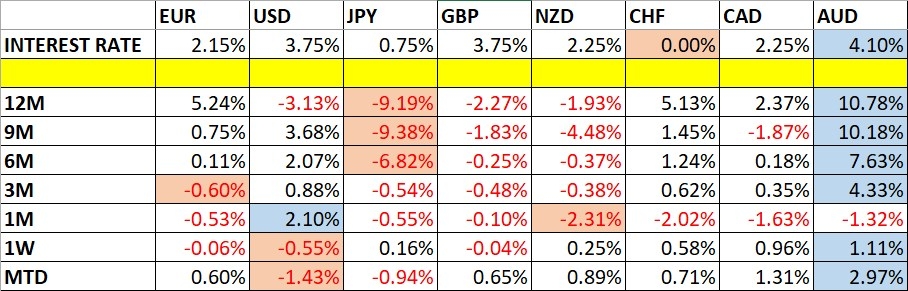
Currency Price Changes and Interest Rates
For the month of April, I forecasted that the USD/JPY currency pair would rise in value. The performance of the forecast so far:

Last week, I made the following forecasts for the coming week:
-
AUD/JPY short – this was a losing trade, as the cross rose by 0.98%.
-
NZD/JPY short – this was a losing trade, as the cross rose by 0.32%.
-
NZD/CAD short – this was a winning trade, as the cross fell by 0.33%.
Overall, the trades gave a loss of 0.97%, which is an average loss of 0.32% per trade.
The Australian Dollar was the strongest major currency last week, while the US Dollar was the weakest.
Next week’s volatility is likely to remain relatively low. However, the ongoing war in the Middle East (subject to the current ceasefires) retains the ability to roil the market if there are any surprises. This could generate volatility in the US Dollar, the Japanese Yen, and the Canadian Dollar, not to mention stock markets.
You can trade these forecasts in a real or demo Forex brokerage account.
Key Support/Resistance Levels for Popular Pairs
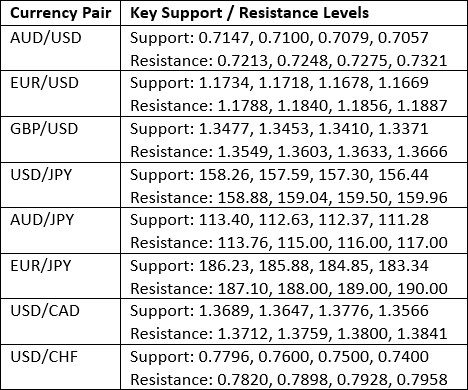
Key Support and Resistance Levels
US Dollar Index
The US Dollar printed a bearish candlestick, with a significant lower wick, and a close that was within the lower half of its range. We have a bearish long-term trend, with the 3-month trend bearish and the 6-month trend also bearish.
Despite the seeming bearish trend, looking at the price chart below, we can see that the greenback is really within a long-term consolidation phase, so we cannot really expect much of a trend in the US Dollar here.
I think the greenback will be more driven by the progress in the current Middle East ceasefire talks – if war breaks out again, it will likely boost the Dollar, not so much as a haven but more as an effect of the inflationary shock of the rising energy prices. If the ceasefire becomes something more durable, conversely, it will probably be bearish for the US Dollar. This latter scenario is what the market is strongly expecting right now, so I will generally prefer to be short of the US Dollar over the coming week, unless the USA/Iran war restarts.
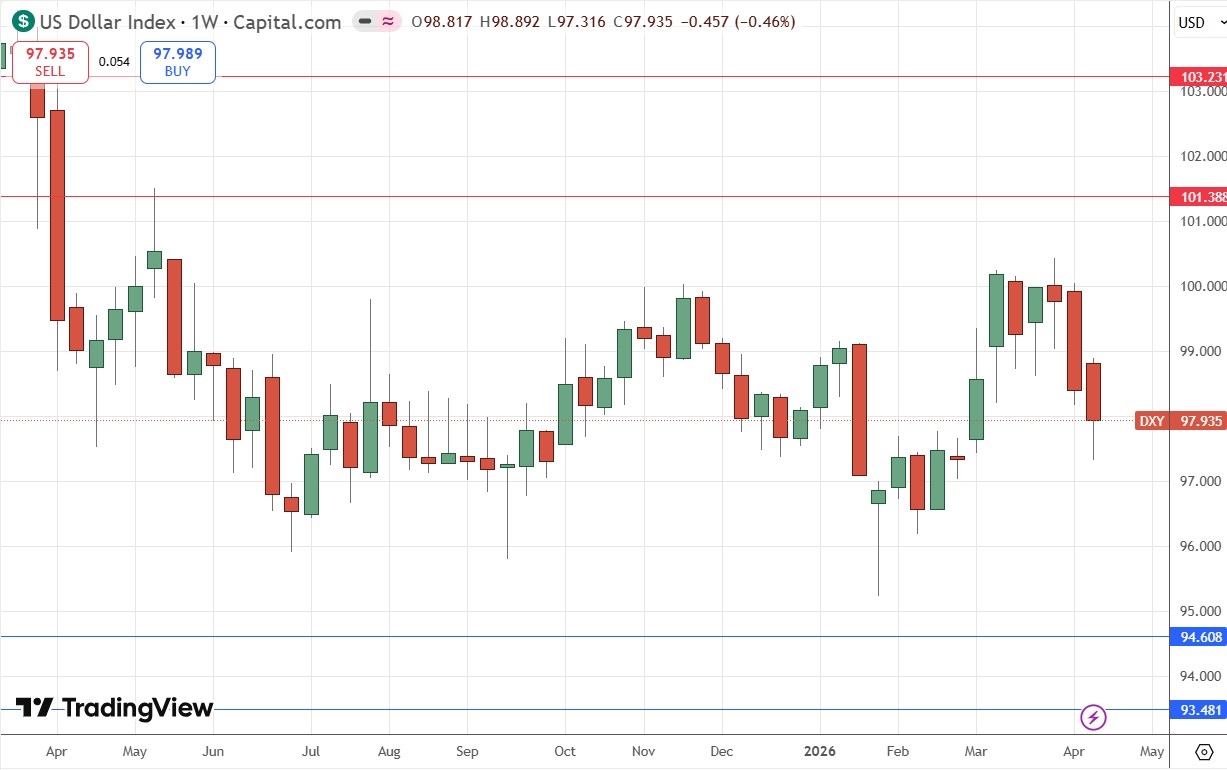
US Dollar Index Weekly Price Chart
AUD/USD
The AUD/USD currency pair was at the heart of the Forex market yet again last week, with the Aussie gaining by more than any other major currency, while the US Dollar was the biggest loser. There has been a very long-term bullish trend in the Aussie, which seemed to have decoupled from risk sentiment to some extent, but we see the Aussie getting bid hard as the world enjoys the increasing expectation that there will be a peace deal soon concluded between Iran and the USA. This is also leading to a decline in the USD, as a safe haven is no longer in such demand.
Another factor pushing the Australian Dollar higher is the relatively hawkish central bank agenda of the RBA, which is likely to hike rates again. The AUD has the highest overnight carry of any major currency, so the Aussie is also being used as a long component in carry trades, possibly against the Swiss Franc or Japanese Yen (the Yen is probably better value overall for that role).
Technically, there is a long-term bullish trend. The price reached a new 3-year high last Friday above $0.7220 but then fell firmly. The price chart below shows last week printed a fairly large bullish candlestick, but it definitely has an upper wick to watch out for.
I think the coming week could give more good long trade opportunities. The support near $0.7150 looks quite strong, so a bullish bounce there might be a good trade entry signal. However, longs will need to watch out for more strong selling potentially above $0.7200.
This pair will likely be at the heart of market volatility, which can be great for day traders, and follow sentiment on the Middle East and the second order effect of a commodity price shock, both up and down.
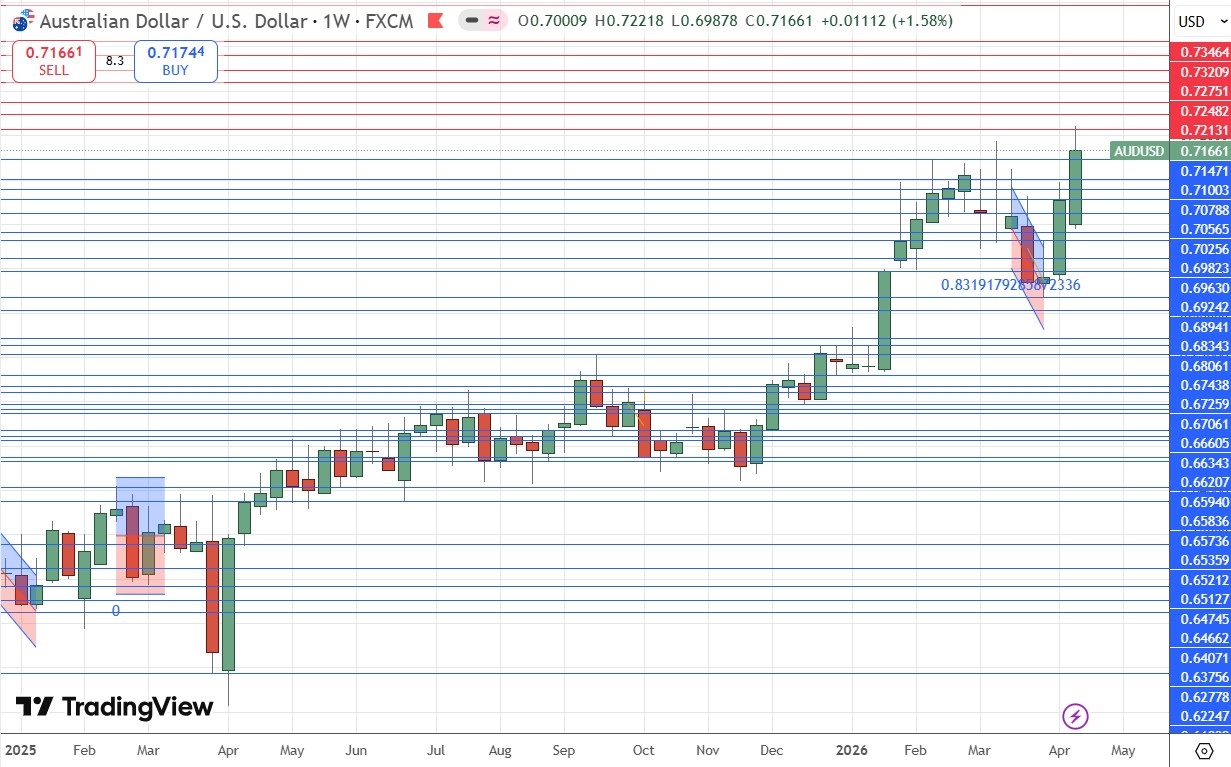
AUD/USD Weekly Price Chart
USD/JPY
The USD/JPY currency pair lost some ground last week, three weeks after finally making the long-anticipated bullish breakout beyond the big round number at ¥160. The problem is not Yen weakness, which can be taken for granted over the long-term it seems. The problem for progress higher by this currency pair is the renewed weakness in the US Dollar now that there is a ceasefire seen as leading to a peace deal in the Middle East war, because if there is a longer-term agreement it will remove some inflationary pressure from the Fed through lower energy prices.
Trend traders will be worrying about the slight bearish bias we are seeing near the highs and the price’s unwillingness to break out, especially above the ¥160 level. The Japanese Yen is weak but the Bank of Japan might get nervous and work for an intervention to strengthen the Yen above that level, adding a potential extra hurdle for bulls.
Bulls might however be encouraged by the fact we see significant lower wicks on all the recent weekly candlesticks below. There is also a very solid ascending trend line which has been supporting the price action for a year.
If we do not see the price make a firm bullish move soon, I fear that we might have a bit of a bearish head and shoulders chart pattern which might complete below ¥157.50, finally knocking out most trend traders from their long position, although some will be setting their stop losses for a break below the trend line at about ¥155.
I remain long, but more cautious traders might want to wait for a daily (New York) close above ¥160 before entering a new long trade.
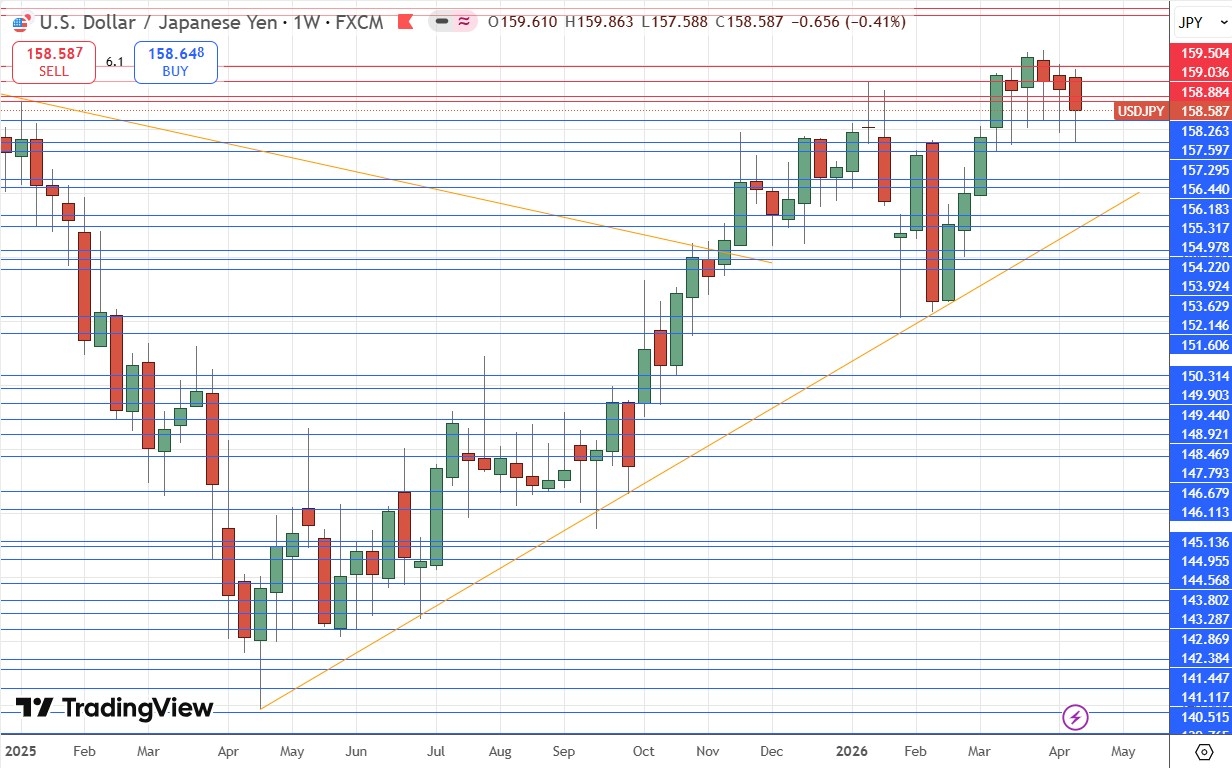
USD/JPY Weekly Price Chart
S&P 500 Index
The S&P 500 Index has been on a wild ride over the past few weeks, rising by more than 13% in value within that time, especially over the past week. If this holds up, it will be the biggest calendar month gain by the Index since 1987, or possibly even 1974. This is quite an extraordinary turnaround after the price fell by about 10% to spend several days trading below the 200-day simple moving average and reaching new 7-month low prices. This is extraordinarily high volatility and an unusual event.
Stock markets are soaring through the same driver that was sending them plummeting just three or four weeks ago – the war between the USA and Iran. The ceasefire and negotiations have generated an increasingly strong expectation that the war will end soon with a comprehensive peace deal. This sent markets soaring higher, and we saw this Index end the week very near the high of its large range after reaching a new all-time high above 7,150.
This is overall a bullish development, this strong breakout to a new record high, and it is generally a signal that the price will go on to rise over the coming months. However, it might be worth considering what could happen if the war unexpectedly resumes this Wednesday when the two-week ceasefire expires. I find it hard to believe the Islamic Republic will accept giving up its nuclear program and will instead try to draw the USA into a long war of attrition, hoping the American eventually give up enough to accept some kind of compromise that leaves their nuclear program to fight for another day. If the war resumes, this would likely send stock markets sharply lower again. However, as a trend trader, I follow what happens, not what I think might happen, and I had to go long at this bullish breakout.
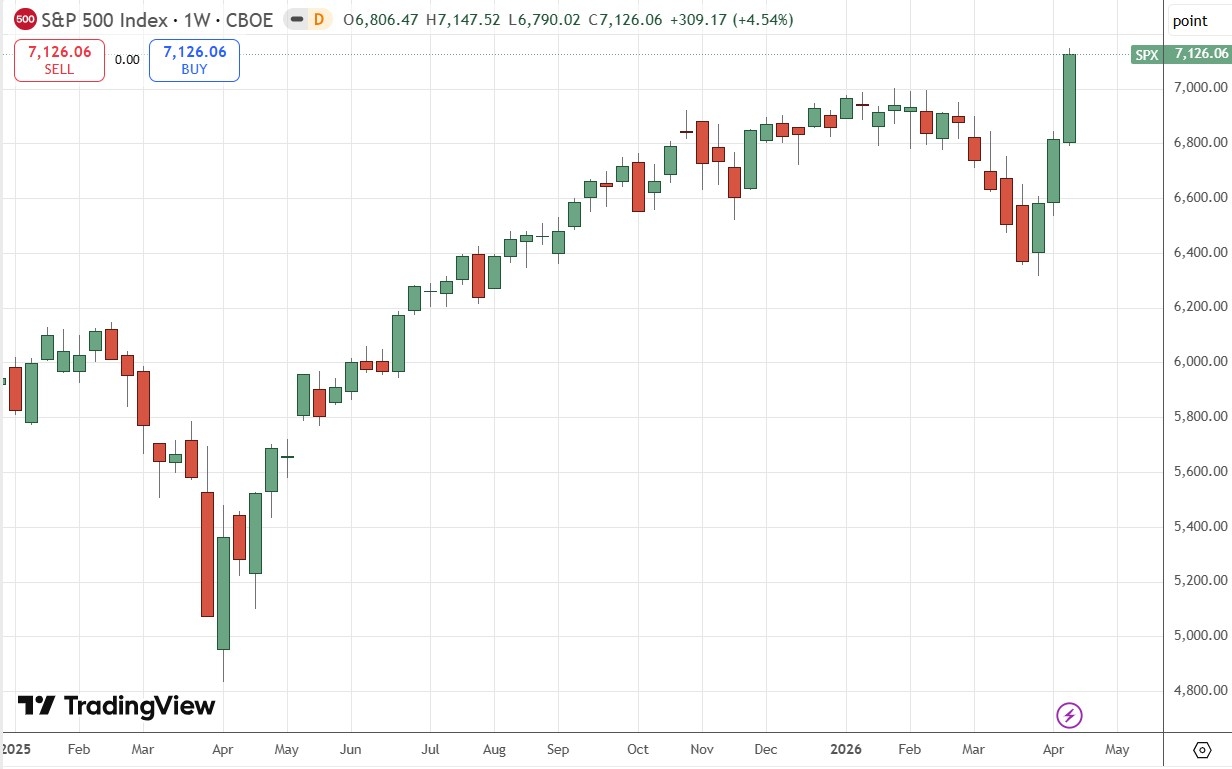
S&P 500 Index Weekly Price Chart
NASDAQ 100 Index
Everything I wrote above about the S&P 500 Index applies equally to the NASDAQ 100 Index, with the small adjustment that the bullish breakout to new record highs here looks maybe slightly less strong. However, the NASDAQ 100 averages a higher return than the S&P 500 Index, so if you want to be long there, you should seriously consider being long here too.
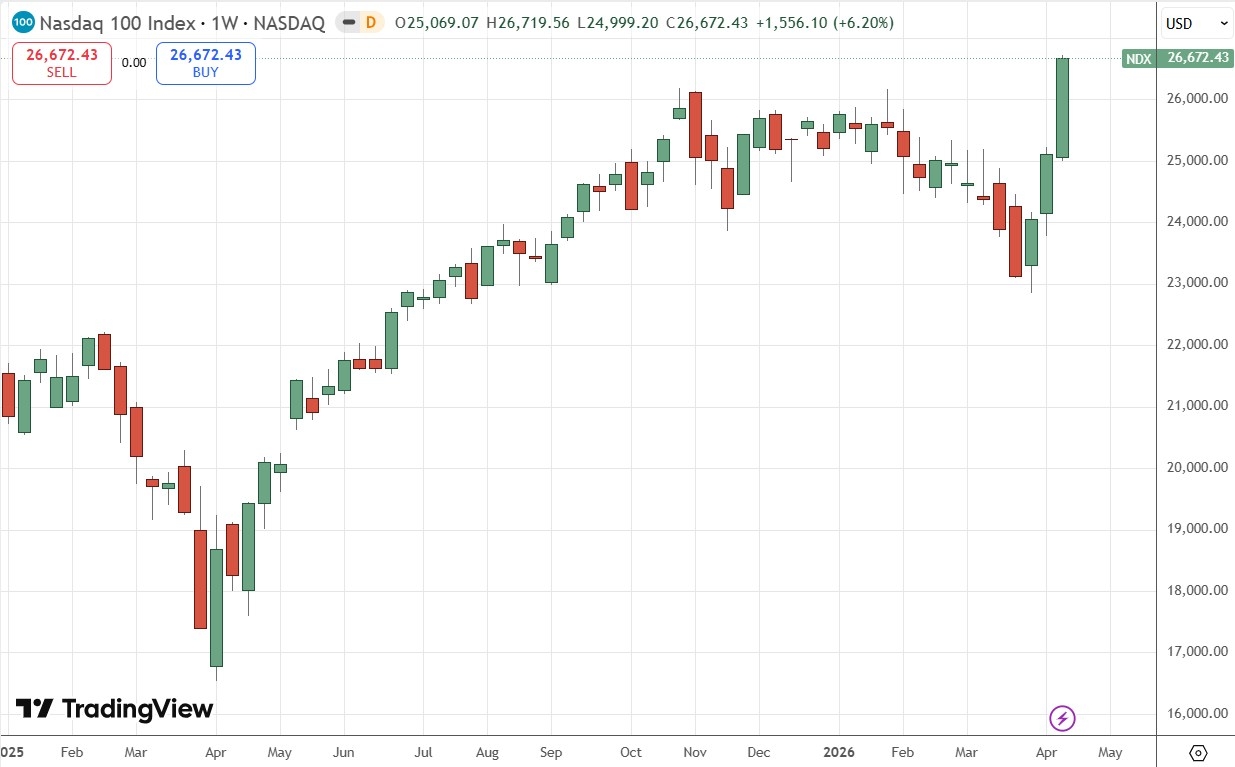
NASDAQ 100 Index Weekly Price Chart
Brent Crude Oil Futures
Brent Crude Oil fell again last week, continuing its journey lower as the USA/Iran ceasefire has continued to hold and give rise to strong expectations of a comprehensive peace deal by the end of May. Just as this has pushed stocks higher, it has sent crude oil lower. Another factor here is the Strait of Hormuz, which Iran opened on Friday before closing again on Saturday and firing on at least three tankers, as the USA continues its blockade of traffic to and from Iranian ports.
This new situation might push the price up a bit, but it is very unlikely to send prices to new highs. I am not sure that the price will fall a great deal further even if there is a peace deal, it may take a while to do that, but it should continue to trade lower in that scenario.
The surprise to consider is, what if all the positivity from President Trump is a feint and he is planning to pretend to negotiate a ceasefire extension, but will then order a fresh attack on Iran the minute the ceasefire expires this Tuesday / Wednesday. If this happened, it would certainly send the price of oil racing higher, we might even see the price rise by $20 in a single day.
I think that unless you have a strong view on whether a resumption of the war is likely, there is no point trading crude oil right now, but on a surprise resumption of the war, a long trade could be a good idea.
I will go long here if we get a daily (New York) close above $112.50 per barrel.
If you do go long, Brent will likely be the better vehicle than WTI, as it is more exposed to events in the Strait of Hormuz.
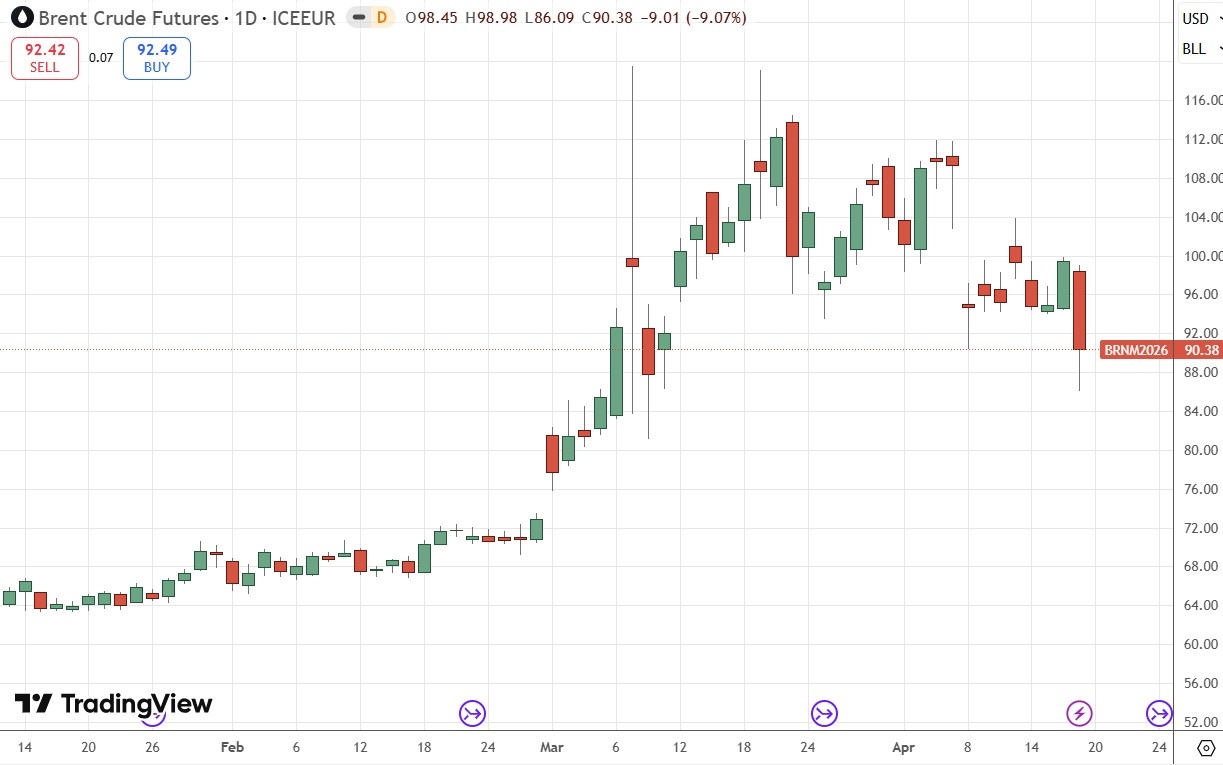
Brent Crude Oil Futures Daily Price Chart
I see the best trades this week as:
-
Long of the USD/JPY currency pair following a daily (New York) close above ¥160.
-
Long of Brent Crude Futures if we get a daily close above $112.50. This is extremely unlikely to set up unless there is a surprise resumption of the war.