Warren Buffett Has 1 Simple Rule for Surviving a Stock Market Crash, and History Says It’s Never Once Failed

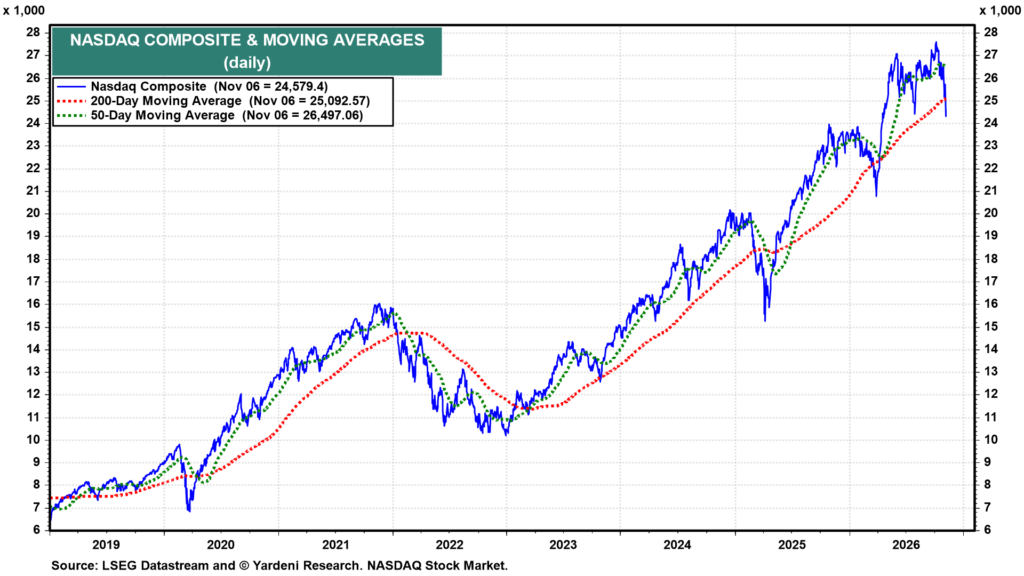
It’s been a roller-coaster of a week for the stock market. The Nasdaq Composite (^IXIC +1.09%) officially entered correction territory after falling by more than 10% from its October peak, while the S&P 500 (^GSPC +0.31%) and Dow Jones Industrial Average (^DJI -0.46%) are down by around 6% and 5%, respectively.

Investors are also grappling with the downturn. The Fear and Greed index measures investor sentiment based on multiple stock market metrics, and it quickly plunged into the “extreme fear” category amid this week’s turbulence.

But it’s not all bad news right now. Warren Buffett has some timeless advice for investing during crashes and bear markets, and history says this strategy has worked out every single time.

Image source: The Motley Fool.

The key to protecting your investments

When the market is shaky, it can be tempting to avoid investing or even sell your stocks in fear that prices will fall further. According to Warren Buffett, though, that’s one of the worst moves to make during a slump.

“A simple rule dictates my buying,” Buffett explained in a 2008 opinion piece for The New York Times. “Be fearful when others are greedy, and be greedy when others are fearful.” He went on to emphasize that “bad news is an investor’s best friend. It lets you buy a slice of America’s future at a marked-down price.” In other words, when the future is bleak, buy more.

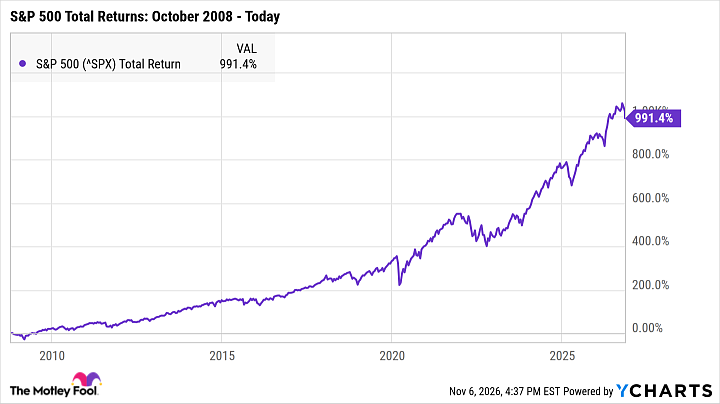
In the years following the publication of that piece, the S&P 500 soared by nearly 1,000%, and the investors who reaped the biggest rewards were those who stayed invested even when it was tough.
^SPX Chart

^SPX data by YCharts

“Over the long term, the stock market news will be good,” Buffett continued, noting the Dow’s extraordinary rise from 66 to 11,497 during the 20th century.

“You might think it would have been impossible for an investor to lose money during a century marked by such an extraordinary gain. But some investors did. The hapless ones bought stocks only when they felt comfort in doing so and then proceeded to sell when the headlines made them queasy.”

History says Buffett’s strategy has never been wrong

No matter how severe the short-term volatility is, the market has always managed to recover.

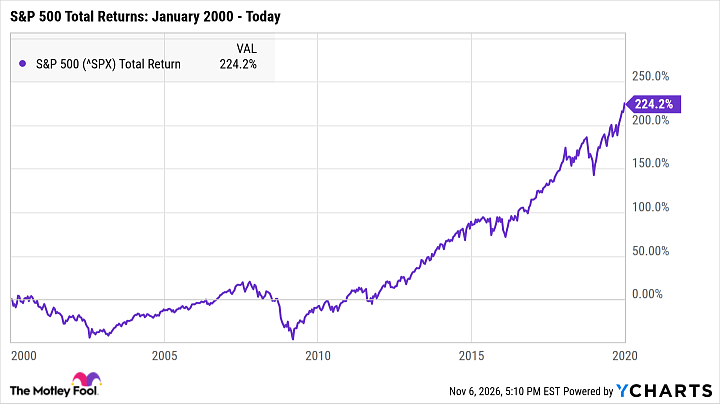
During the dot-com bubble in 2000, for example, the S&P 500 fell by nearly 50% as the tech sector collapsed. It took until 2007 for the index to reach another all-time high, and just a few months later, the Great Recession began.

However, between 2000 and 2020, the S&P 500 still earned total returns of more than 224%. In other words, even if you’d invested at seemingly the worst moment — immediately before the onset of two of the worst recessions in U.S. history — you’d still have more than tripled your money over 20 years.
^SPX Chart

^SPX data by YCharts

This trend holds up throughout history, too. Between 1919 and 2025, all of the S&P 500’s rolling 20-year periods have ended in positive total returns, according to analysis from Crestmont Research. By holding an S&P 500 ETF or index fund for 20 years, it’s historically been harder to lose money in the stock market than to make money.

What should investors do right now?

Regardless of what’s ahead for the market, continuing to invest is key. However, it’s more important than ever to choose your stocks wisely. Weak companies can thrive during periods of economic prosperity, but recessions and bear markets will hit those stocks the hardest. The weakest of them may crash and never recover at all.

Companies with strong fundamentals — such as a durable competitive advantage, healthy finances, and a competent leadership team — are the most likely to rebound after a crash. The more of these stocks you own, the better prepared you’ll be to not only survive a downturn, but thrive over time.


Source link

Visited 1 times, 1 visit(s) today

Related Article

Adobe vs. Palantir Technologies: Which Technology Stock Is a Better Buy Going Into 2027?

Choosing between established giants and high-growth disruptors remains a classic dilemma for investors. For those interested in exposure to the tech industry, deciding whether the steady cash generation of Adobe (ADBE -2.90%) or the accelerating momentum of Palantir Technologies (PLTR +3.48%) can be a challenge, as both have different pros and cons. Adobe provides the

Prediction: This Will Be the Best-Performing AI Stock of 2027

With November here and 2027 right around the corner, it’s time to start thinking about which stocks could be the best performers in 2027. The reality is that the big hedge funds and money in the market are already thinking about this, and there could be some sizable movement in the stock market in the

2 big AI narratives wrestle with each other: What to watch this week

Even before the sell-off last week, we’ve all had the feeling of white-knuckling through the fourth quarter. Anthropic’s (ANTH.PVT) IPO prospectus. Big Tech earnings. Bond yields through the roof. An unexpectedly tall blue wave that lifted the stock market up — and threw it back down. With volatility (^VIX) running hot, investors are balancing on

Is a Market Crash Coming? Warren Buffett’s Warning Is Ringing Loud and Clear.

Is a market crash coming? That’s the question on many investors’ minds today as the strong bull market continues. The S&P 500 (SNPINDEX: ^GSPC) has more than doubled over the past four years, and it’s up 12% year to date. Artificial intelligence (AI) euphoria is still driving the market, but there are signs that suggest

Seoul Mayor Says Lee Government Turned Stock Market Into Casino

Seoul Mayor Oh Se-hoon. News1 “Focus on pumping up prices before the election… nine circuit breakers in five months” On Saturday, Oh criticized the government’s stock market policy through his social media accounts. “Last Friday the Kospi broke below the 5,000 line and a circuit breaker was triggered,” he wrote. “Of the 11 circuit breakers

Why the Dollar Is Gaining as Stocks and Oil Slide?

Fundamental Backdrop and Market Sentiment I wrote on 1st November that the best trades for the week would be: Short of the EUR/USD currency pair below $1.1300. This pair fell over the week by 0.17%. A summary of last week’s most important data in the market: US Average Hourly Earnings – increased at a slightly

Why Marvell Technology Stock Plunged 28.1% This Week

An agreement to acquire optical components provider Lumentum Holdings (LITE +5.67%) in an all-stock transaction valued at $115 billion sent Marvell Technology down 28.1% this week. Marvell Technology stock changed hands at $141.20 as of the close on Friday, Nov. 6, having dropped 32% from Friday, Oct. 30’s close, according to data provided by S&P

Stocks soared on the Democratic sweep. Less than 24 hours later, the AI trade cracked.

Wall Street’s tumultuous midterm election week kicked off with a celebration among investors. On Wednesday, stocks soared after Democrats swept both chambers of Congress. The Dow (^DJI) surged more than 1,500 points. The S&P 500 (^GSPC) rallied nearly 2%. And in less than 24 hours, stocks reversed course, plunging Thursday as Wall Street and Main

Micron and Sandisk Lead the Memory Market. 1 Stock Has Far Greater Upside.

Shares of Micron Technology and Sandisk have soared 280% and 457%, respectively, over the past year as demand for memory processors in data centers jumped. Spending for artificial intelligence (AI) infrastructure isn’t slowing down right now — as Alphabet‘s (GOOGL +0.78%) (GOOG +0.78%) recent quarterly results show — and that’s great news for Micron and Sandisk

Forget video games: Kids as young as 7 are buying stocks instead

At age 7, when most children are collecting Pokémon cards and asking for Messi soccer cleats for their birthdays, Yotam Raz of Moshav Beit Yitzhak, a village in central Israel, wanted to learn how to make money. It was during the COVID-19 pandemic, and he used the lockdowns to make natural soaps, which he later

US MARKETS CALL: S&P 500 Valuation Dives As Earnings Soar

The stock market dived last week. Investors priced in political backlash against data centers after Democrats swept Congress. We anticipated buying opportunities after the midterm elections, and Thursday’s selloff delivered some. This remains an earnings-led bull market. Valuations are falling while earnings are soaring. We still view the AI backlash as another speed bump, not

Stock Market Week in Review – 11/2 – 11/6

It’s a rally. It’s a sell-off. At the end of the week, the only thing that was clear was confusion. Investors were hoping to get clarity with the U.S. midterm elections behind them. Instead, they got more volatility. The reason is uncertainty about future regulation surrounding data centers. The conventional wisdom suggests it may not

A Historically Strong Post-Midterm Market Could Make 2027 a Stock-Picker’s Year

Political gridlock, strong earnings, and a historical pattern that hasn’t failed in 21 midterm election cycles Listen to the audio version of this article (generated by AI). Editor’s Note: The midterm elections are behind us, and Washington is gearing up for another round of political battles. But I still feel optimistic – and so does

Rolls-Royce’s US chief says wealthy clients are ‘quite protected’ from market jitters

Rolls-Royce’s (BMW.DE) well-heeled clients aren’t pumping the brakes on new commissions, despite a choppy stock market and lingering economic worries, according to the automaker’s top executive in North America. “Honestly, no,” Nick Keen, president of Rolls-Royce Motor Cars North America, told Yahoo Finance at the Wynn Concours in Las Vegas when asked if clients are

0
Would love your thoughts, please comment.x
()
x