Ahead of the potential Trump-Xi summit on May 14–15, senior U.S. and Chinese officials held a new round of calls — most likely the final round before the summit.
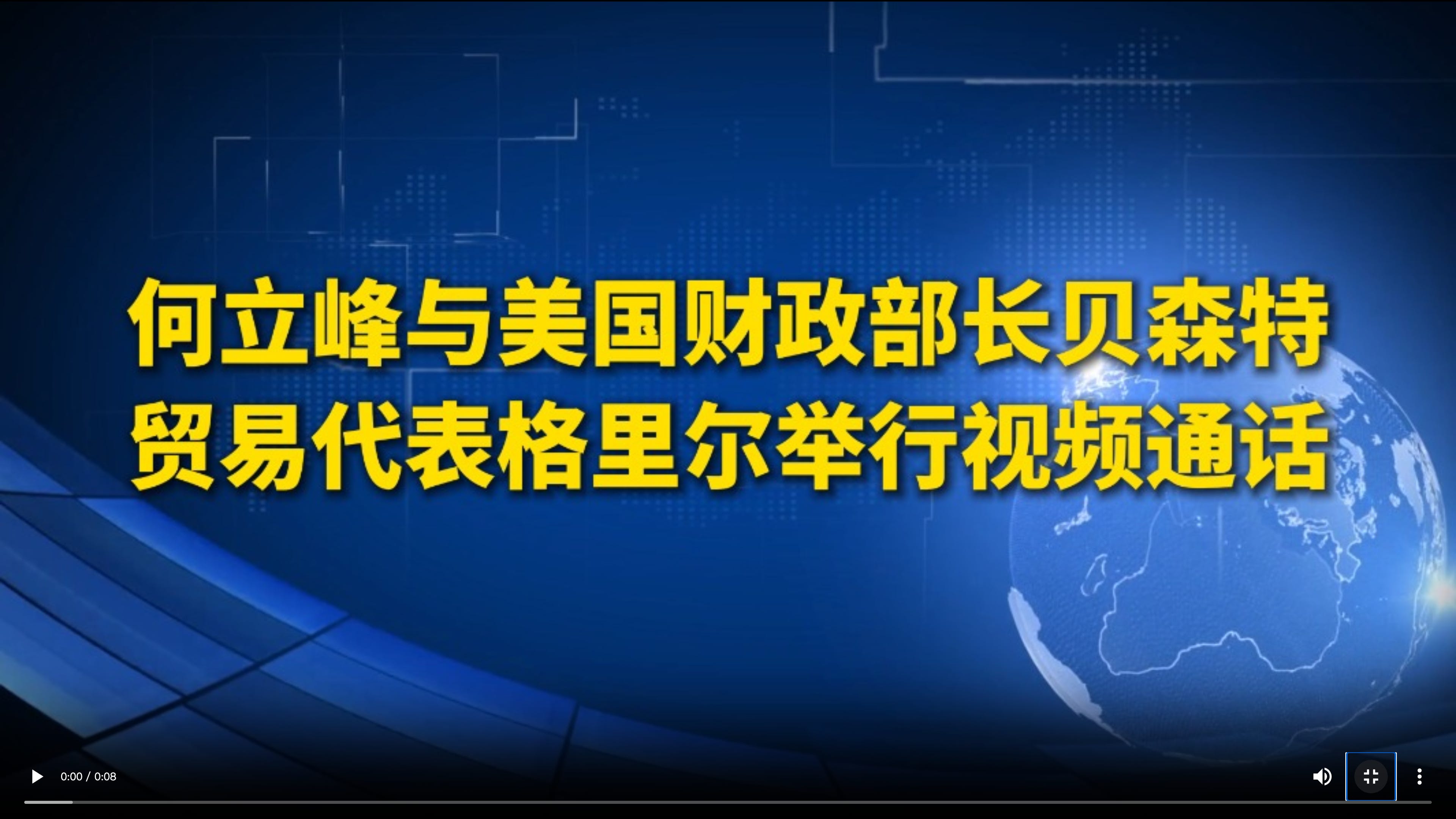
Chinese Vice Premier He Lifeng held a video call with U.S. Treasury Secretary Scott Bessent and U.S. Trade Representative Jamieson Greer.
Almost at the same time, Wang Yi, Member of the Political Bureau of the CPC Central Committee and Director of the Central Foreign Affairs Office, also spoke by phone with U.S. Secretary of State Marco Rubio.
One line in the Chinese readout is particularly noteworthy:
“China expressed serious concerns over recent U.S. economic and trade restrictions against China.”
I took stock of what these “economic and trade restrictions” likely refer to. They should include the following:
1. Reuters reported that the U.S. Commerce Department has asked several chip equipment companies to halt shipments of certain equipment to some facilities of Hua Hong, China’s second-largest foundry. The suppliers involved reportedly include U.S. equipment makers such as Applied Materials, Lam Research, and KLA. The goal is to restrict China’s advanced chipmaking capabilities.
2. This is in line with the MATCH Act recently pushed by Congress. MATCH stands for the Multilateral Alignment of Technology Controls on Hardware Act. Its core objective is to restrict China’s access to critical semiconductor manufacturing equipment that cannot be indigenously substituted by China, especially so-called chokepoint SME. Republicans on the Senate Foreign Relations Committee have said the bill is designed to prevent adversaries from buying from the United States or its partners critical semiconductor manufacturing equipment that they cannot produce themselves.
3. Congress has also been very active recently. In particular, on April 22, the House Foreign Affairs Committee advanced a package of export control-related bills. The official markup list includes measures to extend the statute of limitations for export control violations, increase civil penalties under ECRA, add more BIS export control officers overseas, create a whistleblower incentive mechanism, accelerate Entity List revisions, restrict semiconductor manufacturing equipment exports, and counter the extraction of AI model capabilities.
Among them, RASA — the Remote Access Security Act — deserves particular attention. The bill passed the House in January 2026 and would amend ECRA to extend export controls to foreign persons’ remote access, via the internet or cloud services, to U.S. items, software, or technology subject to the EAR.
4. The most obvious new development recently is that the United States has begun incorporating the protection of AI model capabilities themselves into its national security narrative on China.
Michael Kratsios, Director of the White House Office of Science and Technology Policy, recently accused Chinese entities of extracting capabilities from U.S. AI models in an “organized” and “industrial-scale” manner. Nextgov reported that Kratsios said on X that these foreign entities had used tens of thousands of proxy accounts and jailbreak techniques to systematically extract U.S. AI breakthroughs.
Subsequently, the U.S. State Department was also reported to have sent a diplomatic cable to embassies and consulates around the world, instructing U.S. diplomats to warn foreign governments that Chinese AI companies were allegedly using and distilling proprietary U.S. models without authorization. The report specifically mentioned DeepSeek, Moonshot AI, and MiniMax. Reuters said U.S. concerns are not only about intellectual property, but also about the possibility that distilled models may lack the original models’ accompanying safety safeguards, thereby creating safety and ideological risks.
Deterring American AI Model Theft Act of 2026 (H.R. 8283), advanced by the House Foreign Affairs Committee, aims to prevent foreign adversaries from threatening U.S. national security by extracting key technical features from closed-source U.S. AI models. In essence, the United States is beginning to treat “model capabilities” as a new kind of strategic asset. In the past, the United States regulated chips, equipment, EDA, and manufacturing capabilities; now it is starting to regulate model outputs, model capabilities, distillation, model extraction, lab personnel, API abuse, and synthetic data.
5. On April 24, OFAC announced sanctions on Henglida Petrochemical Dalian Refinery, saying it had purchased billions of dollars’ worth of Iranian oil and was an important customer of Iran’s oil economy. The Treasury Department’s official announcement said Henglida and other Chinese independent refineries play an important role in sustaining Iran’s oil economy. This is particularly important for large Chinese private multinational companies, because once a company is designated by OFAC, the practical impact is often not limited to the U.S. market; it can quickly spill over through banking, insurance, shipping, derivatives, trade finance, and dollar settlement channels.
6. On April 28, the United States, together with Bolivia, Costa Rica, Guyana, Paraguay, and Trinidad and Tobago, issued a joint statement supporting Panama’s sovereignty and criticizing China for allegedly pressuring Panama by increasing detentions and inspections of Panama-flagged vessels. Reuters said the context was Panama’s Supreme Court ruling in January that invalidated the 1997 legal framework granting CK Hutchison the right to operate key port terminals at both ends of the Panama Canal.
However, China’s warning does not seem to have had much effect. On the same day, the U.S. Federal Communications Commission unanimously approved a proposal to ban all Chinese laboratories from testing electronic devices such as smartphones, cameras, and computers for use in the United States.
The impact is as follows:
1. For Chinese companies exporting smartphones, IoT devices, PCs, base stations, and other equipment to the U.S. market, devices developed in China may in future have to be shipped across borders as prototypes to third-party trusted countries, such as Japan, South Korea, Southeast Asia, or Europe, for testing and certification. This will lengthen turnaround time, and the higher cost premium of overseas testing will directly hurt product iteration agility.
2. Chinese domestic testing institutions, including China-based subsidiaries of multinational testing giants, will lose the ability to serve the U.S., the world’s largest single consumer market.
At the same time, after the video meeting, Bessent posted on X summarizing the call. In it, he emphasized that:
“China’s recent provocative extraterritorial regulations have a chilling effect on global supply chains.”
This clearly refers to China’s April 7 issuance of the State Council Regulations on the Security of Industrial and Supply Chains — State Council Order No. 834 — and the April 13 issuance of the Regulations on Countering Foreign Improper Extraterritorial Application of Laws and Measures — State Council Order No. 835. For detailed analysis of the two orders, please see here and here.
Under Order No. 834, if a foreign government takes discriminatory measures against China, China may initiate an investigation. If it determines that such measures have had a substantive impact on China’s industrial or supply chains, China may impose restrictions on trade, services, and other areas. In addition, individuals — for example politicians, legislators, or think tank figures — who directly participate in promoting such measures may also be placed on countermeasure lists. Another scenario is that if a company, in order to comply with foreign policies, suddenly interrupts normal commercial cooperation with China, that too may trigger an investigation. If the behavior is deemed improper, China may take countermeasures. This logic is broadly similar to the Anti-Foreign Sanctions Law and the Unreliable Entity List.
Order No. 835 usefully supplements China’s MOFCOM blocking rules, Anti-Foreign Sanctions Law, Export Control Law, and other instruments by covering gray areas not fully addressed by those laws. Examples include cases where the United States requires Chinese companies to provide supply chain information or undergo additional compliance reviews; where the U.S. Congress subpoenas executives of Chinese companies to testify at hearings; or where U.S. courts seek access to data or evidence located inside China.
Overall, these two State Council orders make it very easy for U.S. companies that need to do business with China to become trapped in legal conflicts between the United States and China, while facing the threat of severe penalties from the Chinese government.
In the Chinese readout of Wang Yi’s call with Rubio, there is also a very interesting sentence.
Wang Yi stressed that:
“The Taiwan question concerns China’s core interests and is the biggest risk point in China-U.S. relations. The U.S. side should honor its commitments, make the right choice, open up new space for China-U.S. cooperation, and make due efforts for world peace.”
The phrase “open up new space for China-U.S. cooperation” appears to be a relatively new formulation. In the traditional language of China’s diplomatic system, especially Wang Yi’s own usual phrasing, references to the Taiwan issue are almost always defensive and red-line-oriented — for example, “the first red line that must not be crossed in China-U.S. relations” or “there is no room for compromise or concession.”
If, in this latest formulation, the handling of the Taiwan issue is directly linked syntactically to “opening up new space for China-U.S. cooperation” — a positive incentive or transactional formulation — that is an extremely rare positive conditional phrase in diplomatic language. It suggests that Beijing may be signaling to Washington, especially to a Trump team with a strongly transactional style, a more direct framework of a possible “Grand Bargain” on Taiwan.
Reuters’ reporting today also seems to support this interpretation:
When U.S. President Donald Trump travels to Beijing next month, his Chinese counterpart Xi Jinping has made clear that Taiwan will sit at the top of his agenda, a stark departure from their South Korea meeting last year, where he deliberately set the issue aside.
People involved in the preparations for Trump’s trip say privately that China has been constantly sending similar signals at a working level ahead of the summit, but declined to discuss the details, citing confidentiality of the talks.
He Lifeng Holds Video Call with U.S. Treasury Secretary Bessent and U.S. Trade Representative Greer
On the evening of April 30, He Lifeng, Chinese lead for China-U.S. economic and trade affairs and Vice Premier of the State Council, held a video call with U.S. leads, Treasury Secretary Bessent and Trade Representative Greer. The two sides, focusing on implementing the important consensus reached by the two heads of state at their Busan meeting and in their previous phone calls, had candid, in-depth, and constructive exchanges on further properly resolving each side’s economic and trade concerns and expanding practical cooperation. China expressed serious concerns over recent U.S. economic and trade restrictions against China. The two sides agreed to continue making good use of the China-U.S. economic and trade consultation mechanism, continuously enhance consensus, manage differences, strengthen cooperation, and promote the healthy, stable, and sustainable development of China-U.S. economic and trade relations.
This morning, I convened talks with Vice Premier He Lifeng to discuss President Trump’s upcoming travel to China.
Our meeting was both candid and comprehensive, and I stressed that China’s recent provocative extraterritorial regulations have a chilling effect on global supply chains.
I look forward to a productive summit between President Trump and President Xi in Beijing.
Wang Yi Speaks by Phone with U.S. Secretary of State Rubio
On April 30, Wang Yi, Member of the Political Bureau of the CPC Central Committee and Foreign Minister, spoke by phone with U.S. Secretary of State Rubio.
Wang Yi said that head-of-state diplomacy has always been the “anchor” of China-U.S. relations. Under the strategic guidance of President Xi Jinping and President Trump, China-U.S. relations have generally remained stable. This serves the fundamental interests of the two peoples and meets the broad expectations of the international community. The two sides should preserve the hard-won stability, properly prepare for important high-level interactions, expand areas of cooperation, manage points of difference, and explore the building of a strategic, constructive, and stable China-U.S. relationship, achieving mutual respect, peaceful coexistence, and win-win cooperation.
Wang Yi emphasized that the Taiwan question concerns China’s core interests and is the biggest risk point in China-U.S. relations. The U.S. side should honor its commitments, make the right choice, open up new space for China-U.S. cooperation, and make due efforts for world peace.
Rubio said that the U.S.-China relationship is the most important bilateral relationship in the world, and head-of-state diplomacy is at the core of U.S.-China relations. The two sides should maintain communication and coordination, respect each other, properly manage differences, accumulate outcomes for high-level U.S.-China interactions, and seek strategic stability in U.S.-China relations.
The two sides also exchanged views on the situation in the Middle East and other issues.