In 1993, A 79-Year-Old Maine Shoemaker Sold His Company To Warren Buffett For Berkshire Shares Instead Of Cash. Buffett Called It His “Worst Deal” As The Shoe Company’s Value Went To Zero, While Harold Alfond’s Berkshire Shares Are Now Worth An Estimated $20 Billion
Quick Read
Harold Alfond sold Dexter Shoe to Warren Buffett in 1993 and demanded Berkshire stock instead of cash, partly to avoid heavy capital gains taxes.
Buffett called Dexter his worst deal because its competitive edge vanished, and paying in stock inflated the cost to Berkshire shareholders to roughly $4 billion.
Alfond’s Berkshire shares are now worth an estimated $20 billion, and he left nearly all of it to a foundation funding Maine college savings.
Released: The Definitive Guide to Retirement Income. It is a free guide from Fisher Investments covering what your retirement will really cost, where the cash flow should come from, and how much you can safely withdraw each year. Learn more here. Learn More Here › (sponsor)
In 1993, as WMTW reported, Warren Buffett agreed to buy Dexter Shoe Company from its founder and offered to pay cash. Harold Alfond was 79 at the time of the sale, according to the Harold Alfond Foundation. He turned down the cash and asked to be paid in shares of Berkshire Hathaway (NYSE:BRK-A, NYSE:BRK-B).
24/7 Wall St.
Forbes explained his reasoning in 1998: “Buffett offered cash, but Alfond did not want to pay huge capital gains on a zero basis for his stock.” Maine TV station WMTW reported this fall that Alfond agreed to sell “on the condition that he be paid in Berkshire Hathaway stock instead of cash.”
That one condition decided how the deal turned out. The shoe company Alfond sold became worthless. The stock he took became one of Maine’s great family fortunes, and Buffett has spent years telling the tale against himself.
If you have ever sold a business, a farm or a stock you bought decades ago, you know the moment Alfond faced. The price was settled. What remained was the form of payment, and your answer to that question can shape your family’s finances as much as the price itself.
——
Now Available: The Definitive Guide to Retirement Income
Many successful investors eventually reach the same moment. The saving is done, the portfolio is built, and the question quietly changes from how much can I grow this to how much can I take out? Get that second question wrong and decades of good investing can come apart in a handful of years.
That is exactly what The Definitive Guide to Retirement Income helps answer. It covers what your retirement could actually cost, which income sources are worth using, and the withdrawal math that decides whether the money lasts. It is free today from Fisher Investments. Read More Here ›
——
From an Empty Mill to Millions of Shoes
Alfond built Dexter from very little. Per the Harold Alfond Foundation, in 1958 he bought a vacant woolen mill in Dexter, Maine, for $10,000, and Dexter Shoe Company was born. WMTW reported that the company went on to sell millions of shoes and employ thousands of people in Maine.
By the time Buffett came calling, Dexter had a well-known name and a long record. Buffett believed it had a lasting edge over its competitors. He was wrong, and he has said so in writing more than once.
Buffett’s Own Verdict on His Worst Deal
In his 2007 letter to Berkshire shareholders, Buffett wrote: “Finally, I made an even worse mistake when I said ‘yes’ to Dexter, a shoe business I bought in 1993 for $433 million in Berkshire stock (25,203 shares of A).” He continued: “What I had assessed as durable competitive advantage vanished within a few years.”
Then came the line that has followed the deal ever since: “To date, Dexter is the worst deal that I’ve made.” If you have ever regretted a sale or a purchase, you may find some comfort in how freely the most famous investor of his era owns up to his.
In his 2014 letter, dated Feb. 27, 2015, Buffett went further: “Berkshire paid $433 million for Dexter and, rather promptly, its value went to zero.” Ranking his mistakes, he wrote, “The most gruesome was Dexter Shoe.” He closed with a flourish: “As a financial disaster, this one deserves a spot in the Guinness Book of World Records.”
Why Paying in Stock Made the Loss So Much Bigger
A failed purchase paid in cash ends with the cash. A purchase paid in shares keeps costing the buyer, because the seller now owns a slice of everything the buyer makes from then on. Buffett spelled that out in the same letter: “By using Berkshire stock, I compounded this error hugely. That move made the cost to Berkshire shareholders not $400 million, but rather $3.5 billion.”
Buffett wrote that “In essence, I gave away 1.6% of a wonderful business” to buy a worthless one, and he put that wonderful business at $220 billion at the time. If you own shares in a company that pays for acquisitions with its own stock, you sit on Buffett’s side of this trade.
The gap kept widening. As of Buffett’s 2014 letter, the Berkshire shares used for the Dexter purchase were worth $5.7 billion.
WMTW’s Jim Keithley put today’s figure far higher, writing in September 2026: “The Berkshire Hathaway shares acquired by Alfond are now worth an estimated $20 billion, making the Alfond family the richest family in Maine.”
Another benchmark: Berkshire Class A stock traded at $852,000 a share around noon on Nov. 19, 2026. At that price, the 25,203 Class A shares Buffett used to buy Dexter would be worth $21.5 billion.
That figure describes the original shares only. How many remain with the Alfond family or the foundation is not public. If you own Berkshire today, you most likely hold the Class B shares, which were created in 1996, after Alfond’s deal. Your shares ride on the same compounding that turned his payment into a fortune.
How a Shoe Fortune Became Maine’s College Fund
Alfond gave nearly all of the money away. According to the Harold Alfond Foundation, “Upon his passing, Harold Alfond committed nearly all of his wealth to the Harold Alfond Foundation, which continues to support charitable causes in the State of Maine today.” Jim Keithley of WMTW reported that Alfond died in 2007 at the age of 93.
That same year, Keithley wrote, Alfond launched his College Challenge, giving every child born in Maine a $500 college grant. Greg Powell, identified by WMTW as executive chairman of the foundation’s board, said “There is over $800 million saved for higher education for Maine kids.”
Powell had his own reply to Buffett’s assessment: “Buffett calls it his worst deal. I’d like to tell Harold, when he was with us, that Warren Buffett was the second greatest investor in America.” He also remembered Buffett telling him: “Well, I made a mistake in buying Dexter, but it’s good to know something great happened because of it.”
What Alfond’s Choice Means for Your Own Sale
You may never sell a company to Buffett, but you could face the same fork when you sell a business or a stock with a tiny cost basis. Selling for cash usually triggers capital gains tax right away, and with a basis near zero, almost the entire price counts as gain. The federal tax code says that in certain corporate reorganizations, when stock is exchanged solely for stock, “No gain or loss shall be recognized” at the time of the swap.
That delay has a cost of its own. Taking the buyer’s shares ties your wealth to a company you do not run, for as long as you hold them. Alfond’s business went to zero inside Berkshire, and his fortune grew only because the buyer kept compounding. If you are considering the same choice, you would want to know how much of your net worth would sit in one stock, whether you could diversify gradually, and who inherits the shares. Under federal law, heirs generally take a basis equal to “the fair market value of the property at the date of the decedent’s death,” which can wipe out a lifetime of built-in gain.
The decision that matters most is the form of payment, because once a sale closes, it is very hard to undo. Your circumstances will differ from Alfond’s, and a stock-for-stock sale can just as easily tie you to a buyer that trips up. Ownership, beneficiaries, and the trust that holds the shares matter as much as the sale itself (we put the full estate checklist in a free guide here). In his case, Buffett lost a shoe company, and the shares Alfond insisted on now help send Maine’s children to college.
Released: The Definitive Guide to Retirement Income
(Sponsor) Most people spend their entire working lives focusing on one thing: growing a pile of money. Then they retire and discover the skill they actually need is close to the opposite. Turning that pile into steady income, year after year, through good markets and bad, without ever running out.
It may be the least discussed and most consequential transition in personal finance, and plenty of otherwise careful investors walk into it with no real plan. That is exactly what The Definitive Guide to Retirement Income helps answer. It is a free guide from Fisher Investments covering what your retirement will really cost, where the cash flow should come from, and how much you can safely withdraw each year. Learn more here. Learn More Here ›
Delayed 12:15:34 2026-11-20 am EST 5-day change 1st Jan Change 6,099.00 JPY +1.23% +1.58% +1.43% Published on 11/19/2026 at 11:44 pm EST MT Newswires This article is reserved for our members. Log in to continue Log inCreate an account 11:44pm Nomura Research Institute Completes Up to 22.6 Billion Yen Share Buyback MT Nov. 19 Nomura
Palo Alto Networks Inc. (NASDAW:PANW) is one of the 10 Stocks Posting Monster Gains Amid Market Downfall. Palo Alto climbed for a second day on Thursday, adding 6.42 percent to close at $361.73 apiece following solid earnings and a higher growth outlook, further supported by plans to expand beyond security services. In its earnings call
Michael Burry, the investor made famous by “The Big Short,” isn’t shy about saying “I told you so.” “Coreweave, Nebius, NVIDIA, semis, I tried to warn you all,” Burry posted on X on Thursday afternoon. “I didn’t say short. But I provided the information one would need to sell.” Missed Nvidia in 2009? This Rare
Advanced Micro Devices (NASDAQ:AMD) has been crushing Intel (NASDAQ:INTC) in the central processing unit (CPU) market, which explains why the former has been enjoying significantly stronger growth in recent quarters. In fact, AMD is all set to become a bigger company than Intel in terms of revenue in the current quarter, and a closer look
Stock market. Photo by BeInCrypto All 20 tech stocks on a list from financial newsletter The Kobeissi Letter trade at least 25% below record highs. CoreWeave (CRWV) leads the slide at 76%. Additionally, the S&P 500 has lost over $6 trillion in six weeks adding pressure to the markets in general. The Nasdaq Composite, however,
With Bitcoin’s spectacular breakdown over the last weeks, a lot of questions about the crypto market’s short-term prospects are being raised. By Alex Carchidi – Nov 19, 2026 at 4:33PM EST Key Points The crypto market fell significantly over the last couple of months. That makes the burst of market activity in the late summer
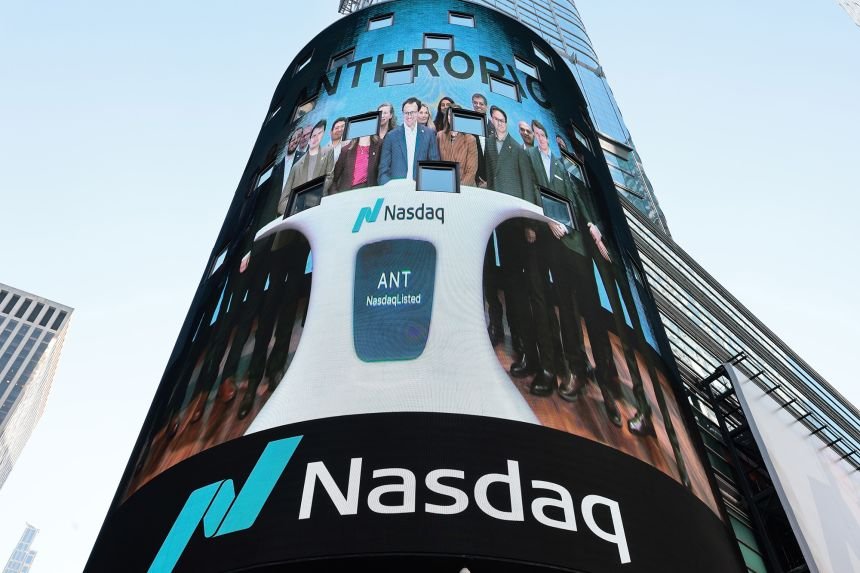
As the artificial intelligence startup Anthropic debuted on the US stock market at an eye-popping $2tn valuation Thursday, protesters from anti-AI groups rallied in front of the Nasdaq exchange at its New York City headquarters in Times Square and several were arrested. Similar demonstrations took place outside Anthropic’s San Francisco headquarters. “I think people are
If Anthropic’s first day of trading was a test, it would have passed with flying colors. With a $2 trillion debut at market open, the AI giant has clearly convinced Wall Street it can transform the way people work – and turn a massive profit doing it. Now comes the hard part. Anthropic will have
Market Closed – 04:00:02 2026-11-19 pm EST After hours 04:22:24 pm 214.94 USD +0.99% 213.88 -0.49% Published on 11/19/2026 at 03:04 pm EST MT Newswires This article is reserved for our members. Log in to continue Log inCreate an account DurationAuto.2 months3 months6 months9 months1 year2 years5 years10 yearsMax. PeriodDayWeek Coherent Corp. is one of
We just published a list of the Analysts Turned Bearish on These 10 Stocks on Wednesday and Freeport-McMoRan (NYSE:FCX) ranked 6th on this list. Wall Street’s November opened with a sharp break for technology shares. On November 3, the Nasdaq 100 slid into a correction, falling 10.4% below its October 6 peak. Economist David Rosenberg
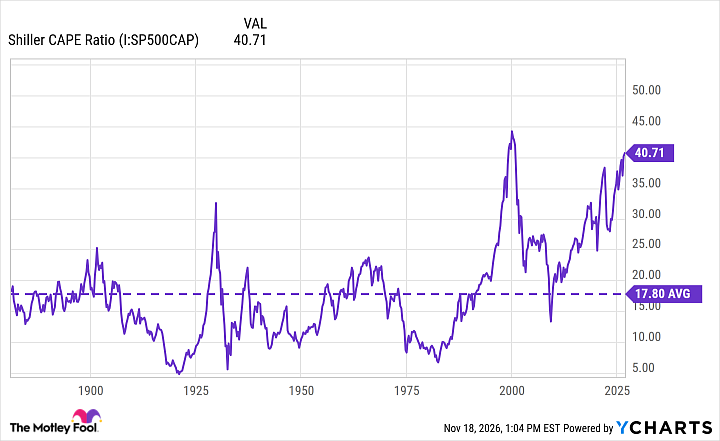
The CAPE ratio is hovering above 30 for only the sixth time in stock market history. By Adam Spatacco – Nov 19, 2026 at 11:00AM EST Key Points The CAPE ratio is a valuation metric that helps determine whether the stock market is over- or undervalued. History shows that when the CAPE ratio lingers above
UnitedHealth Group experienced notable downward pressure during the session, primarily driven by market apprehension surrounding elevated medical utilization and potential margin compression within its core health benefits business. Institutional investors have been closely monitoring signs of persistent upward drift in the Medical Care Ratio, fueled by sustained procedural volumes in outpatient and specialty care, particularly
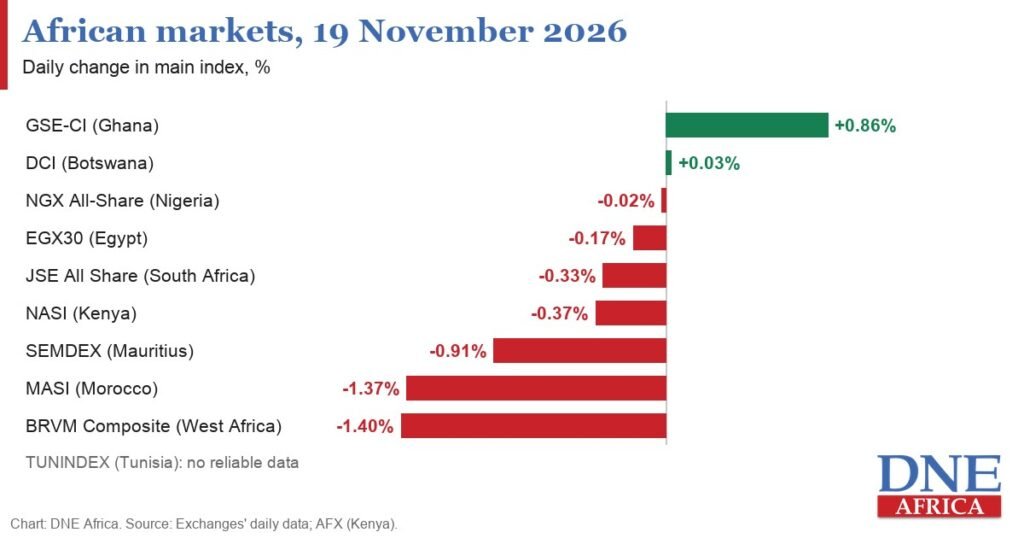
African stock markets fell on Thursday 19 November as the BRVM Composite index of eight West African states dropped 1.40 per cent and Casablanca’s MASI lost 1.37 per cent on its first session after Morocco’s Independence Day holiday. Seven of the nine African stock markets with reliable data closed lower. Only Ghana, up 0.86 per
Quick Read Michael Burry says he is “more in the high 30s now on NFLX,” far below its $60 price after a 46% yearly slide. Michael Burry would buy Alibaba “in the 60s,” well below its $87 close, and he is not buying NVIDIA calls to offset his puts. Netflix grew third-quarter revenue 12% and
The next stock market crash is always around the corner. Keep calm and check your asset allocations. By Ben Gran – Nov 19, 2026 at 10:00AM EST At first glance, the stock market seems to be having a decent year. As of Nov. 15, the S&P 500 index (^GSPC +1.16%) was up about 10.5% in
Much depends on your age and your financial situation. By Selena Maranjian – Nov 19, 2026 at 8:27AM EST Could a bear market be around the corner, happening this year or next? Absolutely — because stock market crashes and corrections, and, often, ensuing recessions, simply do happen every few years. Arguably, Wall Street is due
The stock market recently turned lower, and a growing chorus of risks could fuel further losses. By Anthony Di Pizio – Nov 19, 2026 at 7:16AM EST Key Points The stock market looks vulnerable to a sharp correction as rising interest rates and jitters in the artificial intelligence industry hurt investors’ confidence. Warren Buffett steered
The best stocks don’t just beat the market for a year or two. They compound wealth for a decade or more, and that kind of return almost always traces back to a business that keeps growing its customer base, revenue, and profits. MercadoLibre (NASDAQ:MELI) and Amazon (NASDAQ:AMZN) have both delivered monster returns, and their businesses
Anthropic, the most high-profile AI company to ever hit public markets, starts trading the same day that Grand Theft Auto VI — arguably the biggest video game launch of all time — becomes available. The former is Wall Street’s newest trillion-dollar wager on super intelligence — priced at $83 a share — and the latter is
October’s inflation report came in hot — and the stock market’s leading catalyst, among other factors, is pushing consumer prices higher. By Sean Williams – Nov 19, 2026 at 4:06AM EST Key Points Though new highs for the Dow Jones Industrial Average, S&P 500, and Nasdaq Composite since early August suggest all is well, rapidly