October’s inflation report came in hot — and the stock market’s leading catalyst, among other factors, is pushing consumer prices higher.
By Sean Williams –
Key Points
-
Though new highs for the Dow Jones Industrial Average, S&P 500, and Nasdaq Composite since early August suggest all is well, rapidly rising inflation says otherwise.
-
While higher gas and diesel prices are common scapegoats for elevated inflation, several other factors are also boosting consumer prices.
-
President Trump’s policies and Wall Street’s top growth driver are doing a number on the prevailing inflation rate.
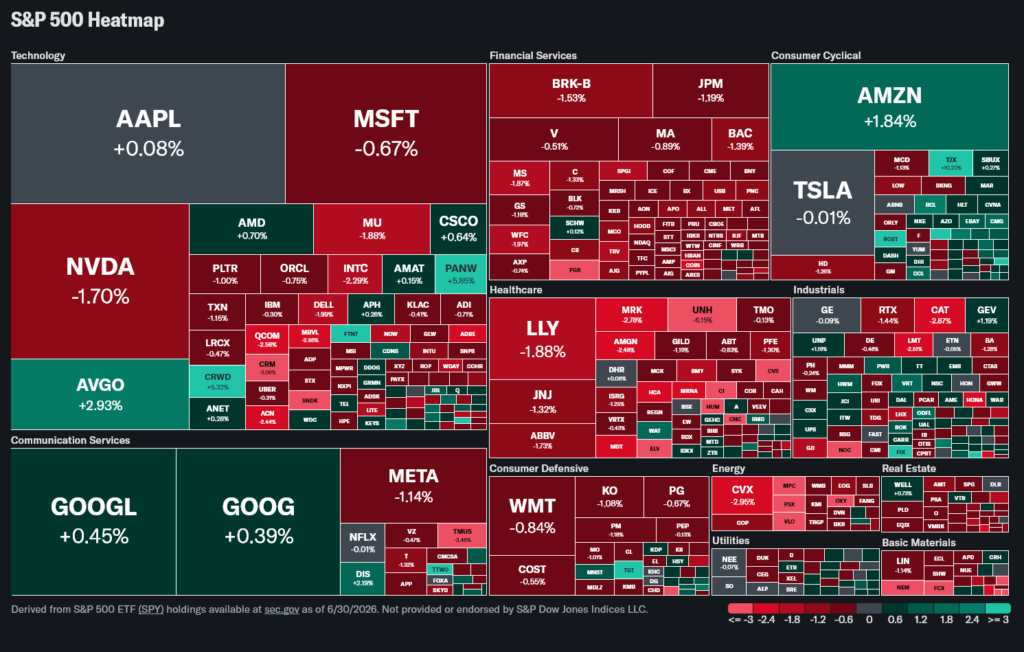
Since early August, the Dow Jones Industrial Average (^DJI -1.11%), S&P 500 (^GSPC -0.23%), and Nasdaq Composite (^IXIC +0.42%) have all blasted to record highs, with the artificial intelligence (AI) infrastructure build-out and better-than-expected corporate earnings leading the way.
But just because Wall Street’s major stock indexes have been on fire for the better part of the last four years, it doesn’t mean all is well with the U.S. economy. Based on the October inflation report, things are once again headed in the wrong direction.
Image source: Getty Images.
Although Fed Chair Kevin Warsh has pledged to return annualized inflation to the central bank’s long-term target of 2%, the Consumer Price Index (CPI) hit a three-year high of 4.2% in May and surpassed expectations on a month-to-month basis in October. Though the U.S. Bureau of Labor Statistics didn’t report an annualized CPI due to last year’s government shutdown, Riccardo Trezzi, former Fed economist at the Board of Governors of the Federal Reserve in Washington, D.C., estimates that annualized inflation for October reached 4%.
Higher fuel prices are certainly to blame for persistently elevated and reaccelerating inflation. But there’s more at play behind higher inflation than just rising gas and diesel prices.
Trump’s tariff and trade policy
To begin with, President Trump’s tariff and trade policy is contributing to goods price inflation. In “How Fast Do Tariffs Pass Through into Consumer Prices?” three New York Federal Reserve economists writing for Liberty Street Economics examined the effect of the president’s 2025 tariffs on consumer prices, finding they added an estimated 2.9 percentage points to goods price inflation by February 2026.
New from the New York Fed: “By February 2026, tariffs had contributed 2.9 pp to goods price inflation, and without them goods prices would have fallen slightly.”
About one quarter of every point in higher tariff rates shows up in consumer prices within one year.
• A 10% across-the-board tariff yields a 2.6% rise in consumer goods prices after one year.
• About two thirds of the increase comes from pricier imports, which get passed through quickly.
• Another third comes from U.S. made goods, as producers face higher input costs and less import competition. This takes longer, about 6-12 months, to filter through.— Nick Timiraos (@NickTimiraos) October 6, 2026
In addition to tariffs directly raising the price of imported products, duties on unfinished goods, such as steel, also increased domestic manufacturing costs.
Furthermore, in instances when imports were considerably costlier than U.S.-based products, domestic manufacturers would raise their prices to capture some of this difference.
The evolution of Iran-war-driven inflation
While higher prices at the pump are the most visible effect of the Iran war, we’re seeing the impacts of Iran-war-driven inflation evolve and reach the broader U.S. economy.
For example, some businesses have been forced to alter their modes of transportation or shipping routes and change suppliers due to the closure of the Strait of Hormuz. Other businesses are paying more for petroleum-based products, such as plastics and synthetic polymers.
Though some companies are absorbing these higher costs, others have chosen to pass them directly on to consumers, leading to higher prices.

Image source: Getty Images.
AI-driven inflation
Lastly, the stock market’s biggest catalyst, the artificial intelligence infrastructure build-out, is also lifting the prevailing inflation rate.
Make no mistake about it: the Dow Jones Industrial Average, S&P 500, and Nasdaq Composite wouldn’t have reached record highs without the data center build-out fueling better-than-expected corporate earnings. Demand for AI hardware is off the charts, and ongoing supply shortages of graphics processing units and memory solutions have led to stratospheric pricing power and gross margins for AI companies.
The AI boom is transforming one of the biggest deflationary forces into a key source of US inflation:
Import prices for computer and electronic products surged +7.4% in the first 6 months of 2026, to 77.1 points, the highest since January 2016.
This also marks a +8.0% YoY jump, the largest annual increase on record.
This represents a historic reversal from a downtrend which persisted for over two decades.
Between 2006 and 2019, computer and electronic product import prices fell -30%, as improving technology and manufacturing efficiency consistently pushed costs lower.
Now, the AI investment boom is straining manufacturing capacity for semiconductors, servers, and electronic components, as companies race to build out AI infrastructure regardless of cost.
The AI revolution has flipped technology from a long-term source of deflation into a major driver of inflation.
— The Kobeissi Letter (@KobeissiLetter) July 21, 2026
At the same time, the insatiable demand for electronic components has increased prices for virtually everything in the tech space. Not only are businesses paying more for AI-accelerated data centers, but consumers are also opening their wallets wider for any device with a central processing unit, storage, or memory.
Tackling elevated inflation becomes incredibly difficult for the Federal Reserve when the stock market’s No. 1 catalyst is a foundational source of that inflation.
Where to invest $1,000 right now
When our analyst team has a stock tip, it can pay to listen. After all, Stock Advisor’s total average return is 794%* — a market-crushing outperformance compared to 203% for the S&P 500.
They just revealed what they believe are the 10 best stocks for investors to buy right now, available when you join Stock Advisor.
*Stock Advisor returns as of November 19, 2026.