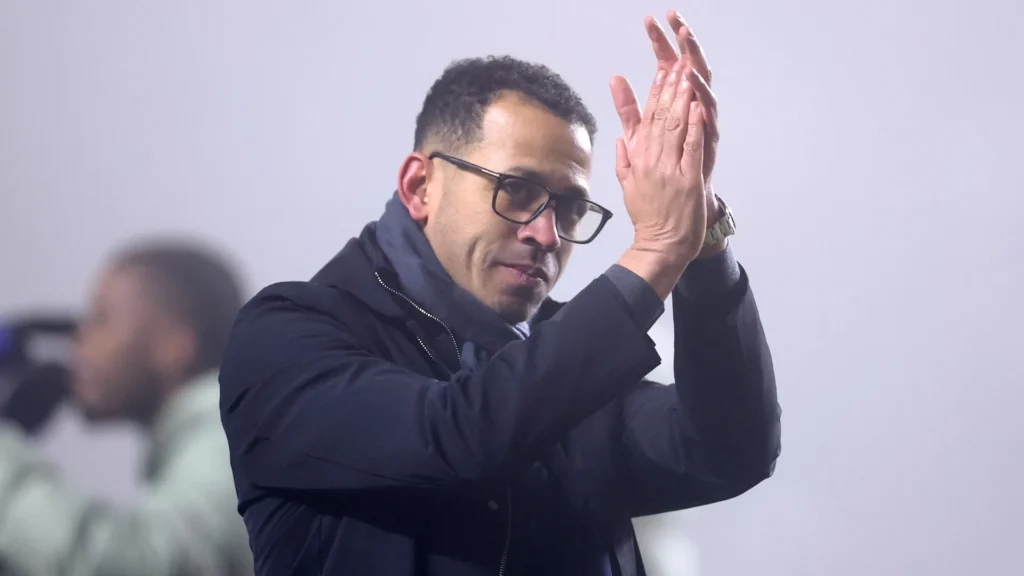
Sid Lowe (Photo courtesy of ESPN)
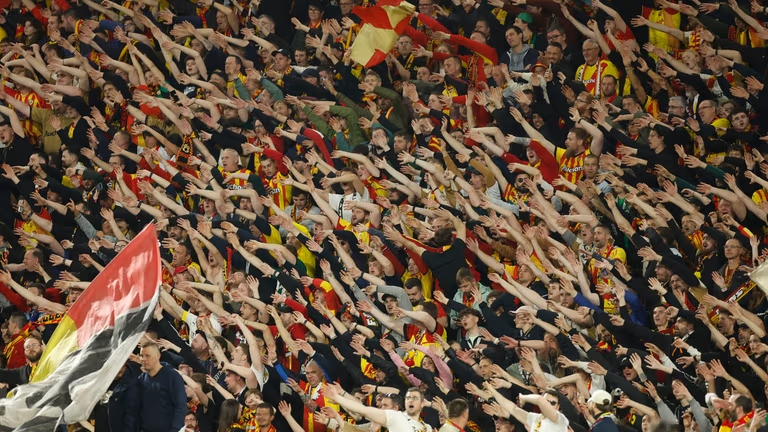
It was November 1, 2012, and Real Oviedo needed money. 11 years after suffering relegation from the Spanish top-flight, Oviedo found themselves languishing in the third tier and headed for liquidation. They needed €1.9 million immediately to avoid a winding-up order, €2.5m million to survive until to the end of the season, and €4 million to secure the club’s medium-term future, prompting them to start selling shares in the club at €10.75 per share.
In order to help Oviedo stave off extinction, Simon James “Sid” Lowe took to Twitter and posted: “The club that gave the Premier League [Santi] Cazorla, Michu and [Juan] Mata is under threat of going out of business. PLEASE buy shares.” It wasn’t long before Lowe’s followers started to pitch in and buy shares in Oviedo, including incoming New York City mayor Zohran Mamdani, whilst former players like Michu, Cazorla, Mata and Adrián López also spread the word and bought shares themselves. Over the course of a fortnight, over 20,000 people in more than 60 countries had purchased €1.93m of shares, ranging from small donations from fans to a $100,000 purchase from Real Madrid, who then ceded the shares to the local council, to eventually a $2.5 million investment from Mexican businessman Carlos Slim, at the time the world’s richest man. Just like that, Oviedo lived to die another day.
“Looking back on the entire process, it’s quite overwhelming in some ways. I was there when Oviedo whent down in 2001 in Mallorca, so to see them return to the first division after 24 years, it’s just extraordinary,” stated Lowe in an exclusive RG interview. It’s a mid-November afternoon in Spain as Lowe, fresh off a train ride from Sevilla to Madrid, glances up from his wristwatch. The Real Oviedo Supporters Group bestowed him with the watch in 2012, when Lowe was given the honor of delivering the opening speech at the city’s annual festivities. “I’ve changed the strap about 15 times because it keeps dying on me, but the actual watch is still the same one.”
“It makes me feel some pride in my role, but I also feel slightly awkward because I think there are so many people who did so much more than me to rescue Real Oviedo. I feel like too much of the story has been about me, so it’s a slightly strange one, and it does make me feel a little bit embarrassed. Whenever I go to Oviedo, people are incredibly nice to me and my family…I don’t deserve all of this, I don’t deserve them being so nice to me, but it is lovely. Being there the day we came up and at our first home game in the top-flight in a quarter-century vs. Real Madrid, it’s just incredible.”
Making the Move from England to Spain
Born in Archway, England on June 21, 1976, Lowe grew up in North London but didn’t support Arsenal or Tottenham Hotspur. Instead, he supported the dominant team of the time in Liverpool after his older brother Ben prohibited him from following his beloved QPR, with Lowe settling on Liverpool due to his admiration for Kenny Dalglish and his love of the color red. After studying abroad in Lorca, Spain at the age of 13, Lowe immediately decided that he was going to pursue Spanish as a subject, graduating with his A-Levels in Spanish. He started off studying History and Politics at the University of Sheffield before deciding to shift to a dual honors degree in History and Spanish, which saw him spend the 1996/97 academic year in Oviedo.
Lowe then started doing postgraduate research on Spanish history and paid for a part-time Master’s degree in History by teaching a course on Southern European fascism at Barnsley College. He also earned a PhD in 20th-century Spanish history from the University of Sheffield, with his doctoral thesis “Catholicism, War and the Foundation of Francoism: The Juventud de Acción Popular in Spain, 1932-1937” being published into a book.
“I came to Madrid in 2001 to earn my PhD, because that’s where all the archives, newspaper libraries and primary materials were. My idea was to come for a year, but at that point, I had already started writing about Spanish football and I just really liked it. One year became two as I argued my case with the university that I should stay; there was no need to come back to Sheffield, there were still so many more documents to gather, and I could do all the work from here. And so that became an extra year, and that extra year is now 25 years.”
In order to make headway in his research, Lowe moved to Madrid, where he has remained ever since. Just as Lowe was getting his first real taste of Madrileño life, The Guardian started taking a keen interest in European football and hired James Richardson for their Serie A coverage and Raphael Honigstein for their Bundesliga coverage. And for LaLiga, Sean Ingle, the head of Guardian Unlimited Sport, decided to hire his former university classmate and football teammate in the autumn of 2000, where Lowe he has remained ever since.
“Sean was running The Guardian’s website – Football Unlimited – and he knew me from university, so it’s a classic case of being lucky to have known someone. Sean knew that I could write and that I was fascinated by football, and that I had spent a year abroad in Oviedo. We had played in the same football team, and there used to be a rotating match report where someone would write a match report each time. Admittedly, those match reports were mostly piss-taking, joke match reports, but he knew that I could write and that I was really into it. He said, ‘Look, we’ve got Germany, Italy, and France, would you like to do a trial run for Spain? And that trial run has never ended.
I’m still here 24 years later, so that was the turning point. I was still in Sheffield at the time, but I was already doing a master’s on Spanish political history, so I was always going back and forth between Spain and England, and the following year, I came to live in Spain, and basically I never went home again. The football writing ended up becoming a bigger part of my life and my time than the PhD, and when David Beckham arrived in 2003, obviously, that side of things completely exploded.”
Balancing Journalism With Fatherhood
Over the past quarter-century, Lowe has been able to parlay his two biggest passions – Spain and football – into an iconic journalism career that has seen him become the foremost English-language voice on Spanish football, working for outlets like World Soccer, FourFourTwo, and TalkSport and serving as a translator for foreign LaLiga players like Beckham, Michael Owen, and Thomas Gravesen. After attending the 2008 Euros as a fan, Lowe covered his first-ever major tournament as an official journalist in the 2012 Euros, which saw Spain prevail with an unprecedented third straight major trophy. One year later, Lowe had his second book published: Fear and Loathing in La Liga: Barcelona, Real Madrid, and the World’s Greatest Sports Rivalry.
He hasn’t looked back ever since, working with big-name stars like Andrés Iniesta, Fernando Torres, Roberto Firmino and Luis Suárez as a translator and author and publishing their stories in the English language, whilst he’s also enjoyed Spanish-language gigs with leading stations like Cadena Ser, MARCA and Onda Cero, in addition to his award-winning The Spanish Football Podcast alongside Phil Kitromilides and Alex Kirkland. It doesn’t matter if it’s the Copa del Rey or the UEFA Champions League or or the Segunda playoffs or the UEFA European Championship or El Clásico; if a Spanish team is playing in a match with major implications, you can bet on Lowe being in the press box or the touchline.
Today, Lowe spends his time writing for The Guardian and other outlets working as a TV correspondent for ESPN, traveling across Spain on a weekly basis and telling the stories that matter, not necessarily the stories that get the most clicks, be that Manolo González’s journey from bus driver to Espanyol coach or Girona’s descent from Champions League nights to relegation battles. And whenever he can, he’ll squeeze in some time to spend with his wife and son, Charlie Mateo.
“It has been tough and still is tough, but I’m very fortunate that there’s a sort of understanding that this is just how it is. There’s an awareness that I’m often going to be away, maybe I can carve out a couple of hours rather than a full weekend or a full day. When it’s international break, I’ll normally just write about one game instead of having to sit and watch six games. My son will ask me, ‘Do you need to watch this game properly?’ and I’ll be like, ‘Well, I need to be aware of it,’ so I’ll have it on in the background whilst he plays PlayStation. It was easier when my son was younger and much more into it than he is now and would go to a lot of games with me…he’s now massively into Real Oviedo but less so the other teams, so it’s about managing that time.”
Leaving His Mark in the Journalism World
As he approaches a half-century on Planet Earth, Sid Lowe is continuing to stake his status as one of the greatest journalists in the history of Spanish football, weaving magic into the words of each story and transporting his readers into the very heart of the action. And after spending the past two summers in Germany and the USA and covering Spain and Real Madrid and Atlético Madrid’s exploits in the UEFA European Championship and FIFA Club World Cup, respectively, all signs point to Lowe playing a leading role in The Guardian’s coverage of next summer’s FIFA World Cup as La Roja pursue their second star.
Having watched from afar when Spain won their first-ever World Cup in South Africa in 2010, Lowe has since covered every single Spain tournament, watching them make history with a third-straight major trophy in the 2012 Euros as well as their long-awaited triumph in the 2024 Euros. It remains to be seen which team will crown itself as the kings of the world in next summer’s final in East Rutherford, New Jersey, but one thing’s for sure: Lowe will be there, chronicling every step of the action.
“I remember saying to my friend Pete Jensen after Argentina won the 2022 FIFA World Cup in Qatar that we should retire now because there’s nowhere we can go after this. It really did feel like everything was built for this, and after this, there’s nothing. Of course, there’s always something after, but I remember feeling, ‘Right, this is where you stop, mic drop, it’s done, you don’t get bigger than this. But that’s the nature of football and the nature of life – there’s always something else.”
“I’ve done World Cups and European Championship, so there isn’t a tournament that I want to tick off my bucket list, but one way to close all of this would be Spain winning the World Cup in Spain in 2030. I think that would be good, but the trouble is, I think it will probably come about 5-10 years too soon. I don’t think I’d be old enough to retire in 2030, but I do quite like the idea of ending it in 2030 with a Spain World Cup, and just saying, ‘Right, that’s the moment….or, do you know what? A Spain World Cup being won by England would be a nice way of rounding it all off.”