Despite Racing’s proud history, having spent over 40 years in LaLiga, there have been troubled times since relegation from the top division in 2012. Indeed, the majority of the past 13 seasons have been spent not even in Spain’s second tier but its third.
Now, the only fully professional team in Spain’s northern province of Cantabria are on the brink of their long-awaited return to LaLiga. Racing are four points clear at the top of the table and they are playing to packed houses in excess of 22,000 every other week.
Off-field issues have been resolved at El Sardinero but what has attracted attention beyond Santander – and is propelling them to promotion back to the top flight – is the brand of football being played under Jose Alberto. Racing are doing things differently.
The conventions of the positional game are not for them. Instead of maintaining the structure, they roam to constantly create new ones. Through passing triangles and clustering around the ball, Racing create overloads that way. It is their own distinctive style.
“For me, the nuance is important,” Jose Alberto tells Sky Sports.
“Positional play is more about structuring the team through predefined spaces and very precise occupation of zones.”
Jose Alberto continues: “Our ‘relationist’ approach focuses more on the interactions between players than on fixed positions.
“We want our players to understand what kind of relationships they need to create in each moment – with the ball, with team-mates, with opponents and with space. That gives us more flexibility.
“We don’t give up on structure because we want balance, but we aim to be a team that can adapt, move and create advantages through connections not just through positioning. In the end, it is less about where you are and more about who you connect with and why.”
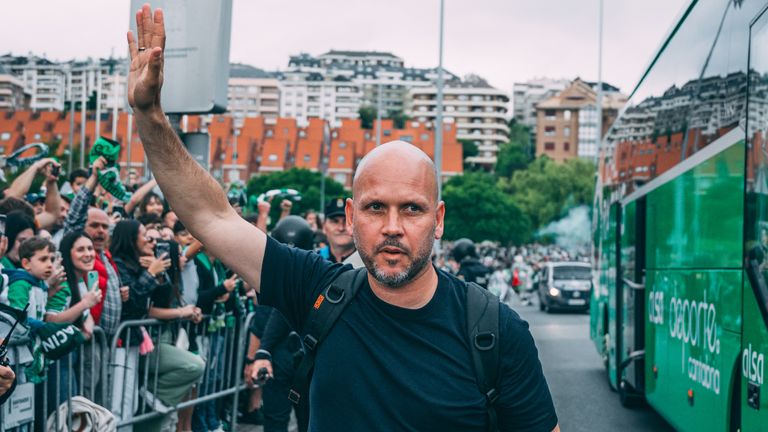
Racing head coach Jose Alberto has become a hugely popular figure in Santander
Others have had success with this ‘relationist’ football. Fernando Diniz won the Copa Libertadores with Brazilian club Fluminense. Henrik Rydstrom was inspired to try it with Malmo in Sweden and won two titles. But doing it in Spain is a particularly bold move.
While Diniz’s work was heralded by some as a return to traditional Brazilian ideas – a focus on dribbling, close interactions between players, an encouragement to play with more freedom – Spain’s success in the 21st century has been built on positional play.
“In Spain, positional play is a huge reference point, and I respect it a lot. I have learned a great deal from it. But I have also been influenced by more dynamic approaches, where the game is less rigid and more interpretative,” explains Jose Alberto, now 43 years old.
“I am interested in coaches who see football as a living system, where players constantly make decisions and where the team flows rather than being strictly organised.” Being interested in an idea is one thing. Implementing it is another. Why choose this approach?
“Because modern football demands adaptability, quick thinking and rich interactions. Opponents are very well prepared, and if you are too predictable, you become easy to control. We want to be a team that is hard to read, while still being balanced, brave and attacking.”
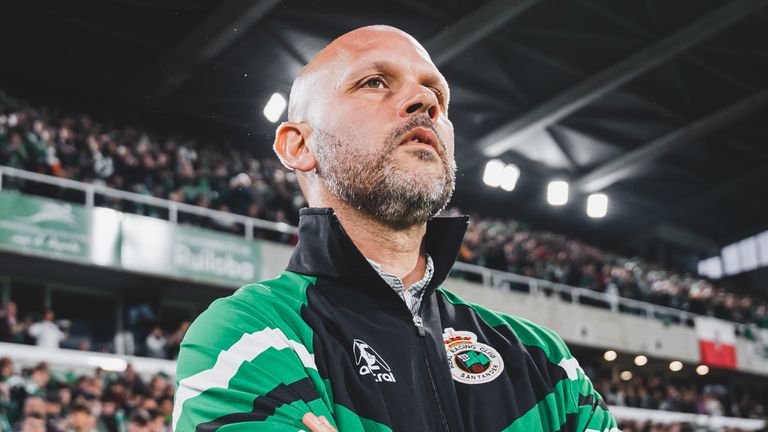
Jose Alberto’s Racing are the top scorers and runaway leaders in Spain’s second division
This is a growing theme in the modern game. Pep Guardiola and Mikel Arteta have both spoken of the challenge presented by man-to-man marking in the Premier League. Positional play is about finding overloads. Man-to-man marking makes finding them trickier.
A ‘relationist’ approach has been floated as a potential solution. “Man-marking, especially in high press or in certain defensive phases, can disrupt rigid structures. In that sense, it can be a useful tool to break opponents’ automatisms,” says Jose Alberto.
“But more than a solution, I see it as a context that you have to adapt to. That is where our model can have advantages because we prioritise relationships, we look to create dynamic superiorities, not just positional ones. If the opponent follows you, you have to be able to drag, free up spaces and connect on the move. It is a challenge, but also an opportunity to unbalance the opponent.”
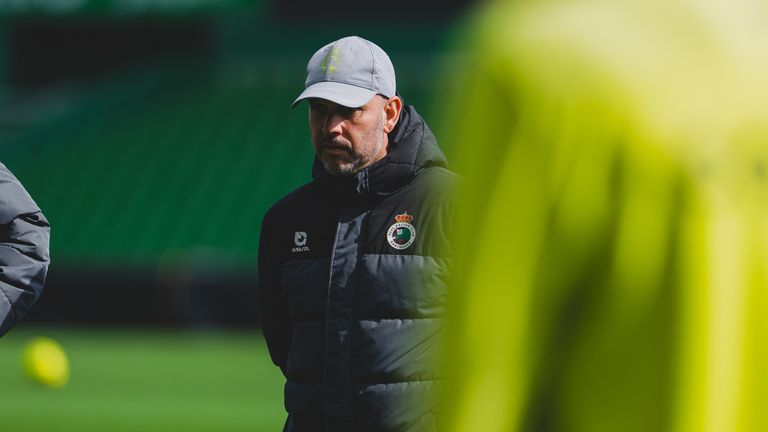
Racing head coach Jose Alberto uses relationism to unbalance the opposition
Racing have succeeded in doing that with their focus on quick one-twos and short passes – no team in their division have played fewer long balls this season. They are also the top scorers, by far, in the competition. But no system is flawless, of course.
For Rydstrom at Malmo, things eventually unravelled. It seems logical that when teams prioritise player relationships over a positional structure, the impact is greater if those relationships are broken. Is this idea more reliant on having long-term connections?
“Yes, it definitely helps,” concedes Jose Alberto. “Relationships are not only coached but they are also built over time. There are connections that come from mutual understanding, knowing a team-mate’s timing, their movements and decision-making.
“That said, we also work to make the model transferable. Any player who comes in should quickly understand the principles and integrate into the team. The balance is having a stable core that creates automatisms, but without depending only on specific individuals.”
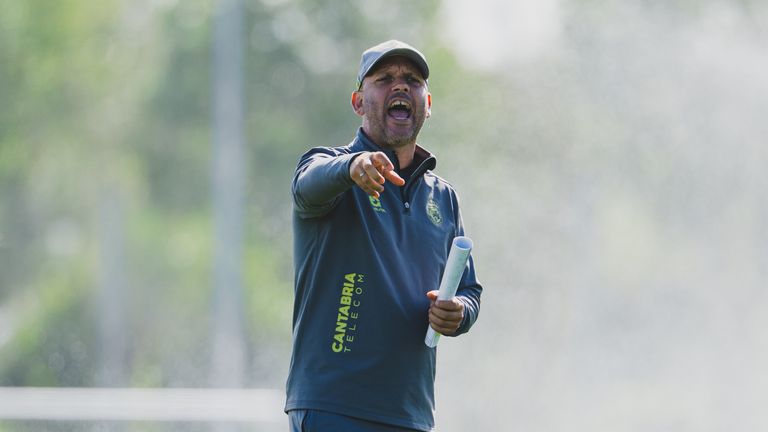
Jose Alberto believes his model has advantages against man-to-man marking
And there is more to Racing’s success than just tactics. “First, the commitment of the group, which has been very strong even in difficult moments. Second, the emotional management, because a season is long and full of ups and downs,” says Jose Alberto.
“Also, having a clear identity is crucial. The players know how we play and why, and that builds confidence. And finally, the environment. The club, the fans. At a club like Racing, that support makes a big difference. When everything is aligned, performance improves.”
But it is the fact that Jose Alberto and Racing have done this their way, a different way, that so intrigues. To finish the job and achieve promotion? “It would be something very special,” he says. “Not just because of the objective, but because of the journey.”
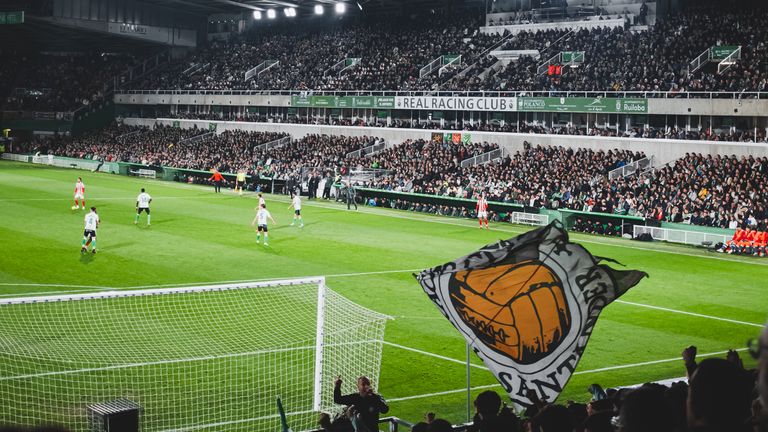
Santander’s El Sardinero stadium is full to capacity as Racing chase promotion
Racing, this “historic club with passionate and demanding fans” who slipped into the regional leagues and came back, are on the brink of a return to the big time. “Achieving promotion would mean we have built something solid, recognisable and competitive.”
And for Jose Alberto? He stresses that he regards this as primarily a collective success. But it is a form of vindication too. “On a personal level, it would validate a football idea I strongly believe in.” The idea of relationism. One that he hopes to be taking to LaLiga very soon.