(As a reminder, you can sign up for our email list here…)
This article is an update to a piece we originally penned in 2020. It was the third article in a four part series written during the pandemic.
Part I: “The Get Rich Portfolio”
Part II “The Stay Rich Portfolio“
Part III: “How I Invest My Money”
Part IV: “Investing in the Time of Corona”
In the first two pieces, we discussed strategies for generating riches and then preserving them. We hold some non consensus views on those topics, and I urge you to read those first before continuing below. (You can read a running list of my non consensus market views here.)
Our third piece illustrates how to combine these strategies in a real world, real time portfolio…my own.
This extends a piece I’ve been writing for years, namely, how I invest my own money.
Readers started showing interest in this topic years ago, usually as December rolled into January.
I suppose some investors found it useful to see how someone in the investment business allocated their money. Others perhaps found the process instructive for application to their own portfolio, or perhaps they just like to watch from the stands so they can cheer on or throw tomatoes (virtually, on Twitter).
What’s important is that you find an approach that works for you. For the late, great John Bogle, that was low cost index investing…
“To repeat, while such an index-driven strategy may not be the best investment strategy ever devised, the number of investment strategies that are worse is infinite.” – John Bogle
Will my strategy be the best strategy devised or the best strategy for everyone? Absolutely not. But is it the best strategy for me? I think so…
With that in mind, let’s pull back the curtain today.
Of course, there’s nothing too dramatic about what’s behind this curtain. As I wrote a moment ago, I’ve been publicly detailing what I do with my money for years, and I’m happy to keep doing so.
But a couple of disclaimers before we launch in…
First, this information shouldn’t matter to anyone outside my family (and, to be honest, none of them will read this). However, I recognize that many investors appreciate the thinking behind the process, either as a “template” for their own portfolio or just to spark some questions for debate.
That said, please understand I’m not offering this information as a recommendation for how you should invest personally. My situation is not yours – and even if it were, there are a million different market approaches that work just fine (the challenge is avoiding the 10 million approaches that are terrible).
Second, the numbers are not exact – and forget about decimal points! Attempting to provide that degree of specificity would be pointless. Furthermore, the most instructive part of this exercise is simply understanding how the big financial pieces fit together to create a holistic financial portrait, so specifics aren’t that helpful.
Third, this post can feel a bit anticlimactic for some investors, since I know most investors looking to get a read on how to position their portfolios are thinking about their stocks specifically. I’ll be 100% transparent about how my investments are positioned, but you’ll see this doesn’t materially change from one year to the next, since most of the funds do the work and make the adjustments for me. So, unfortunately, I have no “hot stock tips” for you in this post. Though if you want to gossip about investments and ideas over a meal or beverage, I’m always game!
Finally, you’ll see that I’m somewhere “in between” when it comes to wealth generation and wealth preservation strategies. I have a young family with plenty of financial needs, so I’m still trying to generate wealth. On the other hand, I’m trying to be thoughtful about my family’s financial future, so that means certain preservation strategies as well. And as I mentioned before, I really like to sleep soundly.
Again, this is what works for me right now, and it will change over time, so I don’t hold it out as a suggestion for any specific reader to follow. It’s merely an illustration.
Enough intro, let’s jump in.
The Biggest Pieces of My Net Worth
Most of my net worth is concentrated in entrepreneurial ventures I founded: my asset management company, Cambria, and my research company, The Idea Farm.
While the exact percentage is open to debate, it is likely somewhere between 75% and 99%. While not quite as extreme as Elon Musk’s “If Tesla & SpaceX go bankrupt, so will I. As it should be.”, ownership stakes in my companies are the biggest determinants of my net worth. This is likely true for many business owners around the world.
Echoing our prior essays on “Getting Rich” and “Staying Rich,” I think it is useful to bucket my holdings into these two categories.
Being a founder and owner of Cambria and The Idea Farm falls into the “Get Rich” bucket.
That said, if you exclude Cambria and The Idea Farm, my largest holdings are about 50% in investments in 400+ private startup companies, 20% in real assets like housing and farmland, and the remainder in my public investment portfolio. (I’d like the split to be closer to 33% each over time, but due to appreciation and some developments detailed below, they have drifted somewhat out of balance…)
All you historians will recognize this ideal allocation as approximating the 2,000 year old Talmud portfolio that is spread equally across real assets, businesses, and “safe” reserves.
(You can download our free Global Asset Allocation PDF here with chapters on various asset allocations, including the Talmud portfolio. Look out for a 2nd Edition in 2027!)
Let’s unpack the categories.
Farmland is generally a pretty stable, income producing asset and is about as non correlated as you can get to the rest of the portfolio. (Stay Rich bucket.)
It also offers real sentimental and emotional value for me because of family roots in the area. Plus, if you ever want to seriously disconnect with some quiet time, there is no better place. (Or if you want to shoot guns, drive around on an ATV, or just not be bothered by anyone…) And when the public markets are going haywire, you can take solace that land values don’t update minute by minute… Here’s a picture of me trying to figure out if farmland went up or down from a few years ago.

So, if you guys ever want to meet up at The B-Hive in Kansas, let me know…
The big update is that I’ve sold my direct farmland holdings and diversified into farms on various private platforms that have been on the podcast over the years. I like having the connection to my family and roots in the Midwest, but the challenge is farming is a big pain in the butt, and most of my family there is “aging out”, meaning the younger generation isn’t interested in farming. Owning the land becomes less a sentimental decision and more a financial one. And if it’s a financial decision, I’d rather have someone else do all the hard work while also diversifying across geography and crop. I plan to add more farmland over the next few years…and in the meantime, I can visit my brother when I need fresh air.
I struggle with whether to include my house in the portfolio, but I lean toward yes.
I’ve also detailed my private angel investing journey over the years on the blog with “Journey to 100x” and on the podcast. (Get Rich bucket. Though, depending on the outcome, it could also be the “Get Poor” bucket…)
I believe that the long (indefinite) holding periods and big tax benefits are major features of this approach. Plus, it’s a lot of fun, incredibly engaging, and you wake up every day a lot more optimistic. (Contrast that with the consistent negative geopolitical news flow in public markets!) I’ve considered my investments so far as “tuition,” and while the performance hurdle for me is the US stock market, the hope is this portfolio will do much better.
As for the performance of my angel investments, most of the 400+ deals I’ve participated in to date are still in their infancy. However, about 100 have exited (53 bankrupt or zeros, 27 acquisitions, 7 IPOs, and 11 with secondary liquidity).
In my still open investments, there are lots of follow on rounds and even a few unicorns on paper. While these results are incomplete and paint a rosy picture of angel investing, I’m very aware this period has been incredibly favorable for private angel equity investments. What’s important in this endeavor is seeing it through a full cycle over the next decade. Believe me, I lived in San Francisco during the early 2000s decimation. I’m sure I’ll see a range of winners and losers.
The biggest cashed out winners have been a 23- and a 57 bagger…still waiting on that 100x! This outcome provides a good lesson in the power laws of private and public markets. (Worth repeating and sharing these good papers here on public markets: Bessembinder, JP Morgan, Vanguard, Longboard. Check out the Chris Mayer podcast for more on public 100 baggers.)
It’s a different mindset when you can’t sell an investment. If my money had been invested in a public stock, what are the odds I would have sold after a double or a triple? (I’m going to say “high” to “very high.”) While buying and holding a stock for the long run is a nice theory, it can be hard to implement in practice. I plan to keep allocating to startups over the next few years as opportunities arise.
The nice feature of investing across vintages since 2014 is that the portfolio now spans companies from tiny $2m market cap startups to well established, cash flowing decacorns worth over $10 billion…
You can sign up for our email list to get updates on this topic in the future.
Public Investments
Okay, let’s turn to my public portfolio now.
First, just a note to anyone reading this who has money in various funds or ETFs, which is most of us…
Ask any mutual fund manager why you should invest with them, and you’ll likely find yourself met with a barrage of sales points, all of which will underscore one takeaway—their fund deserves lots of your money.
But when you ask said manager what they do with their own money – it may surprise you…
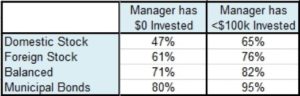
Often, many managers have $0 invested in their own fund!
Below is the percentage of managers that have nothing, zero, zip, invested alongside the client money they manage (thanks to Russ Kinnel at Morningstar FundInvestor for this info):
If you’ve followed my blog or podcast for a while, you know where I’m headed…
This is absurd.
But I guess it shouldn’t be surprising. The mutual fund industry has long been an area dominated by high fees, tax inefficiencies, sales loads, 12b-1 fees, and other investor unfriendly practices. Maybe these fund managers are smart enough to not invest in the funds they manage! But the world is wising up, and investors are voting with their checkbooks, and the fund flows tell the story.
I think it’s important to have skin in the game. If I don’t believe in Cambria’s funds enough to invest my own money here, why should anyone else? I get it if you manage a California muni bond fund, maybe you don’t want all your money in the fund, but still. The next question is, “Yeah, but WOULD you invest in it?” Many PMs would fail the lie detector test. These fund products just have no soul.
So, for better or worse, I invest nearly all the public assets I can into funds I manage. Then, I leave it on autopilot. (Stay Rich bucket.)
Even though the right portfolio is whatever lets you sleep at night, I prefer a moderate risk portfolio that targets higher returns than buy and hold with lower volatility and drawdowns – quite a tall order!
So, that translates into my current allocation of market sensitive assets, what I have described many times before as “buy and trend”, or the Trinity strategy. I implement this allocation mainly through the publicly traded Cambria Trinity ETF (TRTY), as well as the Trinity strategies on Betterment.
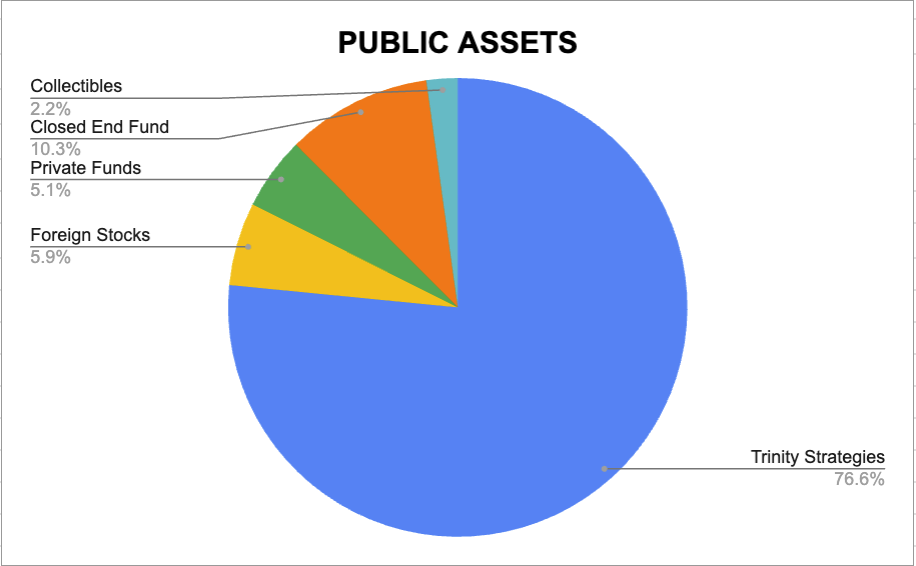
The Trinity approach invests roughly half in a global strategic buy and hold asset allocation that is allocated across stocks, bonds, and real assets. The strategy tilts toward value and momentum, rather than standard market capitalization weighted portfolios. The biggest problem to me with a buy and hold strategy is that it is highly correlated to my human capital and the economic cycle. When the economy is doing poorly, this portfolio often does too, the opposite of what most would prefer!
The other half of the Trinity approach is invested in various trend following strategies. The goal of these strategies is to reduce volatility and drawdowns, while still targeting similar returns to a buy and hold strategy, but with lower correlation. The hope is that trend zigs when buy and hold zags, and vice versa. Trend strategies tend to do well when markets are doing poorly, but they’re not easy to follow when times are good! No strategy is perfect, so I like balancing both.
This works for me because, if you’ve read my blog for a while, you know I’m a trend follower at heart, yet also a value investor. This approach lets me scratch both itches.
As a trend follower, I like keeping half of my portfolio available to move to cash or hedges if markets trend down. Right now, many of these trend strategies are heavily exposed to real assets like commodities and real estate. These assets will hopefully protect the portfolio if the current inflation uptick is here to stay.
But as a value investor, I want exposure to assets that may be cheap over long horizons (like I believe foreign stock markets are now).
I get both with this approach. I want all my public investments totally on autopilot. I don’t want to make trades or think about buying that cheap country when my emotions argue against it, which will likely trip me up. I don’t want to have to think about selling that amazing market as the trend ends.
In fact, I don’t want to think about it AT ALL. But I do want the funds and strategies to make all the adjustments for me, objectively, automatically, and tax efficiently.
This allocation includes what I consider to be my “cash” account. This has been one big change in my thinking over the years: you should invest at least some, or all, of your “safe” money (hat tip to Dan Egan of Betterment for pushing me here).
The earlier piece we did on the Stay Rich Portfolio shows what many investors believe is the safest portfolio, isn’t. I believe, when measured on a “real” after inflation basis, a cash account is as risky as a nice asset allocation, with much less return potential…So, I invest nearly all the cash type investments I would have in a broad allocation ETF and keep only a small amount for short term living expenses.
I currently have a tiny allocation to tail risk strategies. I see this as a hedge against my career beta and my private stock holdings. I’ll plan to add a lot more (and I mean a lot more) if the stock market ever enters a downtrend again…
The next slice is the foreign funds category, which represents some tax exempt accounts that (sadly) have a limited selection of funds. So I toss them into what I see as the best low cost long term investments I can find: foreign and emerging stock markets. (You can see Twitter peeps lose their mind over that revelation…)
Lastly, a tiny amount goes into rare coins, comic books, art, and collectibles. The rare coin allocation goes back to our Van Simmons podcast episode, and this fits in the Stay Rich bucket (and “Fun” bucket.) Comics I’ve probably held for 30+ years (thanks, Mom!) fit into the “Fun” bucket too. I’ve also invested in a few paintings on Masterworks.
Crypto, well, that falls into what I’d call the “regret minimization” bucket. I’m not really attracted to crypto as an asset class, but I’d be willing to make an allocation in line with their market cap in the global market portfolio (about 0.5% currently), mainly to avoid regret if the space ever goes up in value 100x (and to quiet all my friends from badgering me if they do – well worth the sunk cost!). Like many, I wish there were better public low cost choices that I could hold, but fingers crossed, hopefully one day.
In general, I find crypto companies far more interesting than cryptocurrencies themselves, and I’ve made about a dozen investments in that space.
That’s about it! Feel free to shoot me any thoughts, and best of luck with your own investment journey…
But let’s end on an important note that we often overlook in the countless hours we spend on our investments.
What’s the point?
Remember that money is only a means to an end. It’s there to help you achieve your life goals and happiness.
Does it help you fulfill your dream of travel? What about putting your grandkids through college? Perhaps you want to support a local charity or social cause dear to you. Or maybe you want to help establish the next generation of entrepreneurs through capitalism. Or maybe you just want to fish with your friends. Whatever. Let the investments help get you there.
Or the shorter version my Mom and Grandmother had a habit of saying, “You can’t take it with you.”
And below is the longer version we’ve had on the blog since inception over a decade ago…
“People ask me, ‘What is the use of climbing Mount Everest?’ and my answer must at once be, ‘It is of no use. ‘There is not the slightest prospect of any gain whatsoever. Oh, we may learn a little about the behavior of the human body at high altitudes, and possibly medical men may turn our observation to some account for the purposes of aviation. But otherwise, nothing will come of it. We shall not bring back a single bit of gold or silver, not a gem, nor any coal or iron… If you cannot understand that there is something in man which responds to the challenge of this mountain and goes out to meet it, that the struggle is the struggle of life itself upward and forever upward, then you won’t see why we go. What we get from this adventure is just sheer joy. And joy is, after all, the end of life. We do not live to eat and make money. We eat and make money to live. That is what life means and what life is for.”
― George Mallory, Climbing Everest: The Complete Writings of George Mallory
Meb Faber is the Founder and Chief Investment Officer of Cambria Investment Management, L.P. (“Cambria”), a registered investment adviser. The information set forth herein is for informational purposes only and does not constitute financial, investment, tax or legal advice. Please see the appropriate professional advisor for advice specific to your situation. There is no guarantee that a particular investment strategy will be successful. Opinions expressed herein are subject to change at any time. Past performance does not guarantee future results. All investments are subject to risks, including the risk of loss of principal.