Here’s What a $10,000 Investment in Nvidia Stock Will Be Worth by 2030

Nvidia (NVDA -1.43%) has made investors significantly richer over the past four years, turning a $10,000 investment into nearly $179,000 as of this writing.

This massive surge in Nvidia’s shares has been fueled by the advent of artificial intelligence (AI). When OpenAI’s ChatGPT, introduced publicly in November 2022, became a big hit, companies lined up to buy Nvidia’s graphics processing units (GPUs) after it emerged that the semiconductor giant’s chips played an instrumental role in training the chatbot.

The AI economy and Nvidia have come a long way since then. AI is now finding its way into several industries, boosting productivity and economic growth. The good news for Nvidia investors is that AI adoption isn’t showing any signs of slowing, which explains why the company continues to deliver robust growth even after becoming significantly larger over the past four years.

We will take a closer look at the company’s prospects in this article and assess whether investing $10,000 in Nvidia stock over the next five years could be a profitable move.

Image source: Nvidia.

Nvidia is the world’s largest company, but it can become even bigger

Nvidia’s AI-driven surge has made it the world’s largest company with a market cap of $5.2 trillion. So, expecting another 20x jump in Nvidia’s stock price over the next five years would be quite absurd, as it would put its market cap past $100 trillion. However, that doesn’t mean Nvidia stock can’t climb higher over the next five years.

NVDA Nvidia

$214.13-$3.10 (-1.43%)

NASDAQ · As of 4:00 PM ET 10/16/26

After all, the company is still growing at an impressive pace despite the scale it has achieved. Nvidia’s revenue in the first six months of fiscal 2027 (which will end in January 2027) increased by 96% over the same period last year to $177.8 billion. The company expects fiscal Q3 revenue of $108 billion, an 89% jump from the year-ago period.

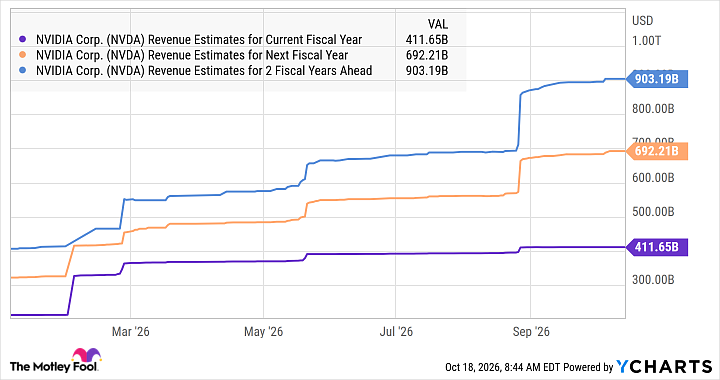
Analysts expect a 91% spike in Nvidia’s revenue for fiscal 2027 to $411.6 billion. Meanwhile, earnings per share are expected to almost double in fiscal 2027 to $9.31. Importantly, Nvidia CEO Jensen Huang is confident that the company’s growth will continue unabated next year. He recently noted at a conference that the number of chips the company sells will double in 2027, according to CNBC.

Huang added that continued investments in AI infrastructure will drive this incredible growth, as companies and governments look to make the most of the technology’s benefits. For example, the World Economic Forum noted earlier this year that AI could increase labor productivity by 1.5% to 3% over the next decade, citing the chief economist of consulting giant EY.

Moreover, investors will do well to note that AI is moving beyond data centers into real-world applications, such as robots and cars. Known as physical AI, Nvidia is pushing into this niche where machines can make complex decisions on their own. From performing precision-related tasks such as threading needles in surgical wards to operating on a conveyor belt, Nvidia is moving into a new frontier that could supercharge its long-term growth.

Nvidia’s physical AI offerings are already being used by the likes of Amazon and Japan’s national AI venture, and I won’t be surprised to see the tech giant pulling in more customers. That’s because the physical AI market’s revenue is expected to grow to 430 billion euros by 2030, suggesting this niche could move the needle significantly for Nvidia over the next five years.

Throw in the $3 trillion to $4 trillion revenue opportunity that Nvidia sees in the AI infrastructure market in 2030, and it is easy to see why analysts have become extremely bullish about its growth prospects through fiscal 2029 (which will end in January 2029).
NVDA Revenue Estimates for Current Fiscal Year Chart

NVDA Revenue Estimates for Current Fiscal Year data by YCharts

According to the above chart, Nvidia’s revenue could increase by 68% in fiscal 2028, which is almost in line with the company’s guidance of 70% growth. That’s expected to be followed by a 30% increase in fiscal 2029 to $900 billion. There is a solid chance Nvidia will maintain strong growth in fiscal years 2030 and 2031 as well, which could set the stock up for further gains.

The stock can still deliver impressive gains

Let’s assume Nvidia’s top line increases by even 10% in fiscal 2030 and 2031 (which will end in January 2031), its top line could reach $1.09 trillion in 2030 (given that fiscal 2031 will coincide with the majority of calendar 2030).

Now, this AI stock trades at 18 times sales. Assuming Nvidia trades at half of this sales multiple after five years, its market cap could jump to $9.8 trillion (based on the $1.09 trillion revenue estimate). That implies a potential upside of 88% from current levels. So, a $10,000 investment in this semiconductor stock will be worth more than $18,800 by 2030.

However, that could be a conservative estimate, as Nvidia could grow faster and command a premium valuation after five years. That’s why investors can still consider buying this AI bellwether, as it has the potential to make investors richer owing to emerging niches within the AI ecosystem.


Source link

Visited 1 times, 1 visit(s) today

Related Article

Buy Alert: 5 Stocks Analysts Upgraded on Thursday

Wall Street’s third-quarter earnings season is nearly over, and the profit numbers are large. With about 88% of S&P 500 companies reported as of November 10, earnings are tracking 31.4% above a year earlier, according to FactSet. That would be the third straight quarter of growth above 25%. On November 10, inflation took over the

Stocks Decline in Asia as Investor Concerns Over Nvidia Fallout Extend Into Another Week

Those worries have spread to Asia, where AI hardware stocks are prominent on markets including in South Korea and Japan. South Korea’s benchmark Kospi index lost 2.8% to 5,142.84. Shares fell for memory chipmaker SK Hynix and Samsung Electronics, two of its most valuable companies. SK Hynix plummeted 5.5%, while Samsung Electronics gave up 3.2%.

External shocks don’t alter A-share long-term case

AI/CAI MENG/CHINA DAILY Recent volatility in overseas technology shares has shown once again how quickly changes in global risk appetite can travel across markets. Concerns about inflation, the cost of financing artificial intelligence investment and the returns on large-scale computing projects have prompted investors to reassess valuations. When tech stocks are crowded trades, leveraged positions

GLOBAL MARKETS CALL: Central Banks Are Tightening

The global AI trade should make a nice comeback now that the latest issue of The Economist sees the bottom falling out of it: The weekly financial magazine, famous for its contrarian cover stories, also recently picked the top in global bond yields when it ran a cover story titled “Will bonds blow up?” in

Is SpaceX Stock Worth Buying and Holding for 10 Years?

Space Exploration Technologies (SPCX -0.59%) has grand ambitions: revolutionizing space travel, making space tourism commonplace, building a human colony on Mars, among others. The rocket company has taken incremental steps toward these goals since it became a publicly traded corporation in June, but its stock has been volatile. It has actually declined from its opening-day

Bloom Energy Is Down 43% From Its High. Should You Buy the Dip?

Bloom Energy (BE -4.92%) had a knockout third quarter, with growth on all sides of its business. Third-quarter revenue came in at $1.24 billion, up 138% year over year, and full-year 2026 guidance was raised again, this time to a range of $4.4 billion to $4.6 billion. Bloom announced another major deal, this one with

2 Brilliant Stocks to Buy Before 2027

Few areas of the economy look much worse than housing right now. Existing-home sales dropped 8.8% year over year in October, according to the National Association of Realtors, as mortgage rates reached their highest levels since 2000, pushing home sales to their lowest level since August 2010. You might expect every business tied to the

Why Fervo Energy Stock Surged This Week

A landmark 15-year power purchase agreement with Alphabet (GOOGL -0.98%) (GOOG -0.96%) and operational progress at its Utah facility sent Fervo Energy (FRVO -1.20%) soaring 297% this week, according to data from S&P Global Market Intelligence. Fervo Energy stock closed at $11.51 on Friday, Nov. 13, up 29% from its close on Friday, Nov. 6.

Want to Invest in Top Growth Stocks Like Amazon, Apple, and Microsoft but Avoid Nvidia? Consider This Low-Cost Vanguard ETF That’s Up 24.8% This Year.

Investors who want to avoid Nvidia (NASDAQ:NVDA) but put capital to work in growth-focused, exchange-traded funds (ETFs) face a difficult challenge. Nvidia is an integral part of index funds and exchange-traded funds (ETFs) — as the second-largest S&P 500 (SNPINDEX:^GSPC) and Nasdaq Composite (NASDAQINDEX:^IXIC) holding behind Apple (NASDAQ:AAPL). Nvidia also joined the Dow Jones Industrial

The Stock Market Is Doing Something for Only the 6th Time in 156 Years, and History Says It’s Clear What Comes Next for Stocks

Despite a few periods of short-lived volatility, 2026 has shaped up as another banner year for the stock market. The ageless Dow Jones Industrial Average (^DJI +0.10%), benchmark S&P 500 (^GSPC -0.40%), and innovation-powered Nasdaq Composite (^IXIC -0.91%) have reached several record highs, courtesy of the artificial intelligence (AI) infrastructure build-out. While history decisively shows

The Evidence Is Piling Up: AMD Could Be the Best Artificial Intelligence (AI) Stock to Buy Amid the Sell-Off

The past few months haven’t been pretty for semiconductor stocks, as evidenced by the 12% decline in the PHLX Semiconductor Sector index over the past three months. Even Advanced Micro Devices (AMD -8.75%) has been caught up in this vortex, experiencing significant volatility amid concerns about the sustainability of artificial intelligence (AI) infrastructure spending, which

These 5 International ETFs Add Stocks From Outside the U.S.

The Vanguard FTSE Developed Markets ETF (VEA +0.01%), Vanguard FTSE Emerging Markets ETF (VWO -0.09%), iShares Core MSCI EAFE ETF (IEFA +0.13%), iShares MSCI Emerging Markets ETF (EEM -0.36%), and Vanguard Total International Stock ETF (VXUS -0.02%) all enable investors to add some international exposure to their portfolio. However, that doesn’t mean these funds are

These 3 Dividend Stocks Just Reported Strong Earnings. Here’s the One I’m Buying Now.

Three real estate investment trusts, or REITs, reported third-quarter results recently, and the results looked strong across the board. Realty Income (O -0.74%), Empire State Realty Trust (ESRT +1.53%) and Ryman Hospitality Properties (RHP -1.04%) own very different kinds of real estate, and all three raised their full-year guidance. I own all three of these

The Stock Market’s Election Day Rally Just Taught Investors a Crucial Lesson

Mr. Market was a fictional character created by Benjamin Graham, the man who helped to train Warren Buffett. The stock market’s response to the mid-term election results is almost the perfect example of how Mr. Market works in the real world. And all you need to see to understand is two days of performance of

Elon Musk’s Tesla and SpaceX Lost More Than $420 Billion in Combined Market Value in Two Days After Democrats Swept the Midterms, With Investors Fearing New Congressional Probes. Here’s Why That Political Risk Matters for Shareholders

Elon Musk-led publicly traded corporations, Tesla (NASDAQ:TSLA) and Space Exploration Technologies (NASDAQ:SPCX), remain volatile. In the days following the U.S. midterm election, they shed a combined $420 billion in market value. Both companies recovered most of these losses and are now back around their pre-election levels, but this recent episode highlighted the extent to which

0
Would love your thoughts, please comment.x
()
x