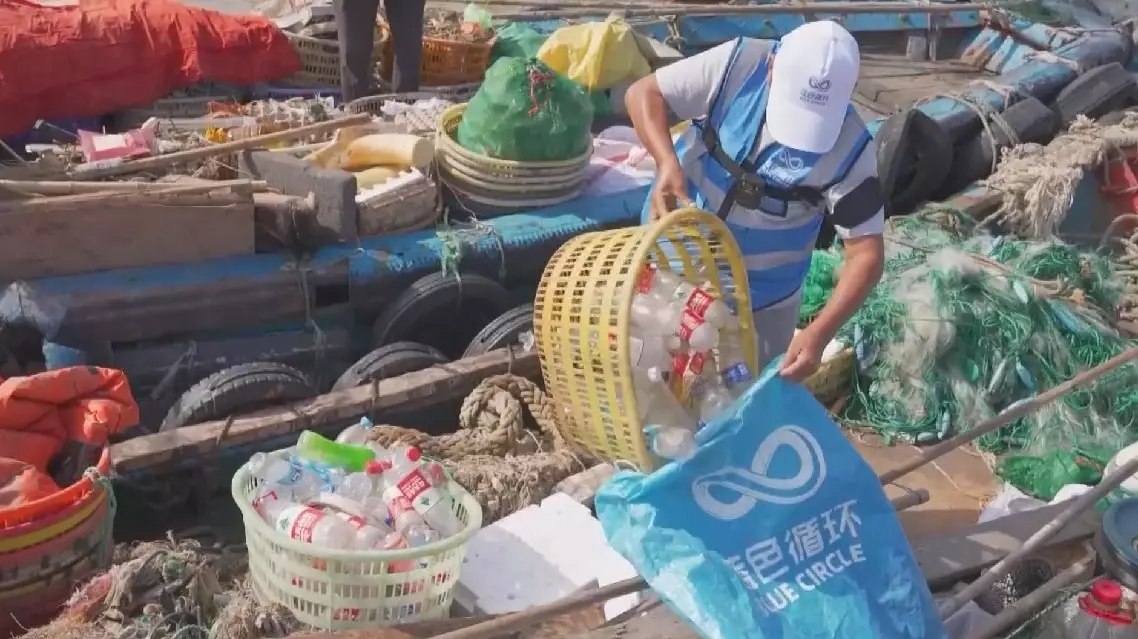
Fishermen in Taizhou City in east China’s Zhejiang Province recently have used the off-season to perform maintenance on their boats in preparation for the upcoming fishing season.
The maintenance for the fishing boats and refrigerator ships generate amount of oily wastewater, which would harm the ocean and local environment.
However, thanks to an innovative program, called the Blue Circle environmental initiative which explores sustainable ways to turn plastic waste into useful resources, all fishermen need to do is to place an order on their phones, and a collecting ship will come to assist them in dealing with the waste.
“We have a record of the whole process. After we collect it, we pull the whole contaminant into our ‘ocean cloud warehouse’ for a treatment,” said Chen Hui, a staff member from Zhejiang Vision Blue Technology Co.
The “Ocean Cloud Warehouse,” developed by the Zhejiang Vision Blue Technology Co., is an intelligent processing system that can sort, temporarily store, purify, and pre-process waste.
The smart pollutant control mode was pioneered by Taizhou in 2019. By using blockchain technology and the Internet of Things, the project comprehensively monitors the entire lifecycle of plastic waste, encompassing collection, regeneration, re-manufacturing and re-sale.
To popularize and promote the project, the Taizhou government has provided free oil pollution treatment services to fishermen for five consecutive years, allowing them to apply without any fees.
Oily sewage and waste oil collected from fishing boats or on the coast are transported to the “cloud warehouse” terminal by cleaning trucks and then sorted to different pipelines according to their types.
“After pretreatment, the oily sewage will go through our primary filtration and then our secondary fine filtration, after which we will conduct an oil-water separation and discharge the treated domestic sewage into our municipal pipe network once it has reached the required standard. When waste oil is separated, it will be transported to a qualified processing company for a compliant disposal,” said Fang Min, director of operation and maintenance department of the Zhejiang Vision Blue Technology Co.
The “Ocean Cloud Warehouse” recently has upgraded with a three-color code system rating all the ships with ecological protection credit evaluations. Ships which are given a yellow or red code will be banned from fishing and it will also affect the follow-up grading and applying for subsidy for the ships.
“Fishing ships that receive a red code will be suspended from fishing until they have completed the process of collecting pollutants on their vessel. Judging from the overall implementation of the project, the awareness of fishermen in this regard has also increased,” said Hu Shaohua, deputy director of Bureau of Agriculture, Rural and Water Resources of Taizhou Jiaojiang District.
At present, Taizhou has processed 6,148 tons of ship waste, and the pollution control efficiency has increased by more than 50 percent. The mode is copied and popularized in many coastal cities now.
Decoding China’s innovative technology in addressing oily ship waste
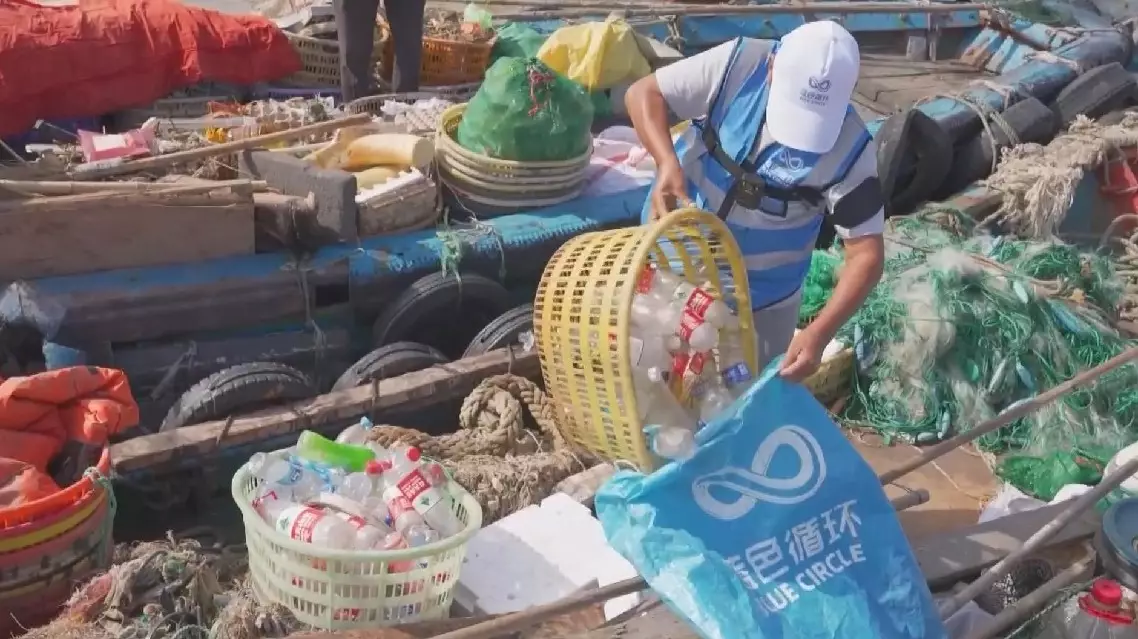
Decoding China’s innovative technology in addressing oily ship waste
Ningbo City in east China’s Zhejiang Province has launched the province’s first “Youth Noon School”, an educational program that allows young people to pursue their interest during lunch breaks.
The program, launched by the Ningbo Talent Development Group Co., Ltd. at the end of June, features various courses in crafting, human resources, business etiquette and smartphone photography, with two to three sessions each week. Each class lasts 45 minutes and is completely free of charge.
“This class is about flower-making. We opened registration for 40 spots three days in advance, and immediately over 2,300 people signed up, with all spots taken within minutes. We will also offer courses on photography and skill development, which have also been very popular,” said Xu Jinbo, co-founder of the program.
In addition to the appealing course offerings, courses are delivered at the Zhejiang Innovation Center, which houses nearly 200 companies, making it convenient for young people to attend.
This program addresses the needs of young people, particularly working mothers. While night schools are available, they are only for those who have free time after work.
Working mothers, who are often busy with children in the evenings, find that lunch breaks provide a more manageable time to explore their interest.
Experts believe that the rise of such programs not only reflects the diverse needs of young people but also their pursuit of a work-life balance.
“Young people want to improve themselves. Programs like ‘noon school’ and ‘night school’ not only provide learning opportunities, but also help alleviate their stress,” said He Zhenbiao, director of the Academic Committee of the School of Media and Law of the Ningbo Tech University.

Ningbo offers young people free interest-based classes during lunch breaks