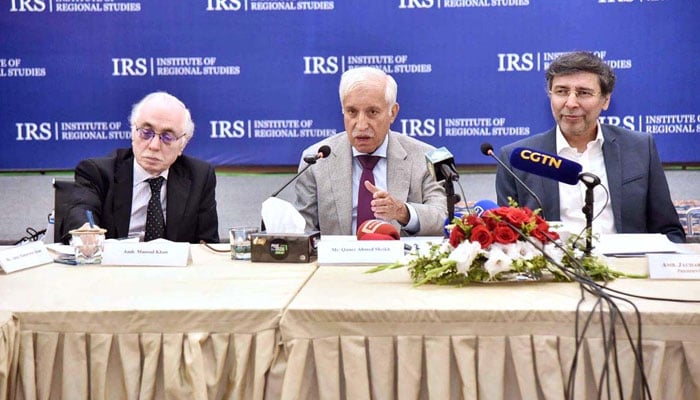
Islamabad:Federal Minister for Board of Investment Qaisar Ahmad Shaikh has urged businesses to move beyond imports toward technology transfer and investment partnerships with China.
Shaikh was delivering keynote address at a policy dialogue on “Strengthening governance and implementation strategies for CPEC 2.0” organised here by Institute of Regional Studies (IRS). Two reports: “Unlocking CPEC Phase II: building capacity for business-to-business cooperation with China and Central Asia” and “From infrastructure to impact: conceptualising the strategic corridors (5Cs) under CPEC 2.0” were also launched on the occasion. The session was moderated by Nabila Jaffer, from IRS.
Shaikh outlined key lessons from China’s economic transformation, highlighting Pakistan’s widening trade gap and the need to boost exports. He noted that nearly 70% of regulatory reforms eliminating redundant approvals and red tape have been completed.
Shi Yuanqiang, Deputy Head of Mission at the Chinese Embassy, highlighted CPEC Phase I’s role in easing Pakistan’s energy shortages and upgrading infrastructure and outlined the five corridors of CPEC 2.0 — growth, livelihood, innovation, green and open. He referred to over $20 billion in energy investments, $400 million in revenue and 6,000 jobs from the Haier-Ruba Economic Zone, 27 firms at Rashakai SEZ, and over 1,000 daily patients at Gwadar Friendship Hospital. He also pointed to space cooperation with Pakistani astronauts training in China and emphasised alignment between China’s 15th Five-Year Plan and government’s Uraan Pakistan initiative, reaffirming commitment to Former ambassador Masood Khalid emphasised removing regulatory bottlenecks, improving federal-provincial coordination and strengthening institutional coherence to attract FDI into SEZs and operationalise CPEC 2.0. He also highlighted the importance of the ML-I track in modernising Pakistan Railways which is key to development. Earlier, Jauhar Saleem, President, IRS, welcomed the participants.