Plug Power Surges 8% Amid Turnaround Hope: Was $1 the Permanent Floor for PLUG Stock?
Quick Read
Plug Power (PLUG) jumped 8% to $1.16, but a $134 million cash cushion and dilution risk keep the $1 floor unproven.
Plug Power cut cash usage 54% last quarter and targets positive EBITDAS in Q4, yet $192 million of noncash gains flattered profit.
Bloom Energy and FuelCell Energy rose 3% alongside Plug, but Bloom’s data center boom sets it apart from Plug’s forklift and hydrogen model.
Read: Building a portfolio and living off one are two completely different skills, and almost nobody teaches the second. This problem is what The Definitive Guide to Retirement Income helps with, and it is free today. Read more here.
A fresh rally in Plug Power (NASDAQ:PLUG) is testing whether the hydrogen company’s recent bottom can hold. Plug Power stock is gaining $1.16 in early trading, up 8%. The gain fits a broader rebound in beaten-down growth and clean energy stocks, and Plug Power’s fuel cell peers are trading higher too.
gchutka / E+ via Getty Images
Over the past five years, Plug Power stock is down 97%, so any talk of a bottom deserves a hard look. That history sets up the central question for the stock: is $1 a durable floor, or just another pause in a long decline?
Why the $1 Line Matters for Plug Power
Nasdaq-listed companies whose shares close below $1 for an extended stretch can receive a deficiency notice, an early step toward possible delisting. For Plug Power, that makes $1 more than a psychological level. A sustained break below it could add exchange compliance pressure on top of the company’s operating challenges.
Plug Power traded as low as $0.88 on November 25 before rallying above $1 the same day, even after an analyst lowered a price target on the stock. Holding that line through a downgraded target suggested buyers were willing to step in near the level. Plug Power’s follow-through now gives the floor argument a second data point.
——
Now Available: The Definitive Guide to Retirement Income
Many successful investors eventually reach the same moment. The saving is done, the portfolio is built, and the question quietly changes from how much can I grow this to how much can I take out? Get that second question wrong and decades of good investing can come apart in a handful of years.
That is exactly what The Definitive Guide to Retirement Income helps answer. It covers what your retirement could actually cost, which income sources are worth using, and the withdrawal math that decides whether the money lasts. It is free today from Fisher Investments. Read More Here ›
——
What Supports a Floor Near $1
Third-quarter results released on November 9 give the bulls their best material on Plug Power. In that report, Plug Power posted Q3 2026 revenue of $200.6 million, up 13.3% year over year. Net cash usage at Plug Power fell 54% sequentially to approximately $28 million, achieved without raising any capital.
Management also repeated Plug Power’s 2026 revenue growth guidance of 15% to 16% and is targeting positive earnings before interest, taxes, depreciation, amortization and stock-based compensation (EBITDAS) in Q4 2026. CEO Jose Luis Crespo framed the quarter around execution: “We grew revenue, improved margins, and significantly reduced cash usage through disciplined execution.” A company that’s shrinking its cash burn while growing sales has a better shot at defending a low share price, and Plug Power is doing both.
PLUG Earnings Explorer — 24/7 Wall St.
What Could Put Plug Power Back Below $1
The bears point first to Plug Power’s balance sheet. Cash and equivalents at Plug Power dropped to $134.1 million at the end of the third quarter from $368.5 million at year-end 2025. Even with lower burn, that cushion doesn’t leave much room for mistakes, and the company has warned that it may need additional capital, which could dilute shareholders.
Plug Power still posted a third-quarter operating loss of $75.253 million. The positive bottom line leaned on $192 million of noncash fair-value gains, and chief financial officer Paul Middleton said on the November 9 call that excluding them, Plug Power would have reported a net loss. That gap between headline profit and operating results is why skeptics see the bounce as thin.
Bloom Energy and FuelCell Energy Rise Alongside Plug Power
Fuel cell stocks are moving in the same direction as Plug Power. Bloom Energy (NYSE:BE) stock is at $156.96, up 3%. Over the year to date, Bloom Energy stock is up 81%, a run tied to AI data center power demand, an end market where Plug Power has far less exposure.
FuelCell Energy (NASDAQ:FCEL) stock is at $7.70, up 3%. The bounce at FuelCell Energy follows a steep slide, with the stock down 33% over the past month. Plug Power’s advance is larger than either peer’s move.
How Plug Power’s Business Differs From Its Fuel Cell Peers
Hydrogen is central to Plug Power’s model. The company sells GenDrive fuel cell systems that power forklifts and other material handling equipment, and it builds GenEco electrolyzers that produce green hydrogen for large industrial projects. That mix ties Plug Power to warehouse spending and to the pace of hydrogen project approvals.
Bloom Energy, by contrast, makes solid oxide Energy Servers that deliver stationary onsite power, with demand heavily linked to hyperscalers and data center operators. FuelCell Energy builds carbonate fuel cell platforms aimed at behind-the-meter data center power, along with carbon capture work alongside ExxonMobil (NYSE:XOM). Both peers mainly sell electricity generation, while Plug Power sells mobility and hydrogen production equipment.
Plug Power’s Fourth Quarter Could Test the $1 Floor
Plug Power’s next test is whether the company delivers positive EBITDAS in the fourth quarter. Hitting that target, along with the steep revenue ramp the company’s full-year guidance requires, would strengthen the case that $1 has become a durable floor. A miss, or another round of dilutive financing, could quickly put the $1 line back in play.
Plug Power’s progress is real, and so is its cash squeeze. A smaller exposure to PLUG stock could make sense until the fourth-quarter EBITDAS question resolves.
Released: The Definitive Guide to Retirement Income
(Sponsor) Most people spend their entire working lives focusing on one thing: growing a pile of money. Then they retire and discover the skill they actually need is close to the opposite. Turning that pile into steady income, year after year, through good markets and bad, without ever running out.
It may be the least discussed and most consequential transition in personal finance, and plenty of otherwise careful investors walk into it with no real plan. That is exactly what The Definitive Guide to Retirement Income helps answer. It is a free guide from Fisher Investments covering what your retirement will really cost, where the cash flow should come from, and how much you can safely withdraw each year. Learn more here. Learn More Here ›
Want to bookmark your favourite articles and stories to read or reference later? Start your Independent Membership today. Join today Already a member? Log in Sitting next to his wife First Lady Melania Trump while calling U.S. service members deployed in the Middle East on Thanksgiving, Donald Trump didn’t hesitate when asked what he’s most
Nvidia’s market share lead is too much to ignore. By Keithen Drury – Nov 27, 2026 at 10:45AM EST Nvidia (NVDA -0.61%) and AMD (AMD +2.43%) are rivals. These companies compete in multiple industries, but none as big as data centers right now. Both AMD and Nvidia have strong product offerings. Still, Nvidia took an
As of this writing (after the market close on Nov. 25), the S&P 500 index (SNPINDEX:^GSPC) has declined in nine of the past 10 trading sessions. Yet despite the sell-off, the benchmark index remains up about 5% for the year; ditto for the Dow Jones Industrial Average (DJINDICES:^DJI) and the Nasdaq Composite (NASDAQINDEX:^IXIC) indexes, which
2026.11.27 2026.11.27 Gold Seeks Support from the Stock Market. Forecast as of 27.11.2026 Dmitri Demidenkohttps://www.litefinance.org/blog/authors/dmitri-demidenko/ Gold has recently been more sensitive to waning interest in AI than to the Fed’s monetary policy, rising Chinese imports, or other factors. A recovery in gold prices requires a stable stock market. Let’s discuss this topic and outline a
Investors have spent weeks running from AI stocks. Many of the funds they’re running to are loaded with them. The Nasdaq-100 (^NDX) has tumbled since its Oct. 6 record, twice falling more than 20% below it during the day, the usual line for a bear market, only to rally back before the close. Meanwhile, chip
The market is unprepared if Nvidia ends up being fine. By Keithen Drury – Nov 27, 2026 at 5:00AM EST Nvidia (NVDA -3.91%) has a handful of problems right now. Although its chief executive officer, Jensen Huang, is back in his former position, there are still questions about his activities and whether any of Nvidia’s
Anthropic’s (NASDAQ:ANT) first two days as a publicly traded company were already days for the history books. It started off trading at about $110 per share before closing at $97. That’s still a double-digit percentage gain from its list price, so it was a great day. Then it was caught up in a rout of
The math on Vertex’s after-hours dip doesn’t add up. By Prosper Junior Bakiny – Nov 27, 2026 at 4:53AM EST Key Points Regulators extended povetacicept’s review period by up to three months. However, a few months of lost sales hardly justify $10 billion in erased market value. Vertex’s core business and promising kidney pipeline make
A sharp decline in artificial intelligence (AI) costs is bringing analytical and trading tools within closer reach of individual investors. As data is processed faster and orders are routed in milliseconds, the quality of investment decisions still depends on the people using the technology. It takes just around 3-5 milliseconds to process and route a
By Dr. David Edward Marcinko; MBA MEd http://www.DavidEdwardMarcinko.com SPONSOR: http://www.MarcinkoAssociates.com *** *** How a U.S. Stock Market Correction Impacts International Markets The United States sits at the center of the global financial system. Because the U.S. economy is the largest in the world and its stock exchanges account for nearly half of global equity market
The past six weeks have been tough for Nvidia (NASDAQ:NVDA) and its shareholders. In October, growing concerns about how businesses will finance future build-outs for artificial intelligence (AI) started weighing on semiconductor stocks. In early November, the mid-term election results showed a clear rebuke of massive data centers and the potential for increased regulations to
Merger talks might jolt Tesla stock by year-end, or they might now. By Prosper Junior Bakiny – Nov 26, 2026 at 5:15PM EST Key Points SpaceX and Tesla committees are reportedly weighing a merger. If a deal moves ahead, it will come with significant uncertainty. Tesla’s own business looks somewhat promising, but the valuation remains
Watching stocks plunge can make even the most seasoned investors nervous. Indeed, the S&P 500 (SNPINDEX: ^GSPC) and Dow Jones Industrial Average (DJINDICES: ^DJI) closed in correction territory on Nov. 20. From there, the Nasdaq Composite (NASDAQINDEX: ^IXIC) surged 6.5%, and the S&P 500 jumped 4.7% on Nov. 23. Image source: Getty Images. Missed Nvidia
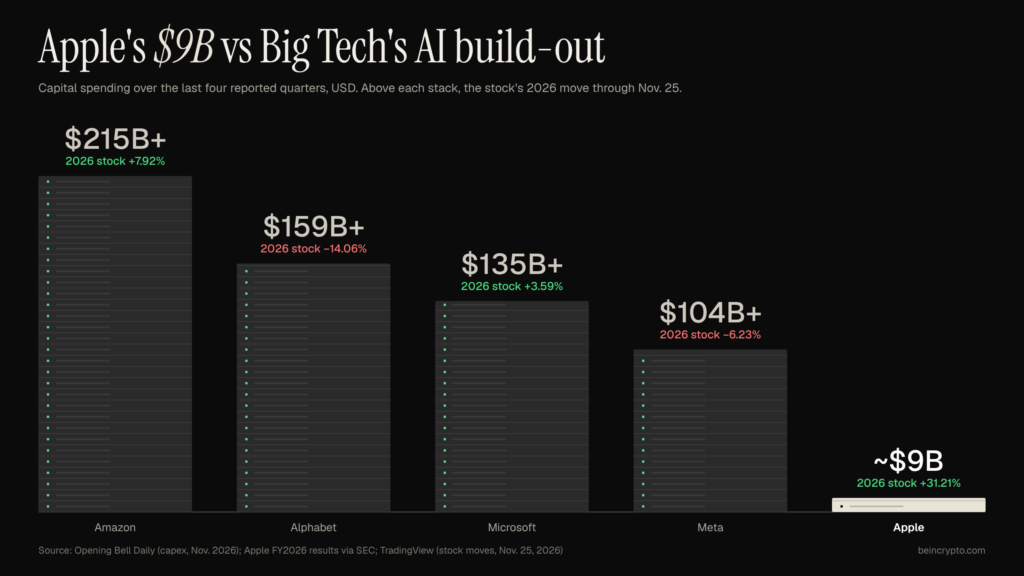
Most US tech stocks erased their entire 2026 gains this month. Yet, Apple (AAPL) stock has gained 31% this year. That is four times more than Amazon. The Magnificent Seven are the largest US tech companies and a core holding in S&P 500 index funds. Five of them remain deep in the red after the
For most of this year, the big question around Oracle (NYSE:ORCL) was whether it could pay for its data center ambitions. The company now says it can. In a Nov. 20 statement, it said all the funding for its OpenAI contract is in place. That message, along with Jensen Huang’s reinstatement at Nvidia, sent the
Quick Read Walmart and Target raised guidance and cover dividends from operating profit, with Target yielding 3% versus Walmart’s 1%, the group’s lowest starting income. Target’s comparable sales rose 6% and traffic grew 5%, but tariff refunds inflate this year’s earnings and will not repeat. TJX lifted its quarterly dividend from $0.26 in 2021 to
A crash would put these dominant businesses on sale, and one already looks cheap. By John Ballard – Nov 25, 2026 at 2:42PM EST Key Points Market crashes are a good time to buy essential, profitable companies with the cash to keep investing through a downturn. Alphabet’s reach, TSMC’s pricing power, and Amazon’s rising profitability
The semiconductor sector has experienced heightened volatility in 2026, with several stocks retreating significantly from their 52-week highs. These deep pullbacks reflect heightened profit-taking and valuation concerns. They have also been exacerbated by shifting investor sentiment after the US midterm elections and uncertainty surrounding artificial intelligence (AI) spending. The Philadelphia Semiconductor Index (SOX), which tracks
Young investors nursing steep losses are delaying marriage, home purchases and plans to expand their families as housing prices keep rising. An illustration shows a distressed retail investor rethinking marriage and homeownership as he faces falling stock prices.CHATGPT Korea’s stock market crash is wrecking not only portfolios but also ordinary lives — upending lives as well