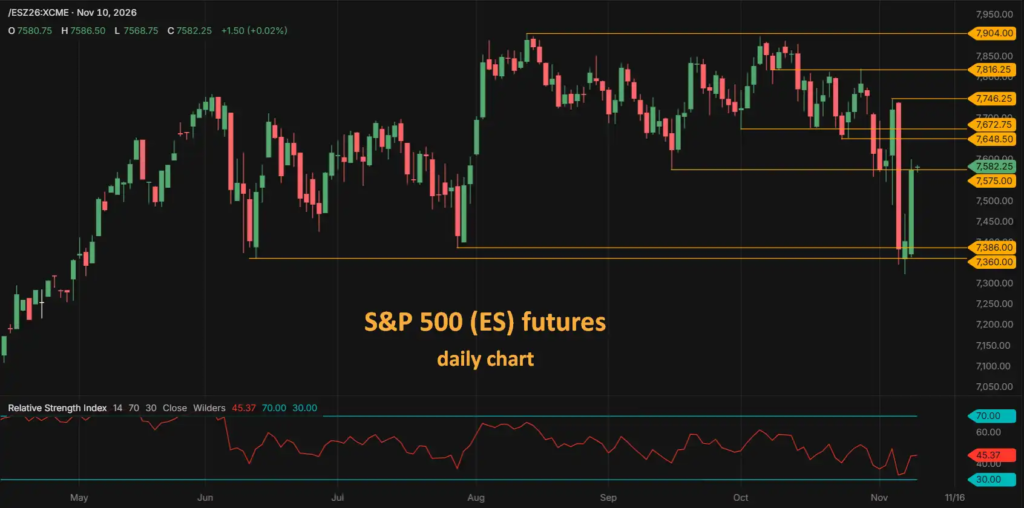
Dip buyers didn’t wait long. Two sessions after the S&P 500’s worst day in 18 months, stocks added more than $1.6 trillion in value, even as Nvidia kept sliding.
The S&P 500 (^GSPC) was up about 2.3% Monday afternoon, its best day in seven months, while the Nasdaq-100 rose more than 3.4%, its best since May 2025.
Chip stocks did the heavy lifting. AMD (AMD) and Broadcom (AVGO) jumped roughly 9% to 13%, adding more than $200 billion in combined market value — more than Nvidia’s (NVDA) loss. Micron (MU), Applied Materials (AMAT) and Lam Research (LRCX) also climbed.
The hole is deep. The S&P 500 lost 4.4% on Nov. 5 — its worst day since the April 2025 tariff tantrum — and the Nasdaq (^IXIC) closed Friday about 11% below its Oct. 6 record, putting it in correction territory.
The bounce usually isn’t the bottom
Since 1950, the S&P 500 has fallen 4% or more in a day and then gained 2% or more within three sessions 17 times, according to Yahoo Finance calculations. That window captures Thursday’s drop and Monday’s bounce.
In 11 of those 17 cases, the index closed below the sell-off day close within three months. But a year later, it was higher 14 times, with a median gain of about 21%. Six of the 17 came during 2008-2009.

The pros ran, the dip buyers didn’t
Last week’s selling came from the top. “Hedge funds de-risked at a historic level,” Nationwide chief market strategist Mark Hackett wrote Monday. By his count, their net bets on rising stocks sank to about the lowest in five years.
Everyday investors went the other way. “Institutions hit the panic button last week, while a surge in leveraged ETFs suggests retail investors were once again buying the fear,” Hackett wrote.
The flows back him up. The Direxion Daily Semiconductor Bull 3X ETF (SOXL), built to triple chip stocks’ daily moves, took in a record $9 billion in October, according to Bloomberg data. It pulled in another $2.2 billion on Nov. 5 alone, the day chip stocks fell 12%.

“We had an aggressive sell on Thursday with, again, net buying from the ETF complex, net buying from payroll contributions,” Dave Nadig said on Yahoo Finance’s “Market Hang.” “Lo and behold, Friday and Monday’s payroll contributions show up, and we’re back in the green.”
Even one of Wall Street’s best-known bears sees an end in sight. Morgan Stanley’s Mike Wilson said the correction is entering its “final phase.”
The Nov. 5 close of 7,353.73 held about 30 points above the S&P 500’s 200-day moving average. A close below it would fit the retest pattern. Holding above keeps the bounce intact into Tuesday’s inflation report.