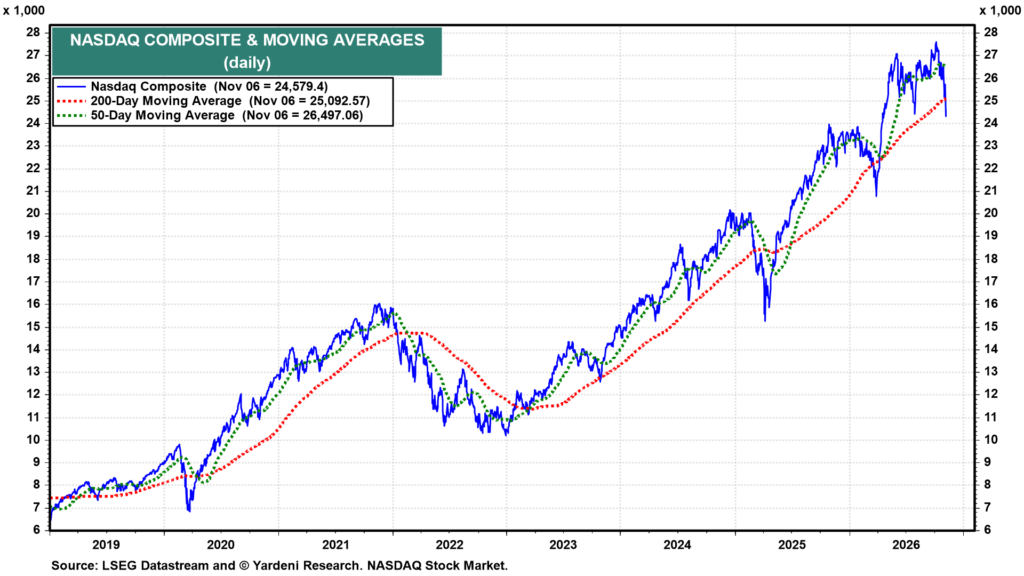
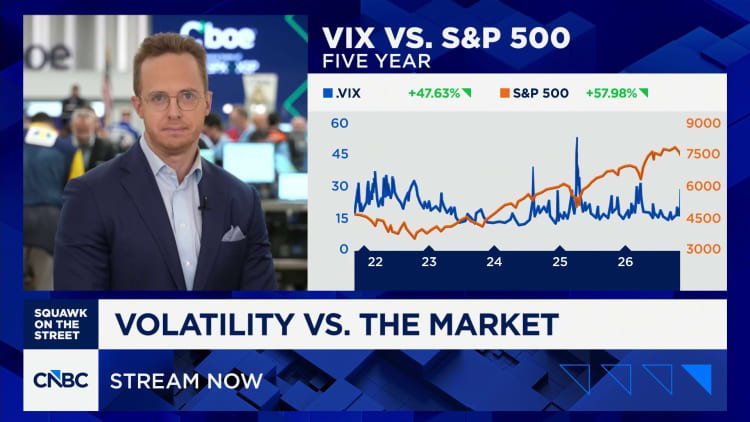
The S&P 500 (^GSPC +0.31%) fell 4.4% on Thursday, its worst day since April 2025, while the Nasdaq slumped 5.5%. That deep sell-off pushed the Nasdaq into correction territory, with it tumbling more than 10% below its recent record.
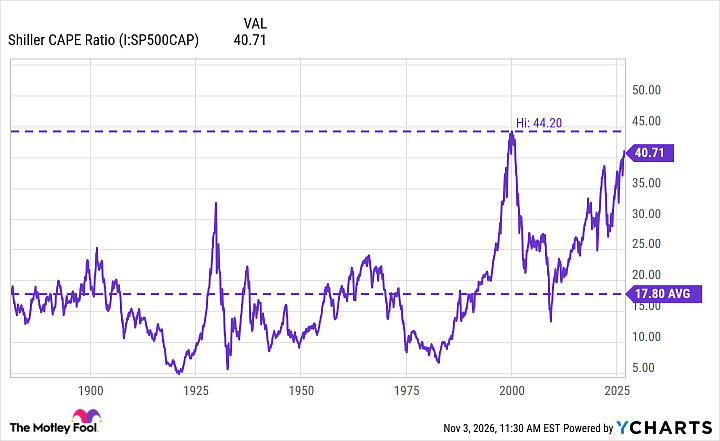
Nobody knows whether that’s the start of something bigger. But it landed in a market already priced for perfection. The S&P 500’s cyclically adjusted price-to-earnings (CAPE) ratio recently closed above 41, more than double its long-term average in the high teens. The only other time it has been this high was right before the dot-com bust.
I can’t tell you exactly when the next crash might occur. However, the S&P 500 has experienced 13 bear markets (a decline of 20% or more) since 1929. They occur regularly, about every seven years on average, so another one is undoubtedly coming. While the last one was in 2022, that doesn’t mean we won’t experience another one sooner rather than later, given the currently elevated CAPE ratio. With another crash inevitable, Warren Buffett’s most famous advice is the best guide I know for preparing for one. For dividend investors, it boils down to three specific moves.
Image source: Getty Images.
Buffett’s rule: be fearful when others are greedy
Buffett’s best-known investing rule is: “Be fearful when others are greedy, and be greedy when others are fearful.” He wrote it down in his 1986 letter to Berkshire Hathaway shareholders.
Buffett’s rule isn’t to try to predict a crash; it’s to become more disciplined when the market becomes overly optimistic. A CAPE ratio above 40 suggests that optimism is ruling the day.
Here’s the part dividend investors won’t want to miss. Greed isn’t limited to AI stocks. It shows up in “safe” dividend payers, too. Coca-Cola (KO -0.06%), one of Buffett’s best-known holdings, has surged 40% over the past year. That puts it at a very rich valuation, trading at nearly 29 times earnings, well above the S&P 500’s 23.5 times earnings. While Coca-Cola is a premium company, that’s still very expensive.
KO – Coca-Cola
$95.67-$0.06 (-0.06%)
NYSE · As of 4:00 PM ET 11/06/26
3 moves for dividend investors
Here are three practical ways dividend investors can heed Buffett’s rule of being fearful when others are greedy, so that you can be greedy when others are fearful.
- Stop paying any price for income. The surge in Coca-Cola’s stock price has driven its dividend yield down from 3% to 2.2% over the past year. As a result, an investment today would generate far less dividend income than one made when the yield was higher. The tip is to compare a potential dividend stock investment’s current yield with its own history. If it’s far below, stop adding. You don’t need to sell great businesses, but you also don’t need to buy more shares at high valuations either.
- Put together a shopping list with target prices. Pick five to eight high-quality dividend payers you’d love to own cheaper, then turn the yield you want into a target price by dividing the annual dividend by your desired yield. For example, Coca-Cola pays $2.12 a share a year. If you’d love to buy Coke at a 3% yield, you’d target a purchase around $71, about 25% below where the stock recently traded (around $96). If the market gets fearful and Coca-Cola falls to your target price, that’s the time to get greedy.
- Turn your dividends into dry powder. With valuations elevated across the market, it’s time to consider pausing your automatic dividend reinvestment program, at least for stocks trading at stretched valuations. Let those payouts pile up in cash, allowing you to build buying power without selling a single share. Berkshire does this on a larger scale: it ended the second quarter with $364.7 billion in cash, giving it significant buying power.
The proof: What happens to dividend stocks when the market crashes
Dividend stocks tend to be more resilient investments. We’ve seen that during prior stock market crashes. For example, when the dot-com bubble burst in 2000, the S&P 500 experienced a 47% crash over the next two years. High-quality dividend stocks, on the other hand, delivered much better performance. S&P 500 Dividend Aristocrats® (the term Dividend Aristocrats® is a registered trademark of Standard & Poor’s Financial Services LLC) gained 4.7% during that period, outperforming the market by a whopping 51.4%. Dividend Aristocrats® also outperformed the S&P 500 during the global financial crisis (-55% to -47.2%). However, they don’t always outperform during bear markets (-1.4% underperformance during the COVID crash of 2020).
The lesson is that while dividend stocks typically hold up well during a crash, that’s not always the case. It’s why investors should avoid buying dividend stocks at premium prices in today’s market.
What to do in the current environment
Just because another crash is inevitable isn’t a reason not to dump your best dividend stocks. The goal isn’t to guess the top; it’s to be ready when prices change.
Start building cash by holding off on new purchases at stretched valuations (including dividend reinvestment) and put together your watch list, so you’re ready for the next crash. The key to following Buffett’s advice is to be disciplined now so that you can view a future crash not as a time to be fearful but as a time to get greedy.