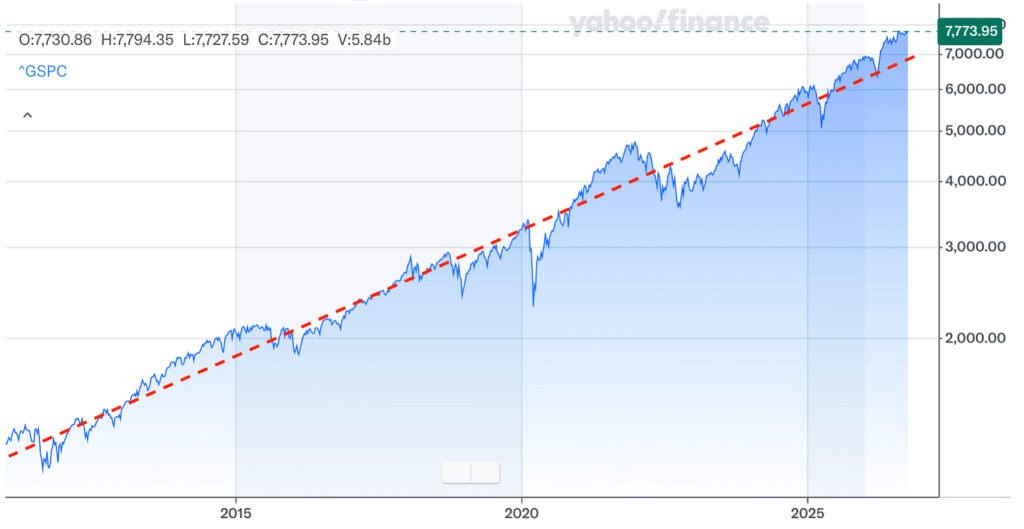
On the surface, the markets seem stable. Stocks are near record highs, and bonds are right about where they’ve been for the past couple of months.
But check under the hood, and you’ll see signs that investors are growing increasingly nervous — mostly because of AI.
This time, the anxiety isn’t because AI is going to kill us all (that was SO last month). The latest concern: AI may be a financial quagmire.
And if the air is starting to come out of the AI bubble, it could threaten to knock over the foundation supporting America’s economic boom.
The stock market is so big and diverse that it’s sometimes useful for investors to measure it in creative ways, comparing two measurements to figure out if there’s a trend that the headline numbers can’t show you.
For example, you can measure the benchmark S&P 500 stock index in a number of ways. The most common way is to weight each stock by its market value — giving gigantic tech companies worth trillions of dollars considerable influence over the ups and downs of the stock market.
But if you look at the S&P 500 another way, weighting each stock equally, you can sometimes get a clearer picture of how the market is performing across industries. Equally weighting stocks ensures companies in smaller industries aren’t drowned out by massive ones, like Big Tech.
When comparing those two measurements on October 22, the result was seriously bizarre — so strange it had only happened twice before in the past three decades.
The main index, weighted by market value, fell 1.2%. But the equal-weighted index gained 0.5%. Since 1995, that massive divergence in the two measurements had happened only twice before: April 14, 1999, and March 30, 2000, noted James Reilly, senior markets economist at Capital Economics.
What does it mean? A clue can be found in another weird thing that happened that same day.
Also on Thursday, the 10-year Treasury yield slammed on the brakes and went into reverse, falling below 5% and tumbling in the largest single-day decline since March 10, 2023 — the day that Silicon Valley Bank imploded.
So investors were pouring money out of tech and into Treasuries and non-tech stocks at a historic pace.
It’s a sign that AI is making some folks on Wall Street kind of nervous.
Bonds had been tumbling (and yields, as a result, had been surging to multi-decade highs) for three core reasons:
-
Iran
-
America’s ballooning debt
-
AI
The Iran war sent inflation on a serious rebound, cutting off the world’s oil and fuel supplies and sending prices through the roof. Bond investors, when confronted with rebounding inflation, demanded higher yields to compensate for the chunk of their investment that inflation has been eating into.
Meanwhile, America’s debt has skyrocketed to $40 trillion, and its budget deficit surged to $2 trillion over the past fiscal year. Politicians across the political spectrum continue to advocate for populist policies, including lower taxes and higher spending, giving investors no hope for a wave of fiscal responsibility soon to take over Washington. That means Treasury will need to keep borrowing — a lot, flooding the market with bonds.
And enormous AI investment has underpinned America’s sustained economic growth in recent years. But the infrastructure needed to power AI is expensive — around $1 trillion a year and growing. Tech companies are borrowing huge amounts of money from investors, in the form of bonds, crowding out demand for other debt, including Treasuries.
None of this has fundamentally changed.
In fact, the Iran war, inflation and the debt problems are potentially about to get even worse. Oil prices are at four-year highs, and fuel prices are exploding higher in some parts of the United States. And President Donald Trump has signaled the costly Iran war is about to kick into high gear again after the midterms.
Even with that backdrop, government bonds, which investors have turned their backs on for months, suddenly grew popular again.
Investors recently started asking some serious questions about the AI part of this three-legged stool that had been supporting bond yields. That wobbly AI leg made folks worried.
And when traders feel nervous, they come running home for safety. And the safest home on the planet offers the security of the US dollar and Treasuries.
If we are in the midst of a paradigm shift, the turning point may have begun with CoreWeave.
The neocloud company, which rents out computing power to AI companies, is fueled by debt. Its borrowing costs ballooned to an astounding 15% earlier this month as investors grew concerned about its financial prospects. That dwarfs its rate of return on its investments.
In other words: CoreWeave is losing a ton of money and may not be able to pay off its debt.
CoreWeave may be an outlier — or it may not be. A Wall Street Journal report on Anthropic’s draft IPO filing showed a nearly $81 billion loss in the first half of 2026 — on pace to dwarf the record for the largest-ever annual loss reported by a public company (if Anthropic goes public this year). Meta reported that it spent $2 billion more cash than it produced in the third quarter, sending its stock tumbling 7% Thursday.
AI’s shaky balance sheets raised questions about that whole circular financing thing that investors have long questioned but the industry and many traders have swept under the rug. If every tech company is invested in every tech company, is this all just a highly leveraged house of cards? And what happens when one of those cards falls?
So some traders are pausing to re-think how much value Wall Street has been placing on AI — and whether these debt levels are sustainable.
“What we’re seeing is elevated volatility around something that looks and feels and smells like a bubble,” said Joe Brusuelas, chief economist for RSM US.

What’s not clear is how long this AI fizzle-out will last. The Nasdaq is in the midst of a two-week-long, 6% slide, but we’ve been down this road before, with investors growing nervous around past earnings seasons that tech companies are spending too much on AI — only to pour money back into AI stocks when some companies report signs of sustained demand.
And even if the AI bubble popped, it wouldn’t necessarily mean the economy would go down with it, Reilly noted. Each financial bubble has its own distinct character.
In recent years, economists have described the economy as in a “rolling recession,” as various sectors boomed and others busted, balancing one another out and preventing the entire economy from entering a downturn.
This time may be the same. Or different. No one knows.
So the market went a little haywire. Bond yields tumbled. And the stock market did something it has done only three times since 1995.
It may be the start of something –– or it may be just another bump in the road.