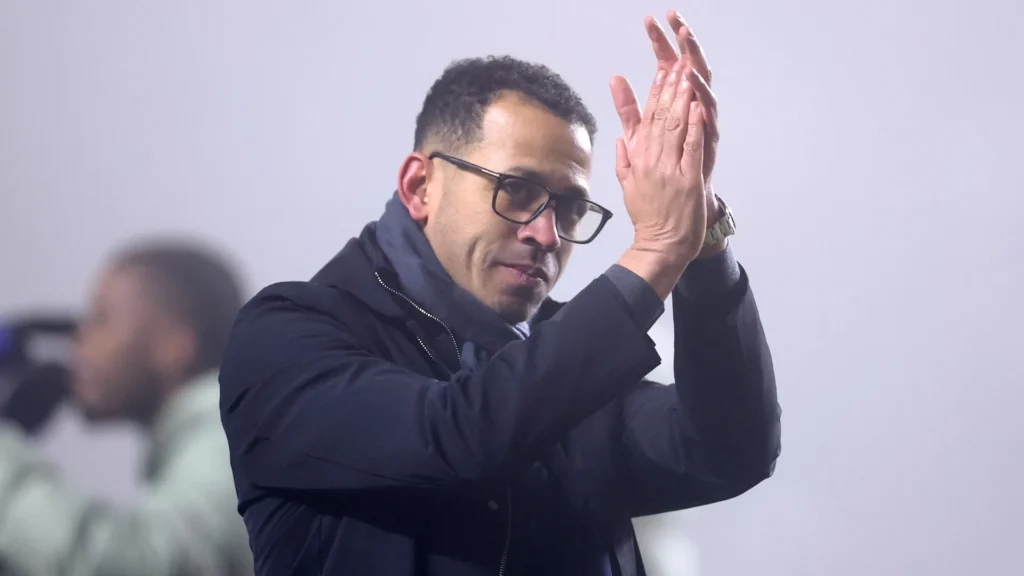
The decision to sack Liam Rosenior after less than four months in charge is not one Chelsea took lightly. But after the humiliating defeat by Brighton & Hove Albion, it is one that felt inevitable.
This was a man closely aligned to the club’s hierarchy and hired on a deal running to 2032. Sacking him is an embarrassment for all concerned, but 106 days after his appointment, Chelsea’s executives felt a change was needed to give the club the best possible chance of achieving their remaining aims for the season.
So how did everything unravel so quickly?
A lack of ideas to stop the downward spiral
Chelsea’s toothlessness in attack and fragility at the back is unprecedented in more than a century. They have lost five successive league games without scoring a goal for the first time since 1912.
Rosenior ran out of possible solutions but injury issues made a bad situation worse. Trevoh Chalobah has only just returned after a month-long absence, with Reece James still unavailable. Cole Palmer, Joao Pedro, and Estevao all missed the defeat at Brighton.
While Rosenior would have been expected to coax better performances from those available, Chelsea’s attackers have failed to step up. Liam Delap is without a goal in 21 consecutive games in all competitions, while Alejandro Garnacho has not scored against Premier League opposition since his brace against Arsenal in the Carabao Cup in January.
Finishing is evidently a problem: Chelsea are averaging 17.2 per cent of shots on target across their past five league games, as opposed to an average of 32.5 per cent across the Premier League season.
That reflects poorly on the players, but Rosenior did not provide any convincing answers. He may not have always had his first-choice attack available, but he did not help matters at Brighton by choosing a system unsuited and unfamiliar to the forwards at his disposal, with Delap and Enzo Fernandez left chasing shadows for much of the first half.
Liam Rosenior’s tactics have been questioned (Alex Livesey/Getty Images)
That, and the substitution of Marc Guiu in the second half (who had not previously played in the league under Rosenior) felt like signs of a coach running out of ideas to spark his attackers back into life.
The same is true at the back. Chelsea have not kept a Premier League clean sheet since a 2-0 win over Brentford on January 17. The players have to bear significant responsibility for error-strewn defending that has led to many of these goals, but none of the head coach’s attempted fixes worked.
In his 23 games in charge across all competitions, Rosenior used 14 different centre-back combinations. All that tinkering did not yield clean sheets; nor did the occasional switches to a back five, against Arsenal in the League Cup, Wrexham in the FA Cup and at Brighton in the league.

The role of the head coach is to provide their players with new solutions and the confidence to execute them. Rosenior has not done that, and the club and fans lost confidence that he could do so in time to salvage anything from the campaign.
A squad lacking energy and motivation
The signs of fatigue were everywhere at the Amex.
From Pedro Neto’s decision to turn back for support despite Rosenior screaming at him to take on Pascal Gross in the second half, to Robert Sanchez’s mishap that handed Brighton a shot on goal 18 minutes in, and the limp collective attempts to track Danny Welbeck before he scored Brighton’s third, they all suggested Chelsea’s physical and mental energy reserves are drained.
Given the size of the club’s injury list, the much-discussed policy of rotation from earlier in the season has failed to achieve its aim of keeping the squad fresh for the run-in.

There have been fitness concerns for Chelsea’s players (Justin Setterfield/Getty Images)
The idea that Chelsea’s participation in the Club World Cup impacted them is not, according to people with knowledge of their outlook, who asked to be kept anonymous to protect relationships, a majority view at Chelsea.
But Rosenior has referred to the heavy load faced by his squad, most of whom also play for their national teams. However, his attempts to introduce a more aggressive man-for-man pressing style also place higher physical demands on already tired players.

Rosenior criticised his team’s “lack of intensity” at Brighton, which he clearly felt stemmed from an issue of application rather than actual physical capacity. As is often the case, the truth probably spans multiple factors: an incredibly busy year is catching up with Chelsea’s players physically, and they are lacking the mental resolve needed.
It did not help that Fernandez, a key player, publicly questioned the wisdom of Enzo Maresca’s departure from Chelsea and suggested he was keen to live in Madrid, comments which saw him suspended for two games by the club. Nor indeed that Marc Cucurella told The Athletic that the club had “paid the price” for not having more experienced players.
These comments effectively undermined Rosenior. Again, that is not his fault — but he failed to muster a response that halted the club’s slide.

Respecting the ball, ageing men, and not limiting limitlessness
Not a week of Rosenior’s short tenure went by without him being relentlessly mocked on social media.
First, it was the clip of him during his time at Strasbourg explaining how management was about “ageing men” (man-age); then it was his tongue-twisting pledge that “I won’t limit limitlessness” ahead of his first game in charge.
Then, a quote you have to imagine will follow him for the rest of his managerial career: his explanation that Chelsea’s players huddled in the centre-circle ahead of their game against Newcastle United, around a stubbornly unmoving referee Paul Tierney, because they wanted to “respect the ball”.
Rosenior took the derision of his LinkedIn language and quirky habits in his stride, even when it veered into the untrue and unfair. There was the clip that circulated where he was accused of only getting up to pretend to coach after seeing himself on a big screen at the Hill Dickinson Stadium, despite there being no evidence the TV feed was live inside the stadium (it usually is not).
He was also accused of being performative when he passed a note to Garnacho towards the end of Chelsea’s 3-0 (and 8-2 aggregate) Champions League last 16 defeat by Paris Saint-Germain, despite the very fair reason that he was asking Moises Caicedo to move to right-back to account for Chelsea having to finish out the game with 10 players after Chalobah’s injury.
In his press conference on Monday, Rosenior pointed out that one video of Fernandez appearing to walk past him after being substituted against Manchester United was cut before the player turned around and hugged him and shook his hand. “I know how these things work,” he said.
Is all of the criticism fair? No. But will it have coloured some fans’ views of him? Absolutely.
His links to BlueCo
Before Rosenior even set foot on the training ground at Cobham, he had already lost the confidence of some supporters due to his bond with owners BlueCo.
Rosenior’s existing relationship with Chelsea’s owners and sporting directors, and his understanding of how to work within BlueCo’s structure, were assets as far as the Chelsea hierarchy were concerned when it came to hiring him,
But to fans who disagree with the club’s direction under their owners, the multi-club model, and favouring of youth and potential over proven experience, Rosenior’s alignment with the hierarchy counted against him.

Chelsea co-owners Behdad Eghbali (left) and Todd Boehly (Clive Rose/Getty Images)
The strength of feeling has been evident in the growing repertoire of anti-BlueCo songs in the stands, and came to a head on Saturday before the defeat by Manchester United with a well-attended protest outside Stamford Bridge.
When Rosenior sat in the stands alongside Behdad Eghbali at Craven Cottage in January before taking over, he will have realised from the away end’s chants that Chelsea fans can turn hostile, and that there were already sections of the fanbase angry at Eghbali and Todd Boehly.
At the Amex, perhaps inevitably, that anger finally turned on him — and his position became untenable.