What a censored speech says about China’s economy | World News

At this time of year, many policymakers want to know how fast their economies will grow in the year ahead. China’s leaders set themselves a still tougher question: how fast their economy “should” grow. They are seeking not a forecast but a target.
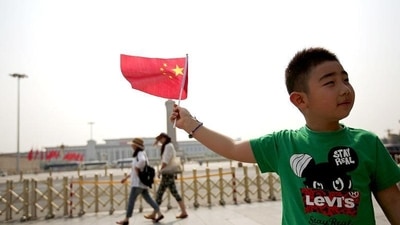
A boy poses with a Chinese national flag in front of Tiananmen Square in Beijing.. (Reuters)

The Central Economic Work Conference will conclude as The Economist goes to press. At the event, Communist Party officials will have debated whether to stick with this year’s growth target of “around 5%”. Their answer, which is not usually revealed until March, will guide fiscal and monetary policymaking in the year ahead, as well as the borrowing and spending plans of state-owned enterprises. Early signs suggest that officials will set an ambitious goal. In recent days party leaders have promised “extraordinary” efforts to fight China’s slowdown, including a “moderately loose” monetary policy and a “more proactive” fiscal policy. They have also resolved to boost consumption “vigorously”.

So what number should they pick? The textbook answer is that an economy should expand as fast as it can without jeopardising price stability. If GDP exceeds its speed limit (the “potential” rate of growth) demand will outstrip supply, and inflation will rise uncomfortably. By this yardstick, China’s economy has room to accelerate. Consumer prices rose by only 0.2% in November, against a year earlier, far below the government’s ceiling of 3%.

In China, though, the link between growth and inflation is puzzling, according to Gao Shanwen of SDIC Securities, a financial firm. The two used to have a steady relationship. Core inflation (excluding volatile food and energy prices) rose or fell in line with the “output gap” between potential and actual GDP. Yet this relationship has broken down in the past two years, he argued during a recent talk in Shenzhen, a southern tech hub. Growth has been close to the speed limit; inflation has been “abnormally” low.

Perhaps the problem lies with the data. “China’s economic data is generally good,” he said, diplomatically. “But some data are better than others.” Prices, for example, are relatively easy to collect. You can leave your Shenzhen hotel and look up the price of an apple at a shop door, he pointed out to his conference audience. Calculating GDP is trickier. So if growth and inflation are suddenly out of whack, maybe growth has been overstated. Cut three percentage points from China’s growth—reducing it from about 5% to about 2% for this year, for example—and its relationship with inflation becomes “completely normal”, Mr Gao said.

Mr Gao highlighted a similar mismatch between China’s growth and its retail sales, which used to expand faster than GDP, but have underperformed it more recently. Retail spending has been particularly weak in provinces with fewer elderly people. In China, paradoxically, the most youthful provinces seem the least dynamic. The country is “full of vibrant old people, lifeless young people and middle-aged people who have lost hope”, he said.

What explains their gloom? One answer is the country’s property slump. Yet Mr Gao suspects that weak retail spending and lacklustre home purchases reflect something deeper: doubts about future job prospects. In China’s cities employment has grown more slowly than its pre-pandemic trend. The cumulative shortfall from 2021 to 2023 amounts to 47m jobs, he calculates, or about 10% of urban employment. Such an undershoot casts further doubt on China’s GDP data: if employment is one-tenth below trend, perhaps true GDP is 10% below the official figure.

Mr Gao’s talk was widely circulated online, then swiftly censored. But just because the government suppressed it does not mean it is true. Amid all the fuss, some of Mr Gao’s claims were misreported. Others remain poorly understood.

Start with the 47m missing jobs. This finding has been wrongly interpreted as 47m extra unemployed people. In fact, many of these missing urban workers, Mr Gao was careful to point out, either stopped looking for work (in which case they do not technically count as unemployed) or left cities in search of jobs elsewhere. Rural employment, Mr Gao calculates, has exceeded its historical trend by over 41m across the same three-year period.

Farm out

Moreover, the 47m figure seems to yoke together a shortfall in 2021 (of 5m), 2022 (22m) and 2023 (20m). Mr Gao perhaps has in mind a measure more akin to man-hours or “person-years” than urban employment. If a ten-person firm loses an employee to sickness for two years, it has lost two person-years, but it is still only a man down. Similarly, cities lost 47m person-years of work from 2021 to 2023, but as of last year, there were only 20m people down. Assuming workers found rural jobs, operating at a quarter of urban productivity, the hit to GDP in 2023 would be about 2.5%, not 10%.

The broken relationship between inflation and output is also not proof that GDP is wildly miscalculated. In theory, when growth is close to the speed limit, inflation should not be falling, but it can still be low. And in practice, links of this kind can be treacherous. After Japan’s central bank loosened policy in 2013, the output gap vanished, even as prices stayed flat. The central bank blamed “a deflationary mindset” and stubbornly low price expectations. Thus soft prices may reflect the same subdued view of the future that Mr Gao sees at work elsewhere in China’s economy.

Mr Gao’s speech clearly upset Chinese officials, who do not want incisive commentary to further undermine the public’s morale. But the party’s recent promise of loose, proactive and vigorous policy suggests they broadly share Mr Gao’s prescriptions. Policymakers, he said, have more work to do to stimulate the economy by easing monetary policy, expanding government borrowing and bolstering financial institutions. Analysts can have doubts about how fast China’s economy is truly growing, and still feel sure that growth should be faster.

Subscribers to The Economist can sign up to our new Opinion newsletter, which brings together the best of our leaders, columns, guest essays and reader correspondence.
Source link

Visited 1 times, 1 visit(s) today

Related Article

Image may contain Advertisement Book Publication and Poster

The Online Fiction Boom Reimagining China’s History

If you could travel back in time, what year would you choose? What would you change about history? For a surprising number of Chinese people, their answer turns out to be the same: Use what they know today to save China from its unglorious past. In a new book titled Make China Great Again: Online

ביג מיוחד נשיא ארה"ב דונלד טראמפ ו נשיא סין שי ג'ינפינג

China breaks silence as US pressures Iran

For 40 days of war with Iran, China remained relatively restrained. It issued condemnations of the Israeli and U.S. strikes and called for protecting Gulf states targeted by Iran, but avoided escalating its strategic rivalry with Washington. Beijing refrained from harsh rhetoric, did not exploit the diversion of U.S. resources from Southeast Asia to increase

Defense Metals Announces Inclusion in New Sprott Rare Earths Ex-China ETF

VANCOUVER, BC, April 16, 2026 /PRNewswire/ – Defense Metals Corp. (“Defense Metals” or the “Company”) (TSXV: DEFN) (OTCQB: DFMTF) (FSE: 35D), a company focused on the development of the Wicheeda Rare Earth Project (“Wicheeda Project”), located near Prince George, British Columbia, Canada, is pleased to announce that it has been included in the newly launched Sprott

Amazon launches first-ever smart warehouse in China to cut storage costs by…

Amazon launches first-ever smart warehouse in China to cut storage costs by…

Amazon has launched its first smart warehouse in China. This marks a new step in the e-commerce giant’s logistics strategy to support cross-border sellers. According to a South China Morning Post report, the facility is located in Shenzhen and is designed to help Chinese merchants reduce storage costs by up to 45%. The move comes

Mercedes investors warn luxury focus could hamper China recovery

April 16, 2026, 11:02 a.m. ET Investors pressed Mercedes-Benz Group AG on its recovery plans for China on Thursday, warning that a luxury-focused strategy could hurt the German brand’s chances of winning back Chinese consumers after a slump in sales. Like rivals BMW AG and Audi, Mercedes has lost ground in the world’s largest car

A dynamic, abstract painting featuring overlapping, fragmented shapes and waves of red, blue, and yellow, conceptually representing the tension and conflict between China and the United States over foreign policy issues.

China Rejects US Claim on Iran Arms Sales

Got story updates? Submit your updates here. › The clash of global powers as China firmly rejects U.S. claims over arms sales to Iran.Washington Today China has firmly rejected claims by the U.S. that Beijing agreed not to sell or supply weapons to Iran, calling such reports ‘rumors’ and stating that China’s defense cooperation with

China’s Refinery Runs Slip as War Squeezes Crude Supply

China’s Refinery Runs Slip as War Squeezes Crude Supply

Chinese refinery processed 2.2% less crude last month, at an average daily of 14.52 million barrels daily amid the war-related squeeze on oil supply. Fuel output was also down, with gasoline shedding 2.95% to 13.51 million tons and kerosene production falling by 3.72% to 5.13 million tons. Diesel fuel production was up modestly, by 0.88%17.49

China Weighs Solar Technology Export Curbs to U.S.

Real-time Estimate Cboe BZX 09:40:42 2026-04-16 am EDT 5-day change 1st Jan Change 386.14 USD -1.48% +14.19% -12.85% Published on 04/16/2026 at 04:25 am EDT MT Newswires This article is reserved for members Unlock the article: REGISTER NOW! © MT Newswires – 2026 DurationAuto.2 months3 months6 months9 months1 year2 years5 years10 yearsMax. PeriodDayWeek Tesla, Inc.

A photorealistic painting of a lone Chinese person sitting in an empty airport terminal, the space bathed in warm, diagonal sunlight and deep shadows, capturing a sense of isolation and unease.

China Issues U.S. Safety Alert for Citizens Citing ‘Malicious Questioning’

Got story updates? Submit your updates here. › A somber scene of a Chinese scholar waiting alone in a dimly lit airport terminal, reflecting the growing tensions and unease surrounding the treatment of Chinese citizens at U.S. borders.Seattle Today China’s foreign ministry has issued a notice warning Chinese citizens of security risks when traveling to

A highly detailed, glowing 3D illustration of a complex, futuristic AI neural network architecture in shades of neon cyan and magenta, conveying the power and complexity of AI technology.

Nvidia CEO Urges US-China AI Collaboration Amid Chip Policy Tensions

Got story updates? Submit your updates here. › As the US and China vie for AI supremacy, industry leaders call for open collaboration to ensure the safe and responsible development of transformative technologies.Washington Today Nvidia CEO Jensen Huang is using the recent viral success of Anthropic’s Mythos AI model to argue that the United States

A serene, photorealistic painting of a Catholic church building in a Chinese city, with the facade bathed in warm, golden light and the surrounding area cast in deep shadows, conveying a sense of quiet contemplation and the fragility of religious freedom.

China Pressures Underground Catholics to Join Official Church

Got story updates? Submit your updates here. › As the Chinese government tightens control over religious practice, a once-vibrant underground Catholic community faces an uncertain future.NYC Today According to a new report from Human Rights Watch, Chinese authorities are increasing pressure on underground Catholic communities to join the state-controlled official church, while also tightening surveillance

A vibrant, fractured painting of a person drinking from a steaming mug, surrounded by overlapping geometric shapes and waves of warm colors, conceptually representing the global embrace of Chinese cultural practices.

The ‘Becoming Chinese’ Meme Shows China’s Soft Power Moment

Got story updates? Submit your updates here. › The ‘becoming Chinese’ meme reflects a growing global fascination with Chinese culture and habits, though the trend raises complex questions about cultural appropriation.Brooklyn Today In recent months, 20-somethings around the world have taken over social media with posts enthusing about how they’re embracing Chinese ways of life,

A solitary figure of a Chinese scholar standing alone in a dimly lit airport terminal, their face partially obscured by shadows, conveying a sense of unease and uncertainty through the use of muted colors and a cinematic, nostalgic style.

China Warns Citizens of Security Risks Traveling to US

Got story updates? Submit your updates here. › China’s warning about security risks for its citizens traveling to the U.S. highlights growing tensions over border policies and the treatment of foreign nationals.Seattle Today China’s foreign ministry has issued a notice warning its citizens of security risks when traveling to the United States, advising them not

New record! Apple’s India vendors export $2.5 billion components to China; may reach $3.5 billion under ECMS

New record! Apple’s India vendors export $2.5 billion components to China; may reach $3.5 billion under ECMS

Experts say the surge in electronics exports represents an unexpected boost from the smartphone production-linked incentive scheme. (AI image) In a big achievement for the government’s electronics component manufacturing scheme (ECMS), Apple’s India vendors have already exported a record $2.5 billion components to China. The development also signals a shift from the earlier pattern, where

A dynamic, abstract painting depicting a ship navigating the turbulent waters of the Strait of Hormuz, with overlapping geometric shapes and waves of deep blues, greens, and grays conveying the geopolitical tensions in the region.

Col. Wilkerson: Iran and China Show Control of Strait of Hormuz, Challenging Trump

Got story updates? Submit your updates here. › As tensions escalate over control of the strategic Strait of Hormuz, the growing alliance between Iran and China threatens to disrupt global energy markets and challenge American foreign policy.Austin Today Col. Larry Wilkerson, former Chief of Staff to the U.S. Secretary of State, said China is decrying

China urges Iran to reopen Strait of Hormuz – JNS.org

( Apr. 16, 2026 / JNS ) China on Wednesday called on Iran to restore normal navigation through the Strait of Hormuz. Chinese Foreign Minister Wang Yi told his Iranian counterpart Abbas Araghchi in a phone call that while Iran’s sovereignty and security in the strategic waterway should be respected and safeguarded, freedom and safety

China’s economy grows 5% in first quarter, shrugging off initial impact of Iran war

HONG KONG — China’s economy accelerated in the first quarter of this year, expanding 5% from a year earlier as it largely shrugged off impacts from the Iran war so far, according to data released Thursday. Subscribe to read this story ad-free Get unlimited access to ad-free articles and exclusive content. The January-March data released

0
Would love your thoughts, please comment.x
()
x