Warren Buffett Told His Trustee to Put 90% of His Wife’s Inheritance in One S&P 500 Fund and Named Vanguard. On $500,000, VOO Costs $150 a Year and SPY Costs $472.50
Quick Read
On a $500,000 stake, VOO costs $150 a year while SPY costs about $473, though both track the same S&P 500 benchmark.
Warren Buffett told his trustee to put 90% in a “very low-cost S&P 500 index fund” and 10% in short-term government bonds, suggesting Vanguard’s.
Selling SPY in a taxable account can trigger capital gains tax that outweighs years of fee savings, while IRAs and 401(k)s generally avoid it.
Read: Building a portfolio and living off one are two completely different skills, and almost nobody teaches the second. This problem is what The Definitive Guide to Retirement Income helps with, and it is free today. Read more here.
The State Street SPDR S&P 500 ETF Trust (NYSEARCA:SPY) is the oldest and most familiar way to own the S&P 500. Plenty of retirement accounts hold SPY for that reason. One ticker buys 500 large U.S. companies with no stock picking. SPY launched in January 1993 as the first ETF listed in the United States, and it still does its job well. Yet the author of the 2013 Berkshire Hathaway (NYSE:BRK-B) shareholder letter outlined a plan for his own family that indirectly points to a cheaper fund tracking the same benchmark: the Vanguard S&P 500 ETF (NYSEARCA:VOO).
Mark Wilson / Getty Images
In that letter, Warren Buffett wrote: “What I advise here is essentially identical to certain instructions I’ve laid out in my will. One bequest provides that cash will be delivered to a trustee for my wife’s benefit.” Buffett then gave the trustee a two-line plan: “Put 10% of the cash in short-term government bonds and 90% in a very low-cost S&P 500 index fund. (I suggest Vanguard’s.)” The word “Vanguard’s” appears in his letter, but he doesn’t name a specific Vanguard fund or ticker. Vanguard’s S&P 500 ETF goes by the ticker VOO.
——
Now Available: The Definitive Guide to Retirement Income
Many successful investors eventually reach the same moment. The saving is done, the portfolio is built, and the question quietly changes from how much can I grow this to how much can I take out? Get that second question wrong and decades of good investing can come apart in a handful of years.
That is exactly what The Definitive Guide to Retirement Income helps answer. It covers what your retirement could actually cost, which income sources are worth using, and the withdrawal math that decides whether the money lasts. It is free today from Fisher Investments. Read More Here ›
——
Why Buffett Built a 90/10 Plan for His Widow
In a March 2014 CNBC Squawk Box interview quoted by CFA Institute, Buffett said he had laid out what “the average person who is not an expert on stocks should do,” adding that his widow “will not be an expert on stocks.”
Buffett said the 10% in short-term government bonds lets the beneficiary draw from that reserve during “a terrible period in the market” rather than “selling stocks at the wrong time.” Of the index fund, he said: “It’s low-cost, it’s in a bunch of wonderful businesses, and it takes care of itself.”
Same Index, Two Price Tags
Both funds target the same benchmark. According to State Street, SPY seeks to match the price and yield performance of the S&P 500, and Vanguard’s April 28, 2026 prospectus says VOO tracks the S&P 500 Index. With identical exposure, cost is the clearest difference between them.
An expense ratio is the annual fee a fund deducts from its assets, and it comes out every year whether markets rise or fall. SPY’s net expense ratio is 0.0945% per State Street. A $500,000 position pays $472.50 a year at that rate.
VOO’s net expense ratio is 0.03% per Vanguard’s fact sheet. The same $500,000 costs $150 a year. That gap repeats every year the position remains open and widens as the balance grows, which is exactly the kind of cost Buffett told his trustee to minimize.
What a Switch From SPY to VOO Involves
Moving from SPY to VOO takes a sale and a purchase. Depending on your brokerage, each trade can carry a commission, and every trade carries a bid-ask spread, the small gap between the price buyers pay and sellers receive. Your broker’s pricing determines the full one-time cost of a switch, which you can then compare with the recurring savings.
How Each Fund Handles Dividends Between Payouts
The unit investment trust structure of SPY requires cash dividends from its holdings to sit uninvested until the trust pays them out. VOO, an exchange-traded share class of Vanguard 500 Index Fund, is an open-end fund that can reinvest that cash at the fund level between payouts.
The payment calendars differ. SPY’s latest dividend went ex on September 18, 2026, and paid on October 30, 2026. VOO’s went ex on September 28, 2026, and paid on September 30, 2026.
Your Mix May Differ From Buffett’s 90/10
The 90/10 split was written for one beneficiary. Your own mix depends on your circumstances, including your age, your other income, and how much a market downturn in the first years of withdrawals would shake you (planners call that sequence-of-returns risk, and we mapped out how to defend against it in a guide that costs nothing here). The fund choice inside the stock portion is a separate decision from how much belongs in stocks at all.
Capital Gains Taxes Can Outweigh Fee Savings on a SPY Sale
Selling SPY shares in a taxable account can trigger capital gains tax, and on a long-held position that bill can outweigh years of fee savings. Your broker reports the sale and your cost basis on Form 1099-B, according to IRS Publication 550. Switching inside a tax-advantaged retirement account such as an IRA or 401(k) generally avoids that tax hit. In a taxable account, new contributions placed in VOO would carry the lower fee without requiring a sale.
How SPY and VOO Measure Up Against Buffett’s Cost Focus
Buffett asked for a very low-cost S&P 500 fund and named Vanguard. SPY and VOO both track that benchmark, so a buy-and-hold retiree following that advice gets the same businesses for $150 a year instead of $472.50 on $500,000. Of the two, VOO is the lower-cost fund, which lines up with the cost focus in his instructions.
Released: The Definitive Guide to Retirement Income
(Sponsor) Most people spend their entire working lives focusing on one thing: growing a pile of money. Then they retire and discover the skill they actually need is close to the opposite. Turning that pile into steady income, year after year, through good markets and bad, without ever running out.
It may be the least discussed and most consequential transition in personal finance, and plenty of otherwise careful investors walk into it with no real plan. That is exactly what The Definitive Guide to Retirement Income helps answer. It is a free guide from Fisher Investments covering what your retirement will really cost, where the cash flow should come from, and how much you can safely withdraw each year. Learn more here. Learn More Here ›
With Jensen Huang back as CEO, Nvidia stock could be worth $500 by the end of 2030. By Geoffrey Seiler – Nov 29, 2026 at 1:00AM EST Key Points The AI infrastructure build-out is projected to remain strong in the coming years. Vera Rubin should be a big growth driver for Nvidia in the coming
After years of declines, Annaly Capital (NYSE:NLY) increased its dividend in the middle of 2025 and again in the middle of 2026. Dividend investors usually view dividend increases as a sign of strength, but Annaly’s dividend yield is nearly 17%, suggesting Wall Street is worried about the dividend. That fear isn’t unreasonable, which is why
The market has been volatile in recent weeks, and semiconductor companies have been particularly affected. There are several reasons for that. Here are three of them. First, many investors continue to fear that the artificial intelligence (AI) industry’s growth won’t last that much longer. With several chip stocks having already gained significantly on the AI
The market has cooled on Anthropic (NASDAQ:ANT). The Claude maker’s shares tumbled 6.5% on Nov. 24, and they’re 26.5% below the opening price from the initial public offering (IPO) on Nov. 19. Nonetheless, the dominant artificial intelligence (AI) model developer sports a massive market capitalization of just under $1.1 trillion. It took less than six
The latest round of tariffs could spell bad news for some stocks with surprisingly little exposure to them. By Steven Porrello – Nov 28, 2026 at 2:12PM EST Key Points Inflation is moving away from the Fed’s 2% target. Another round of tariffs could prolong the period of elevated interest rates, putting additional pressure on
Friday’s rally added around 70 times the contract’s reported value to the company’s market cap. By Daniel Sparks – Nov 28, 2026 at 4:21PM EST Key Points Poland’s defense ministry signed a deal on Nov. 27 to use Palantir’s AI decision-support software across every branch of its military. Sales outside the U.S. were 16% of
One of Wall Street’s most important valuation metrics is flashing a rare warning that investors can’t afford to ignore. By Adam Spatacco – Nov 28, 2026 at 6:33PM EST Key Points The CAPE ratio is trading at more than double its historical average. CAPE readings above 30 have historically preceded significant stock market downturns. Valuation
When a large U.S. bank like United Fidelity collapses and regulators step in, attention swings quickly to the biggest institutions that might absorb stress or benefit from shifting deposits. That kind of shake up can reshape where capital flows, and investors who study the ripple effects instead of the headlines alone often spot openings others
Analysis of S&P 500 historical returns shows: the stock market often delivers above-average returns right after its biggest declines. By Ben Gran – Nov 28, 2026 at 2:28AM EST Key Points Capital Group research found that the S&P 500 delivered more than 18% average annualized returns in the five years immediately following the market’s biggest
Anthropic (NASDAQ:ANT), maker of the Claude artificial intelligence (AI) model, made history last week as the biggest initial public offering ever. It was oversubscribed, and it raised more than $100 billion at $83 a share. After soaring to $111 on its first day of trading, it sank back 10% on the second day. There’s likely
Jensen Huang’s return turned November 23 into a relief rally for the AI trade. The chipmaker he co-founded announced his reinstatement as chief executive, president, and director, reversing its leadership upheaval. Its shares finished 31.48% higher, while the S&P 500 gained 4.7%. The rebound spread well beyond one company, lifting businesses that supply the chips,
A credit rating cut may be on the way. By Adria Cimino – Nov 28, 2026 at 7:05AM EST Key Points S&P Global Ratings has put Nvidia’s credit rating under review for a possible downgrade. The concern is about management and governance, and it adds to a growing list of worries. As the leading maker
Even while its sales growth slows, the streaming giant’s earnings per share might climb over 75% by 2030. By Daniel Sparks – Nov 28, 2026 at 4:47AM EST Key Points Netflix’s year-over-year revenue growth has slowed in all of the past three quarters. Netflix keeps shrinking its share count with buybacks. Netflix’s price-to-earnings ratio has
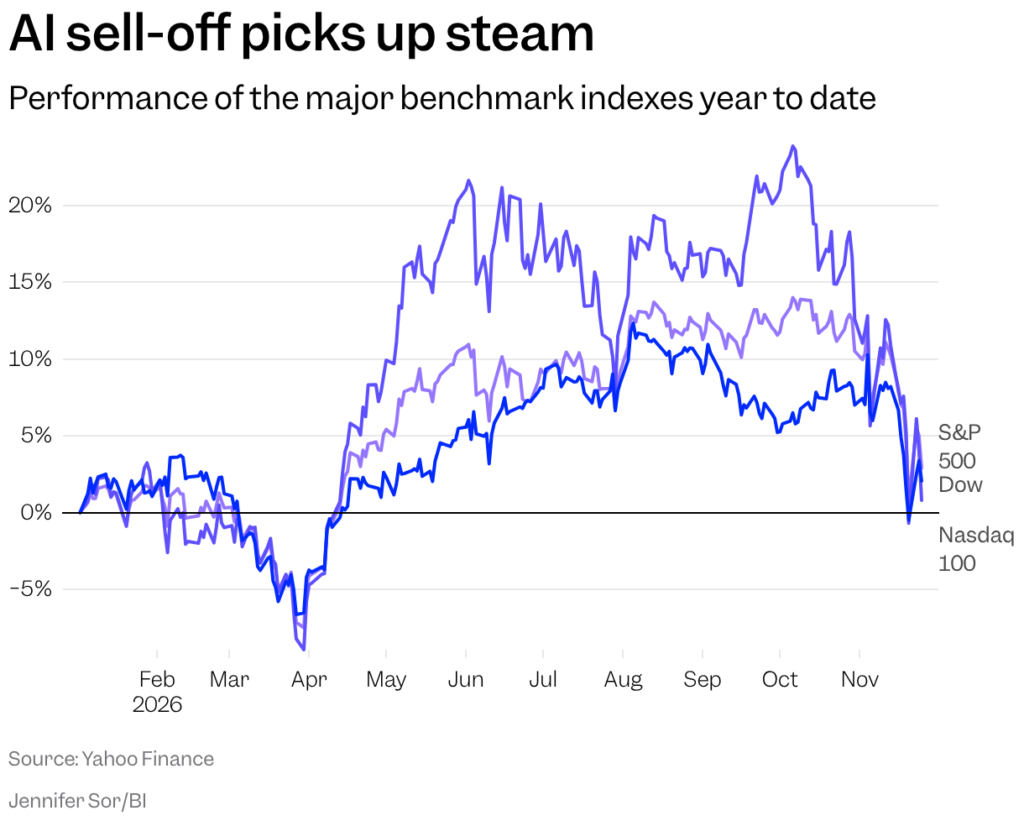
An analyst who called the dot-com crash thinks stocks are heading for a period of pain. Albert Edwards, the in-house permabear at Société Générale, is flagging the risk of another steep drop in equity prices as the AI sell-off picks up steam. In a note to clients on Wednesday, the longtime analyst said he saw
Booking’s $7.2 billion in GAAP net income and Uber’s 13.9% revenue growth frame a tight race, but the valuation gap may settle it. By Brendan Coffey – Updated Nov 28, 2026 at 8:42AM EST Key Points Booking Holdings generates substantial net income through its high-margin online travel agency model and its evolving Connected Trip strategy.
Reports in late November indicated that Alphabet plans to trim 2027 shipments of Broadcom designed TPU AI chips by about 20%, which came alongside wider concern about whether heavy AI data center spending will generate adequate returns. The development highlights how Broadcom’s AI semiconductor outlook depends on a concentrated group of hyperscale buyers, leaving its
Nvidia’s accelerating earnings growth and historically cheap valuation could help investors double their money by the end of 2027. By Adam Spatacco – Nov 27, 2026 at 7:51PM EST Key Points Nvidia’s Vera Rubin chip architecture is fueling an increasingly bullish growth outlook. Nvidia’s $227 billion stock buyback program could fuel earnings expansion throughout next
One of Wall Street’s most famous forecasters, Marty Zweig, made “Don’t fight the Fed” a market mantra. He also invented a buy signal with a perfect record, and the two are on a collision course. Days before the 1987 crash, Zweig told PBS’s “Wall Street Week” he didn’t like what he saw. His bets against
A more-than-decade-long price reversal, stemming from the artificial intelligence (AI) infrastructure build-out, bodes poorly for an expensive stock market and the U.S. economy. By Sean Williams – Nov 28, 2026 at 4:06AM EST Key Points Statistically, the Dow Jones Industrial Average, S&P 500, and Nasdaq Composite have thrived with President Trump in the White House.
Bill Ackman and his team at Pershing Square, the parent company of the investment manager Pershing Square Capital Management, run a concentrated portfolio. Ackman is not afraid to play contrarian, and he isn’t afraid to hold stocks long term, which is a different strategy from that employed by most standard hedge funds. Ackman has also