Jensen Is Back: These 10 AI Stocks Are Riding Nvidia’s Rebound
Jensen Huang’s return turned November 23 into a relief rally for the AI trade. The chipmaker he co-founded announced his reinstatement as chief executive, president, and director, reversing its leadership upheaval. Its shares finished 31.48% higher, while the S&P 500 gained 4.7%. The rebound spread well beyond one company, lifting businesses that supply the chips, connect the servers, and build the data centers behind the spending boom.
After the recent selloff across AI suppliers, that change in mood matters. Huang’s return offers continuity to partners planning around a demanding product roadmap. It does not settle the debate over AI infrastructure spending and financing risks, or erase the company’s continuing independent investigation. The stocks below have identifiable commercial connections to that roadmap, but their ability to extend the rally will depend on more than the return of a familiar face.
For another perspective on the AI sell-off, check out our video exploring the five stocks Michael Burry is backing in his latest portfolio and what his investment moves could signal for the market.
To build our list, we reviewed company announcements and financial coverage for U.S.-listed AI stocks with documented business ties to Jensen Huang’s Nvidia, including suppliers, technology partners, cloud customers, and businesses backed by its investments. We also included Nvidia, which Huang co-founded and leads. Among the qualifying stocks identified, we selected the ten with the largest percentage share-price gains on November 23, 2026, and ranked them in ascending order, with the biggest gainer at No. 1. We also report hedge fund holder counts from Insider Monkey’s database for the third quarter of 2026.
Why are we interested in the stocks that hedge funds pile into? The reason is simple: our research has shown that we can outperform the market by imitating the top stock picks of the best hedge funds. Insider Monkey’s quarterly newsletter strategy selects 14 small-cap and large-cap stocks every quarter and has returned 612% since May 2014, beating its benchmark by 375 percentage points (see more details here).
Moving data between AI chips is becoming almost as important as supplying the chips themselves. That puts Lumentum, a producer of optical components and lasers, close to Huang’s plans for larger AI systems. On March 2, Nvidia announced a $2 billion investment in Lumentum alongside a multibillion-dollar purchase commitment and rights to future capacity for advanced laser components. The partnership also supports a new U.S. manufacturing facility.
The connection is therefore a commercial one: Lumentum supplies technology used to move information through AI infrastructure, and Huang has publicly backed the partnership. Its shares climbed 18.20% to $544.38 on November 23. Operating growth was already visible before the rebound, with fiscal first-quarter revenue rising 136.5% to approximately $1.26 billion, according to results released November 2.
There is another development investors need to watch. Marvell’s proposed acquisition would give Lumentum shareholders 4.5 Marvell shares for each share they own, subject to approvals, with closing expected in the first half of 2028. That makes the pending deal an additional influence on the stock. The question of whether Lumentum can turn demand into sales also remains relevant as it expands capacity. A stronger AI mood helps, but manufacturing execution and merger conditions still matter.
Marvell’s relationship with Huang challenges the idea that custom AI chips must sit outside Nvidia’s ecosystem. On March 31, the companies announced a collaboration through NVLink Fusion, which allows Marvell’s custom processors to connect with Nvidia infrastructure. Nvidia also invested $2 billion in Marvell, giving the relationship a financial dimension alongside the engineering work.
For Marvell, the attraction is access to customers that want their own processors without having to build every supporting connection from scratch. The collaboration also covers optical interconnects. Huang’s return matters to that strategy because Marvell is working within the broader platform he has championed, even while helping customers develop alternatives to standard processors. The shares gained 18.37% on November 23 to close at $144.74.
The proposed Lumentum acquisition adds another layer to the optics opportunity. Announced November 2, the all-stock transaction is expected to close in the first half of 2028, subject to shareholder and regulatory approvals. It could broaden Marvell’s role in linking AI systems, but approval and integration are still ahead. Investors also have to contend with the timing risks in Marvell’s custom-chip business: a promising design does not become revenue until customers bring the product into use.
A faster AI processor still needs memory that can keep it supplied with data. Micron occupies that part of Huang’s product roadmap. On March 16, the memory producer said it was shipping HBM4 in high volume for Nvidia’s Vera Rubin platform, with volume shipments having begun in the first calendar quarter. It also outlined memory modules for Vera-based systems and storage optimized for Nvidia’s BlueField-4 processor.
These are specific product relationships, rather than a general claim that AI demand benefits memory. They make the pace of Nvidia’s next-generation systems relevant to Micron’s shipments. Shares rose 19.04% to $707.70 on November 23 as investors returned to businesses connected to the AI buildout.
Micron’s September 30 results showed how far that business had already expanded. Fiscal fourth-quarter revenue reached $54.23 billion, compared with $11.32 billion a year earlier, while full-year net capital expenditure was $27.37 billion. Those figures help explain the attention on Bernstein’s view of Micron after the memory selloff. They also underline the stakes: Micron is committing substantial capital to capacity. Huang’s return can steady sentiment toward its customers, but memory pricing and the timing of additional supply remain important variables for future earnings.
Applied Digital gives investors a connection to Huang’s AI expansion through the buildings that house computing equipment. Nvidia participated in the company’s $160 million financing in September 2024, alongside other investors. That was the total financing amount, not Nvidia’s individual contribution. The continuing operating connection includes CoreWeave’s tenancy at Applied Digital’s Polaris Forge 1 campus, placing the developer within Nvidia’s cloud infrastructure network.
Applied Digital also had important news of its own on November 23, when the stock gained 20.28% to $13.82. The company announced an 18-year lease covering 150 megawatts with an unnamed investment-grade hyperscaler. It expects approximately $5.4 billion of base-term revenue from that agreement, taking total contracted base-term lease revenue above $41 billion.
The new lease means the day’s rally cannot reasonably be assigned entirely to Huang’s reinstatement. It gave investors a separate reason to reconsider the developer’s revenue visibility and customer mix. Yet the funding demands behind Applied Digital’s expansion remain central. Long leases support the business case, but campuses still have to be financed, built, and delivered before that contracted revenue is fully realized. The appeal is tangible exposure to AI capacity; the uncertainty is how smoothly that capacity reaches customers.
Nebius sells access to AI computing, making the availability and performance of Nvidia systems central to its business. On March 11, the companies announced a partnership aimed at deploying more than five gigawatts of Nvidia systems by the end of 2030. Nvidia also announced a $2 billion investment in Nebius. The collaboration spans data-center design, software, and early adoption of new processors, with Huang personally endorsing the relationship.
That gives Nebius a direct connection to the company Huang leads, beyond simply buying a popular chip. It is building its service around successive generations of Nvidia hardware and the software needed to operate them. Shares rose 20.28% to $97.80 on November 23, extending the market’s interest in a name that had already featured in an earlier rally alongside AI cloud peers.
Results released November 12 showed third-quarter revenue of $980.8 million, up 571% from a year earlier. Expansion also consumed cash: operating cash outflow was $273 million, and purchases of property, equipment, and intangible assets totaled about $7.3 billion during the quarter. The growth explains why renewed confidence in the supplier attracts buyers. The spending explains why securing capacity and financing it remain separate tests for shareholders.
While we acknowledge the risk and potential of NBIS as an investment, we believe certain AI stocks offer greater upside potential and carry less downside risk. If you’re looking for an extremely undervalued AI stock that also stands to benefit significantly from Trump-era tariffs and the onshoring trend, see our free report on the best short-term AI stock.
A credit rating cut may be on the way. By Adria Cimino – Nov 28, 2026 at 7:05AM EST Key Points S&P Global Ratings has put Nvidia’s credit rating under review for a possible downgrade. The concern is about management and governance, and it adds to a growing list of worries. As the leading maker
Even while its sales growth slows, the streaming giant’s earnings per share might climb over 75% by 2030. By Daniel Sparks – Nov 28, 2026 at 4:47AM EST Key Points Netflix’s year-over-year revenue growth has slowed in all of the past three quarters. Netflix keeps shrinking its share count with buybacks. Netflix’s price-to-earnings ratio has
An analyst who called the dot-com crash thinks stocks are heading for a period of pain. Albert Edwards, the in-house permabear at Société Générale, is flagging the risk of another steep drop in equity prices as the AI sell-off picks up steam. In a note to clients on Wednesday, the longtime analyst said he saw
Booking’s $7.2 billion in GAAP net income and Uber’s 13.9% revenue growth frame a tight race, but the valuation gap may settle it. By Brendan Coffey – Updated Nov 28, 2026 at 8:42AM EST Key Points Booking Holdings generates substantial net income through its high-margin online travel agency model and its evolving Connected Trip strategy.
Reports in late November indicated that Alphabet plans to trim 2027 shipments of Broadcom designed TPU AI chips by about 20%, which came alongside wider concern about whether heavy AI data center spending will generate adequate returns. The development highlights how Broadcom’s AI semiconductor outlook depends on a concentrated group of hyperscale buyers, leaving its
Nvidia’s accelerating earnings growth and historically cheap valuation could help investors double their money by the end of 2027. By Adam Spatacco – Nov 27, 2026 at 7:51PM EST Key Points Nvidia’s Vera Rubin chip architecture is fueling an increasingly bullish growth outlook. Nvidia’s $227 billion stock buyback program could fuel earnings expansion throughout next
One of Wall Street’s most famous forecasters, Marty Zweig, made “Don’t fight the Fed” a market mantra. He also invented a buy signal with a perfect record, and the two are on a collision course. Days before the 1987 crash, Zweig told PBS’s “Wall Street Week” he didn’t like what he saw. His bets against
A more-than-decade-long price reversal, stemming from the artificial intelligence (AI) infrastructure build-out, bodes poorly for an expensive stock market and the U.S. economy. By Sean Williams – Nov 28, 2026 at 4:06AM EST Key Points Statistically, the Dow Jones Industrial Average, S&P 500, and Nasdaq Composite have thrived with President Trump in the White House.
Bill Ackman and his team at Pershing Square, the parent company of the investment manager Pershing Square Capital Management, run a concentrated portfolio. Ackman is not afraid to play contrarian, and he isn’t afraid to hold stocks long term, which is a different strategy from that employed by most standard hedge funds. Ackman has also
Keeping a long-term perspective can help investors stay calm and confident during stock market crashes. By Ben Gran – Nov 27, 2026 at 5:46AM EST Key Points The author recommends a long-term perspective for stock investors, with the saying, “You don’t need the money today.” The S&P 500 index has delivered 9.98% annualized returns for
Quick Read SanDisk (SNDK) jumped 13% to $83 but remains down 47% in a month, still trapped below moving averages that sit above $100. Micron (MU) gained 6% and Seagate (STX) 5%, yet both fell far less than SanDisk, explaining its stronger bounce. Citi’s Asiya Merchant sees $262.50 on AI storage demand, but NAND price
The stock is down nearly 30% over the past month, even as its fundamentals have only improved. By Rick Munarriz – Nov 27, 2026 at 7:38PM EST Key Points Nvidia is now trading at a year-ahead earnings multiple in the single digits. Your faith may be rattled by Nvidia’s CEO and its boardroom, but the
Shares of Anthropic (NASDAQ:ANT) climbed nearly 11% on Friday, placing the artificial intelligence (AI) leader’s closing price well above its initial public offering (IPO) price of $83. Image source: Getty Images. Missed Nvidia in 2009? This Rare Signal Is Flashing Again. In 2009, a “Double Down” signal flashed for a little-known chipmaker called Nvidia. For
Heading into Thanksgiving, I did a special edition of First Trade focused on what investors should feel thankful for in markets. Now that the holiday has passed and we’re emerging from our post-turkey-and-football haze, it’s time to look ahead. As Black Friday shoppers check off their lists, I’ve put together a wish list of my
A lower price tag doesn’t make a stock a bargain by default. As Warren Buffett’s quote reminds us, the key word is “quality” — some stocks are marked down for a reason. By The Premium Team – Nov 27, 2026 at 1:55PM EST Key Points Demand pushed GE Vernova’s backlog to $197 billion in the
We just published the list of Jim Cramer Is Still Bullish On These 10 Tech Stocks Despite AI Bear Market, and Dell Technologies Inc. (NYSE:DELL) ranked 6th on this list. The Nasdaq-100 briefly fell 20% below its October 6 record closing high on November 25 before recovering much of the day’s loss. The sell-off had
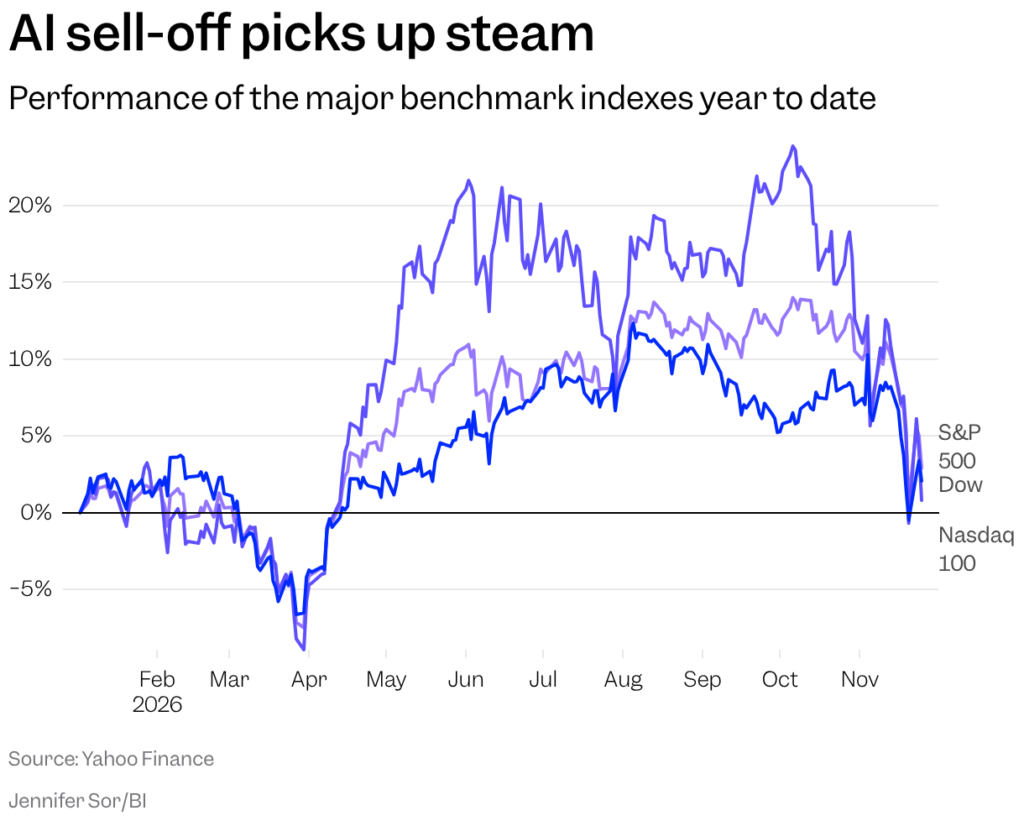
The major indexes entered the Thanksgiving holiday in correction territory, with the S&P 500 down about 10% since its all-time closing high on Oct. 6 and the Nasdaq Composite off 17% since then. Where it goes from here is unknown, but the cyclically adjusted price-to-earnings (CAPE) ratio, also known as the Shiller P/E ratio, is
Image source: Getty Images A small investment trust with a dividend yield of almost 10% and more than two decades of payments behind it. Sounds like a bargain, doesn’t it? It’s a bit like spotting a corner shop selling Champagne at lemonade prices. That’s the pitch for City Natural Resources Growth and Income (LSE:CYN). A
A roughly 10% weekly drop followed by a sharp bounce is the kind of whiplash that tends to linger. One options-based ETF is designed for it. By David Dierking – Nov 27, 2026 at 5:48PM EST Last week, the Nasdaq-100 fell more than 10% on the week, and briefly touched bear market territory, falling 20%
The S&P 500 fell 3.7% on Friday, November 20, its seventh straight losing session and its longest losing streak since the pandemic crash, according to Jared Blikre, global markets and data editor at Yahoo Finance. The index closed in correction territory, about $8 trillion below its October 6 record, and the Nasdaq-100 dropped 5.6% to