The U.S. Could Lose the Space Race to China

Artemis II ventured farther into space than any manned craft had gone before. Human eyes saw the far side of the moon for the first time in more than 50 years. The U.S. seemed to have captured an early lead in the new lunar race with China.

A Chinese Long March-2F carrier rocket lifts off.

Except it didn’t. For all its pageantry, Artemis II masked an uneasy truth: Washington is trailing Beijing.

By many measures, Artemis II was a triumph. The mission demonstrated the Orion spacecraft’s life-support systems and its powerful Space Launch System rocket. It enabled the first manned deep-space optical communications test. The images it beamed back to Earth were breathtaking.

Yet these achievements hid serious problems. The National Aeronautics and Space Administration had intended to launch Artemis II in 2023. Then technical issues repeatedly postponed the mission: hydrogen leaks, failures in helium flow, unexpected erosion of the heat shield. Beset by delays and pivot fatigue, NASA has downgraded its next Artemis flight from a manned lunar landing to an Earth-orbit docking test in 2027. It now seems that U.S. astronauts won’t walk on the moon until 2028 at the earliest.

Meanwhile, China grinds away. In February its space agency conducted a successful in-flight abort test from Hainan. Early in the ascent, mission controllers deliberately triggered an escape system that pulled an unmanned Mengzhou capsule away from the rocket. The capsule parachuted safely to sea while the rocket continued its flight. After re-entry the booster reignited its engines and performed a controlled, propulsive splashdown. NASA’s moon rocket can’t do that.

Beijing also leads in landing technology. Last year it demonstrated the Lanyue manned lander, which performed both a propulsive lunar landing and a lunar launch in simulated moon gravity. The test validated the craft’s design, shutdown procedures and interface compatibility between subsystems. Suddenly, China’s stated mission to put people on the moon before 2030 seems less like bluster.

“Nature does not hurry, yet everything is accomplished,” Chinese philosopher Lao Tzu wrote. China isn’t ready for a translunar journey, but its space program is making patient and consistent progress. Though Beijing has experienced its share of failures, its lunar program is achieving serious leaps in the technologies that matter.

China has built the robotic infrastructure—sensors, hoppers and relay satellites—needed for a permanent lunar base. Later this year, China’s Chang’e-7 mission is expected to explore the lunar south pole, where NASA intends to touch down. Included in China’s mission package is a novel rocket-propelled scout that can reach terrain inaccessible to rovers. Its task: hunt for ice water.

Missions such as Chang’e-7 should spur action in Washington. If the U.S. is to maintain leadership in the race to the moon, it must take China’s progress more seriously. It must also resist the temptation to rest on its laurels.

Whichever nation lands on the moon first in this century can do far more than plant a flag. It will choose where to build infrastructure. It will decide where to mine regolith and extract the ice water that, separated into hydrogen and oxygen, becomes rocket fuel for everything that comes next.

To stay ahead, Washington must stop optimizing for spectacle and start building for permanence. Artemis has proved that the U.S. can still reach the moon. The question now is whether it can remain there. That will require a shift in priorities—from timelines to cargo capacity, from singular missions to sustained infrastructure. Power systems, communications relays and resource extraction should take priority over manned missions.

Washington also needs strategic coherence. China’s advantage is as much organizational as technical. The U.S. should establish a unified lunar strategy with clear timelines, accountable leadership and authority that extends across agencies. Otherwise delays will compound, and opportunities will slip away.

Finally, the U.S. government needs to sell the lunar project to the American people more effectively. Artemis missions won’t matter if voters think the moon is yesterday’s achievement. This isn’t a replay of 1969. It’s a contest over governance, access to critical resources, and the ability to establish infrastructure that will determine economic and military activity in space for generations. Washington must make the case in terms the public appreciates: power, prosperity and security.

NASA Administrator Jared Isaacman sounded the alarm during his confirmation hearing last year: “This is not the time for delay, but for action, because if we fall behind, if we make a mistake, we may never catch up.”

Despite the success of Artemis, there’s a risk that his fears are already being realized.

Mr. Buono is an assistant professor of humanities at the University of Florida’s Hamilton School and the author of “The Province of All Mankind: How Outer Space Became American Foreign Policy.”
Source link

Visited 1 times, 1 visit(s) today

Related Article

If I Could Only Invest $500 in AI This Month, I’d Buy This 1 Stock.

If I could only invest $500 in one artificial intelligence stock this month, I’d pick Netlist (NLST +4.67%). Major developments in several court cases have fortified the company’s balance sheet and point toward soaring net profit margins in the years ahead. It’s a mid-cap valued at just $2.1 billion, and it’s still trading well below

Amazon or Alphabet: If I Could Only Own One for the Next Decade, It Would Be This One

Amazon (NASDAQ: AMZN) and Alphabet (NASDAQ: GOOG) (NASDAQ: GOOGL) are two companies that hardly need an introduction. Both are leaders in their respective industries, generally post excellent financial results, and have crushed broader equities over the long run. Investors arguably can’t go wrong with either of these, and I personally own shares of both. But

$4,000 in These 4 Non-Nvidia Chip Stocks Could Be Worth This Much by 2030

Nvidia (NASDAQ: NVDA) is now the largest company on the planet; its market cap represents around 7.5% of the value of the S&P 500. As such, if you own any mutual funds or exchange-traded funds (ETFs) — particularly index funds — you probably already have a lot of exposure to the giant chipmaker. However, if

Here’s What $10,000 Invested in SpaceX and Tesla Could Be Worth in 2030

If you want to invest in the future, splitting your investment between Elon Musk’s two companies, Space Exploration Technologies (NASDAQ: SPCX) and Tesla (NASDAQ: TSLA), could be a solid bet. With just under $10,000 split between the two stocks, investors could buy 14 shares of Tesla and 34 shares of SpaceX. Tesla is the older

3 Reasons to Sell JACK and 1 Stock to Buy Instead

3 Reasons to Sell JACK and 1 Stock to Buy Instead Since April 2026, Jack in the Box has been in a holding pattern, posting a small loss of 4.4% while floating around $12.15. The stock also fell short of the S&P 500’s 8.9% gain during that period. Is there a buying opportunity in Jack

Sports Team Value Gains Lag Stock Market Since 2022

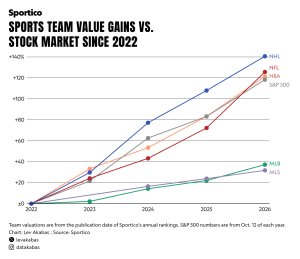
The cost of buying a sports team has soared in recent years, including record price tags in 2026 for the Los Angeles Lakers ($12.5 billion), Seattle Seahawks ($9.34 billion) and Los Angeles Angels ($4 billion). It has spurred talk of a sports valuation bubble. Yes, sports team values are up huge, but they trail stock

Anthropic to publicly file for IPO as early as Friday, sources say

Anthropic (ANTH.PVT) is set to publicly file its S-1 investor prospectus as soon as Friday, according to three people familiar with the artificial intelligence firm’s plans. The move would mark a crucial next step for what could be the biggest IPO in history. The much-anticipated public debut, expected to surpass SpaceX’s (SPCX) June IPO, is

​Europe stands by Ukraine – but how long can that last? | World news

​Europe stands by Ukraine – but how long can that last? | World news

Europe woke up last Friday to another belligerent outburst from Donald Trump – this time berating Ukraine’s wartime leader Volodymyr Zelenskyy again. Just a few days after his diesel deal with the Kremlin, the US president said Zelenskyy was more difficult to deal with than Vladimir Putin and blamed Ukraine’s leader for rocketing oil prices

Prediction: $150 a Month Invested in Micron Stock Will Be Worth This Much by Year-End 2030

Over the last year, memory chip manufacturers have benefited from extraordinary demand for artificial intelligence (AI). In particular, Micron Technology (NASDAQ: MU) has witnessed its market capitalization propel from just $53 billion at the start of the AI revolution to more than $1 trillion today. MU Market Cap data by YCharts Missed Nvidia in 2009?

Micron Tripled in 2026. Can It Repeat in 2027?

Micron (NASDAQ: MU) stock has more than tripled so far in 2026, making it the fourth-best-performing stock in the S&P 500 (SNPINDEX: ^GSPC) this year. That’s an impressive run, but for investors, the past really doesn’t matter; only the future. So, could Micron repeat this feat in 2027? One metric suggests that the answer to

Penang among world’s top 25 places to visit in 2027

Penang has earned further international recognition in tourism after being named one of the world’s 25 best places to visit in 2027 by National Geographic, highlighting the state’s rich heritage, cultural diversity and renowned food scene. The recognition places Penang on the prestigious list of destinations recommended by the internationally acclaimed publication, making it the

GM Just Beat Earnings Estimates. Is Ford Still the Better Dividend Stock?

Quick Read Ford (F) yields nearly 5% versus GM’s (GM) sub-1%, making Ford the clear winner for investors who need cash income today. GM’s dividend is covered 18 times by free cash flow versus Ford’s 2.6 times, making GM’s payout far safer for long-term holders. GM’s stock gained 187% over ten years versus Ford’s 62%,

HKSAR govt issues travel alert for France

People walk past a looted store after violence erupted during nationwide protests against rising living costs and poor conditions in schools in Paris, Oct 19, 2026. (PHOTO/AP) HONG KONG – The Hong Kong Special Administrative Region government on Tuesday issued an amber outbound travel alert (OTA) for France. The move was made in view of

Trumpflation Is Evolving, and There’s a New Twist That Threatens to Sink Stocks

For the better part of the last four years, the stock market has been unstoppable. The artificial intelligence (AI) infrastructure build-out has helped propel the Dow Jones Industrial Average (DJINDICES:^DJI), S&P 500 (SNPINDEX:^GSPC), and Nasdaq Composite (NASDAQINDEX:^IXIC) to several record highs this year. But these gains may prove fleeting, courtesy of Trumpflation — inflation specifically

Data compiled from the International Monetary Fund’s (IMF) World Economic Outlook 2026 and World Trade Organization (WTO) trade statistics tracks economic performance around leadership changes in five countries.

Regime change doesn’t translate into economic recovery: Data

Regime change doesn’t translate into economic recovery or chart a country’s growth path, recent data from South Asia shows. Economic indicators in some South Asian countries have shown signs of gradual improvement following major political upheavals, but they have yet to fully recover, with persistent challenges regarding GDP growth, inflation and trade. Data compiled from

Hong Kong schools weigh pulling out of Paris iGEM event amid unrest in France

Several Hong Kong schools are considering withdrawing from next month’s iGEM competition in Paris amid concerns over unrest in France, as the Education Bureau stressed that student safety should remain the top priority for overseas study activities. More than 30 secondary schools and universities, involving nearly 600 students and teachers, had been scheduled to travel

0
Would love your thoughts, please comment.x
()
x