I believe AI poses a significant market risk, but I’m not selling my technology stocks.
By Reuben Gregg Brewer –
The number one thing I don’t want to do, at any time and for any reason, is change my long-term investment approach to fit the current market zeitgeist. It is hard to stick to a long-term plan, especially when you believe there’s a material risk of a stock market correction. But history shows that while corrections come and go, the market has always resumed its upward march.
This is why, despite my concerns about an artificial intelligence (AI) bubble, I’m not selling either of my two technology stocks: International Business Machines (IBM -1.11%) and Texas Instruments (TXN -1.16%). Here’s a deeper dive into why sticking to my dividend-centric investment approach trumps the risk of the AI bubble bursting.
Image source: Getty Images.
There will be a bear market
I don’t know when it will arrive, but I know with 100% certainty that there will be another bear market. And if history is any guide, a bull market will follow, eventually pushing the market to new all-time highs. That’s what history shows, and you just have to look at a graph of the S&P 500 index (^GSPC -0.23%) to prove to yourself that buying and holding is a pretty good investment plan.
That said, I am a dividend investor with a value focus. My preference is to buy companies with long histories of dividend growth when they have historically high yields. I believe those two facts indicate a good business and an attractive valuation. That’s how I came across IBM and Texas Instruments. At this point, IBM’s dividend streak is up to 31 years, while Texas Instruments’ is at 23 years.
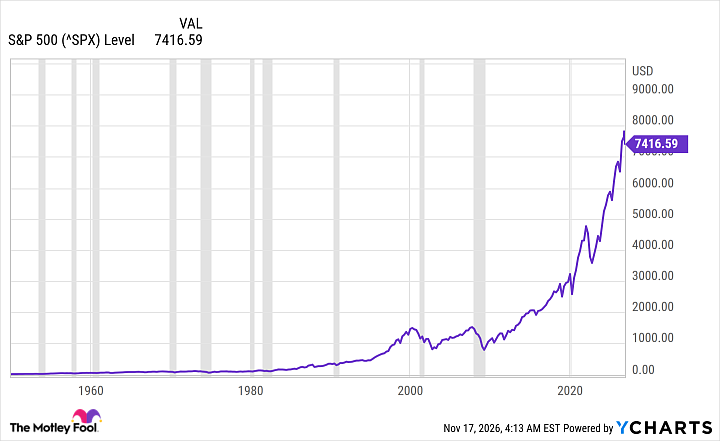
I bought both stocks before the artificial intelligence trade took off, so my decision to jump aboard had nothing to do with that technology. I like IBM because it has an over 100-year history of adapting to the world around it, with a focus on serving business customers. I’m fond of Texas Instruments because it makes boring computer chips that go into just about every electronic device. I would fully expect the two companies to be involved in AI and, in fact, I would be upset if they didn’t attempt to benefit from this still-emerging technology in some way.
I’m not getting rid of a good business
To be honest, I’d expect most of the companies I own to find a way to benefit from AI, even if that just meant using it to better serve customers or lower operating costs. But I lived through the dot-com bubble and see similarities to what is going on today with AI, which I believe is in its own bubble. If history rhymes, the bursting of the AI bubble could take the broader market down with it. The truth is, I don’t just expect a stock market correction; I expect a prolonged and painful bear market led by the technology sector.
IBM International Business Machines
$228.53-$2.56 (-1.11%)
NYSE · As of 4:00 PM ET 11/18/26
IBM and Texas Instruments are both likely to be caught up in the downdraft to a material extent. I’m not planning on selling either stock. The reason is that I want to stick to my long-term investment approach and avoid shifting it in response to Wall Street’s often mercurial mood swings. AI is likely to change the world, just like the internet did at the turn of the century. And IBM and Texas Instruments will likely benefit for years to come from the changes that accompany broad AI adoption.
TXN Texas Instruments
$292.43-$3.43 (-1.16%)
NASDAQ · As of 4:00 PM ET 11/18/26
Unless either of these technology icons cuts their dividends or dramatically changes their business approach, my thesis for owning them isn’t altered. Thus, my plan is to stick out the next bear market with companies I believe are worth holding over the long term. IBM and Texas Instruments are exactly those kinds of businesses.
The long-term history is clear, but that doesn’t make buy and hold easy
As the above S&P 500 index graph highlights, buying and holding has been a winning long-term strategy. I lean into that with dividend stocks. I know that there’s a bear market coming, because that’s just how the market works. I expect the next correction to include AI-related stocks, including my only two tech holdings: IBM and Texas Instruments. I’m still not going to abandon my long-term investment approach because it has nothing to do with AI and everything to do with owning good businesses for the long term. IBM and Texas Instruments are still good businesses.
Where to invest $1,000 right now
When our analyst team has a stock tip, it can pay to listen. After all, Stock Advisor’s total average return is 794%* — a market-crushing outperformance compared to 203% for the S&P 500.
They just revealed what they believe are the 10 best stocks for investors to buy right now, available when you join Stock Advisor.
*Stock Advisor returns as of November 18, 2026.