I keep coming back to this post on why I think working in finance is so fascinating and never boring. Things change all the time. And even if the same thing happens again and again, stocks, bonds and other assets react differently to the same event all the time. That post looked at stock market reaction to economic surprises from the 1990s to the 2010s, but since the pandemic, things have changed yet again.
A team from the Bank of Italy has analysed how stock markets in the US and Europe react to inflation surprises. Admittedly, we had rather a lot of surprises in inflation over the last five years. The chart below shows the surprises in US inflation vs the expectations in inflation surveys among economists and investors. Obviously, we had particularly large surprises after the war in Ukraine started, but what is notable is how big the cumulative surprises were over time.
US inflation surprises
Source: D’Andrea et al. (2025)
Now, traditionally, we finance professionals are trained to think about higher-than-expected inflation as a negative thing for stocks because it increases costs, thus reducing profits. And higher inflation, if it persists, increases the cost of capital and the discount rate for future cash flows. The effect is more pronounced for stocks with a lot of debt and financial leverage because for them the impact on the net present value of future cash flows is larger.
Ok, so what really happened?
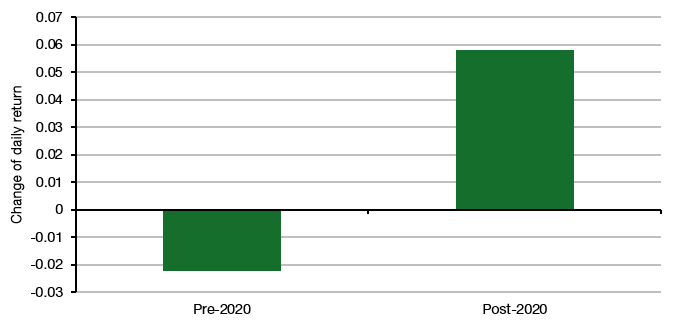
The chart below shows the price action of stocks on the day of the inflation surprise. The independent variable is the size of the inflation surprise times the financial leverage of the company, measured as the ratio of debt with more than five-year maturity divided by total assets.
That’s all very technical, but the bottom line is that before 2020, a positive inflation surprise was negative for the share price, and it was more negative for companies with higher financial leverage on the balance sheet. Just as we knew it would happen.
But look at the share price reaction since 2020. All of a sudden, it is in the opposite direction. Higher inflation is positive for the share price, and it is even better for highly levered companies.
Huh?
The answer lies in the type of inflation shock we experienced since 2020 vs the 2010s. In the 2000s and 2010s inflation shocks were mostly demand-driven, i.e. inflation rose because the economy was growing hot. In this environment, the central bank can cool inflation by hiking interest rates and reducing economic growth.
But since the pandemic the inflation shocks have been supply-driven shocks similar to the 1970s. In this environment, the central bank is powerless to reduce inflation because hiking interest rates is not going to move more tankers through the Strait of Hormuz. So, the inflation shock from supply-side disruptions tends to be more persistent and effectively creates a devaluation of nominal debt companies own. Hence, from the perspective of a company, such an inflation shock is great for their balance sheet because it helps pay back debt without having to actually pay back debt. And this is good for the share price.
Of course, there are limits to this mechanism. If the inflation shock becomes too large, as it eventually became in 2023, company profits suffer as well, and share prices go down. But if you are in the golden middle where inflation helps reduce debt in real terms but is not permanently impairing profits, it is great news for stocks. And that seems to be the current regime.
Share price reaction to a positive inflation surprise
Source: D’Andrea et al. (2025)