Goldman Sachs believes that the market has transitioned from a phase of ‘unquantifiable extreme panic’ to ‘orderly pricing of known risks.’ Iran’s willingness to negotiate has significantly reduced the probability of extreme tail-risk scenarios. The impact on the U.S. stock market is characterized as being driven by inflation rather than growth, diminishing the necessity for urgent central bank action. Under the baseline scenario for oil prices, Brent crude is projected to be $82 and $80 per barrel in the third and fourth quarters, respectively, with a high threshold for substantial declines and limited downside risk.
Despite the failure of US-Iran negotiations to reach an agreement, Trump’s announcement to blockade the Strait of Hormuz dampened risk sentiment. However, the temporary ceasefire still drove a noticeable relief rally in the markets this week. Goldman Sachs’ macro trading team believes that the most severe tail risks have significantly narrowed, and the market has officially entered a ‘new phase of crisis.’
Goldman Sachs macro traders Rikin Shah and Cosimo Codacci-Pisanelli pointed out that while questions remain about the details and stability of the ceasefire, Iran’s demonstrated willingness to negotiate is a key signal, helping to reduce extreme downside tail risks. For the stock market, this impact is characterized as an inflation shock rather than a growth shock overall. If the ‘peak pressure’ has passed, the equity market may refocus on forward-looking perspectives, trading with expectations of double-digit earnings growth.
On the central bank policy front, the ceasefire has reduced the urgency for major central banks to take emergency actions, but the pass-through of energy prices to inflation continues, and hawkish tendencies have not fully dissipated. Among them, the probability of the Federal Reserve raising interest rates is the lowest. However, the tail risks of a large-scale rate hike cycle have been significantly reduced, and interest rate volatility is expected to continue to decline.
Narrowing tail risks, stock market shows resilience
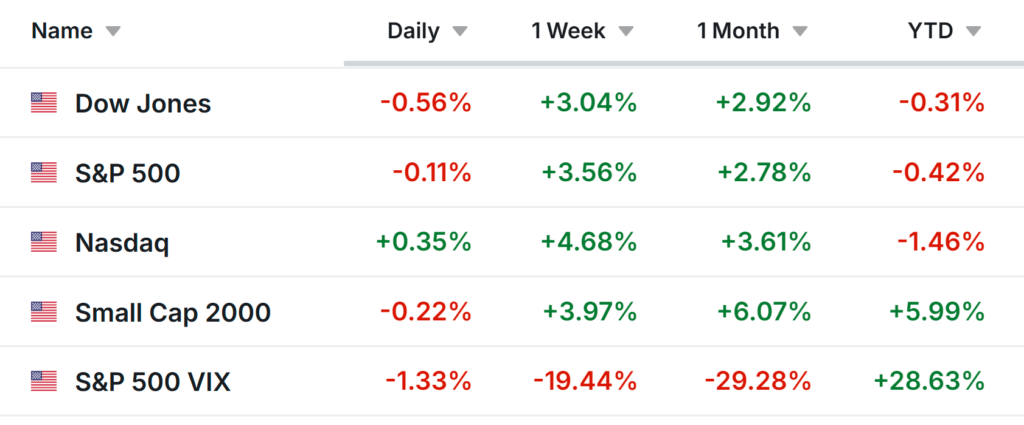
The ceasefire news pushed global stock markets to record their largest weekly gain in over two years last week. Despite the failed negotiations over the weekend, the market decline on Monday was relatively restrained. The core feature of this week’s market is the relief rally following the ceasefire. Previously, uncertainty about Iran’s response drove negative sentiment, forcing significant accumulation of risk premiums, with commodities and short-term rates being hit the hardest.
Notably, during this period of turbulence, the stock market demonstrated stronger resilience compared to physical commodities. Reviewing historical experiences such as the COVID-19 pandemic and tariff shocks, the equity market has shown the ability to shift its time horizon and navigate short-term uncertainties—provided the path ahead becomes clearer.
Regarding the oil price outlook, the base case scenario anticipates that energy flows through the Strait of Hormuz will begin to resume by the end of this week, with Persian Gulf exports gradually returning to pre-war levels within about a month. Brent crude oil forecasts for Q3 and Q4 of 2026 stand at $82 and $80 per barrel, respectively, aligning closely with current market pricing.
Analyst Daan Struyven noted that for oil prices to fall to $70 by year-end, five conditions must be met simultaneously: the rapid reopening of the strait, no permanent damage to production capacity, continued smooth inflow of sanctioned Russian and Iranian crude into the market, significantly higher-than-expected output from Russia and the US, and weak demand. The likelihood of achieving this combination of conditions is low, suggesting that downside risks for oil prices remain relatively limited.
The Federal Reserve may stay on hold
Markets maintain the view that the Federal Reserve is least likely to raise interest rates, consistent with current pricing. The sensitivity of the US economy to oil prices is far lower than in the 1970s, and the federal funds rate remains 50 to 75 basis points above the median estimate of the neutral rate by the Federal Open Market Committee.
Market signals indicate that the pricing of the Federal Open Market Committee is close to unchanged for the year, with a slight premium for rate cuts by the end of the year. The U.S. breakeven inflation rate does not show signs of uncontrolled inflation expectations, and the volatility of short-term dollar interest rates has already reversed about 50% of last month’s increase. Market expectations suggest that if Walker becomes the next Fed chair, the threshold for raising interest rates will remain high.
The strong performance of last week’s non-farm payroll data alleviated immediate market concerns about the labor market, with three-month trended wage growth approaching the breakeven level estimated by Goldman Sachs’ commodity research team. Overall, the likelihood of growth risks emerging in the U.S. in the near term is low, and short-term interest rates are expected to remain muted, with realized volatility staying at low levels.
However, long positions in U.S. interest rates for 2027 can still serve as a hedge against downside growth risks—current market pricing for rate cuts remains insufficient, and fiscal support for growth is expected to gradually diminish later this year.