Market downturns can make retail investors take riskier stock bets

Columns

As portfolio values fall, investors may cling to losing stocks, sell winners and take bigger risks to try to recover.

A screen displays stock market figures at Hana Bank’s trading room in Jung District, central Seoul, on the morning of Nov. 9. The Kospi opened at 5,034.20, down 25.49 points, or 0.50 percent, from the previous session’s close, falling briefly below the 5,000-point mark during intraday trading.


Choy Jung-hyuck

The author is a professor of economics, finance and asset management at Hanyang Cyber University.

The Kospi, which reached an intraday record high on June 19, had fallen about 46 percent by Nov. 6. Over the same period, retail investors purchased a net 36 trillion won ($25 billion) worth of shares on the main stock market. Because they bought heavily during the downturn, many are likely holding portfolios with substantial unrealized losses. Market crashes typically raise fears of panic selling. Yet an opposite danger deserves equal attention: As losses deepen, investors may become increasingly reluctant to sell their losing stocks.

Behavioral finance calls the tendency to sell winning stocks readily while holding on to losing ones the disposition effect. A 2024 study by Professor An Li of Tsinghua University and fellow researchers extended that concept: It found that decisions about selling an individual losing stock depend not only on that stock’s performance but also on the gains or losses across an investor’s entire portfolio.

Among U.S. retail investors whose overall portfolios were profitable, the likelihood of selling a winning stock was 1.21 times that of selling a losing stock. When their portfolios were underwater, the ratio climbed to 2.14. In China, the corresponding ratio rose from 1.73 to 3.56. In other words, investors become particularly unwilling to realize losses on individual holdings when their portfolios as a whole are already losing money. The researchers also found that the disposition effect intensified when stock markets had performed poorly over recent quarters.

Why does this happen? Investors evaluate individual holdings and their total portfolio simultaneously. When the portfolio is profitable overall, accepting a loss on one stock may feel manageable. Gains elsewhere provide a psychological cushion. But when the entire portfolio is losing money, selling another stock at a loss can feel like admitting once again that an investment decision was a mistake. The reluctance reflects more than a calculation of future returns; it is also a response to the discomfort of acknowledging failure.

Such behavior can undermine risk management during a market plunge. If investors sell their profitable holdings first and retain their losers, the remaining portfolio may become increasingly concentrated in particular companies or industries. That can leave them more vulnerable to another downturn, especially when the struggling holdings share similar economic or business risks. The situation may worsen when the desire to recover losses begins driving investment decisions.

Research by Nobel Prize winning economist Richard Thaler suggests that people who have suffered losses can become more attracted to risky choices offering a chance to break even. The same psychology may encourage averaging down, the practice of buying additional shares after a stock’s price has fallen. Although doing so reduces the average purchase price per share, it also increases the amount invested. If the stock declines further, potential financial damage also grows accordingly. A lower average cost does not, by itself, make an investment safer nor improve a company’s prospects.

During a sharp market decline, investors should therefore examine the structure of their entire portfolio before focusing on the profit or loss of each stock. They need to review the weight of individual holdings and sectors, identify excessive concentrations and consider selling losing positions when the original investment rationale has weakened. Decisions to buy more should likewise rest on expected future returns and risks, not simply on a desire to lower the average purchase price or recover past losses.

This distinction matters because a stock that has fallen sharply is not necessarily cheap, just as a stock showing a gain is not necessarily overvalued. The price originally paid is a historic reference point, not a reliable measure of what the security is worth today or tomorrow.

No one knows when the market will rebound. What investors can decide is which assets and exposures they will carry until that recovery arrives. In a falling market, the priority should not be protecting losing positions from the discomfort of a sale. It should be preserving the health and resilience of the portfolio as a whole. Only then can investors remain positioned to benefit fully when markets eventually recover.
This article was originally written in Korean and translated by a bilingual reporter with the help of generative AI tools. It was then edited by a native English-speaking editor. All AI-assisted translations are reviewed and refined by our newsroom.

Source link

Visited 1 times, 1 visit(s) today

Related Article

Nvidia’s boardroom bombshell hits a fragile chip rally: Chart of the Day

Chip stocks spent four sessions clawing out of last week’s AI rout. Nvidia’s boardroom crisis just pulled the rug out from under them. The comeback was fragile to begin with. A Yahoo Finance basket of 62 chip stocks had won back less than a third of the market value it lost from early October to

Prediction: After Losing Over $1.7 Trillion in Market Cap This Year, Nvidia Stock Will Rebound in Epic Fashion. Here’s Why.

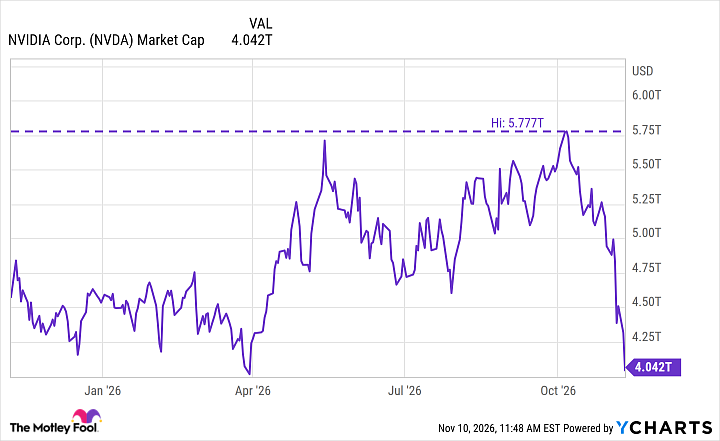
For much of 2026, Nvidia (NVDA +2.87%) looked unstoppable. The artificial intelligence (AI) chipmaker delivered strong financial results, while Wall Street rewarded its dominance with a lofty valuation. In early October, Nvidia’s market capitalization peaked around $5.8 trillion, making it the world’s most valuable company. Unfortunately, the momentum didn’t last. As of this writing (Nov.

Is Nvidia Stock a Buy After Hitting a Seven-Month Low? (Hint: Yes.)

Many investors have been waiting for opportunities to buy into popular artificial intelligence (AI) stocks at a discount, and in recent years, those chances have been rare. But right now, perhaps the highest-quality AI stock globally is on sale. From a business perspective, everything is going right for Nvidia (NVDA +2.87%). As the largest seller

We’ve Witnessed the Stock Market Do This 19 Times in 76 Years, and Equities Have Been Higher One Year Later 100% of the Time

This has shaped up as another stellar year for the iconic Dow Jones Industrial Average (^DJI +0.49%), benchmark S&P 500 (^GSPC +1.31%), and growth-focused Nasdaq Composite (^IXIC +1.60%). The artificial intelligence (AI) infrastructure build-out, better-than-expected corporate earnings, and record S&P 500 share buybacks have collectively lifted all three stock indexes to several new highs. But

Billionaire venture capitalist Vinod Khosla says judge AI by usage, not stock prices

Wall Street wants to know whether AI is a bubble. Most of the worry is about who’s paying for it. The companies leading the build-out are spending faster than their businesses bring in cash. Combined free cash flow for Amazon (AMZN), Alphabet (GOOG, GOOGL), Meta (META), Microsoft (MSFT), and Oracle (ORCL) fell to about minus

Cullen/Frost Bankers, Inc. Primary Exchange Listing will Change to Texas Stock Exchange from New York Stock Exchange

Market Closed – 04:00:02 2026-11-11 pm EST 5-day change 1st Jan Change 157.85 USD -0.20% -1.15% +24.65% Published on 11/11/2026 at 07:20 pm EST S&P Capital IQ Effective November 12, 2026, Cullen/Frost Bankers, Inc. primary exchange listing will change to Texas Stock Exchange from New York Stock Exchange. 07:20pm Cullen/Frost Bankers, Inc. Primary Exchange Listing

Cramer Says Tito’s Refused Costco on Price and Kirkland Made Vodka for Half

Quick Read Jim Cramer says Costco tells suppliers that raise prices it will make a Kirkland version at half the cost, citing Tito’s vodka. Costco’s CFO Gary Millerchip says Kirkland saves members at least 15% to 20% versus national brands with equal or better quality. Sam’s Club grew comparable sales 4.4% excluding fuel, trailing Costco’s

CoreWeave, Fossil Rally as BrightView Shares Plunge

Mumbai, 11 November 2026: US stock markets saw mixed corporate developments on Wednesday, November 11, 2026, as investors reacted to quarterly earnings, revised financial forecasts, acquisition updates and shareholder return announcements. Several companies reported results that exceeded analyst expectations, while others faced pressure from weaker profitability, revenue shortfalls and financial challenges. CoreWeave and Fossil Group

Jiangxi Copper’s Board Approves Proposed Share Buyback Plan

Delayed 08:45:26 2026-11-11 pm EST 5-day change 1st Jan Change 24.02 HKD -1.80% -6.16% -43.89% Published on 11/11/2026 at 07:12 pm EST MT Newswires This article is reserved for our members. Log in to continue Log inCreate an account DurationAuto.2 months3 months6 months9 months1 year2 years5 years10 yearsMax. PeriodDayWeek Jiangxi Copper Co Ltd is a

Prediction: Nvidia Stock Will Be Worth This Much by Year-End 2027

Nvidia‘s stock (NVDA +2.87%) closed at a record high of $239.24 per share on Oct. 6. But today, the AI chipmaker‘s stock trades at about $175. Let’s see what caused that 27% decline — and where Nvidia’s stock might be trading by the end of next year. Why was Nvidia the hottest AI stock? Nvidia

Nov. 13 Could Be a Huge Day for SpaceX Stock

On Friday, Nov. 13, Space Exploration Technologies Corp. (SPCX -2.33%) will try to catch both stages of an orbital rocket — the Super Heavy booster and the Starship upper stage — with the arms of its launch tower in Starbase, Texas. Wall Street is treating Starship Flight 15 like a major event for the stock

Jim Cramer’s Top 5 Dividend Stocks for Safe, Consistent Returns

From 2000 through 2009, dividends earned S&P 500 investors an annualized 1.8%, according to Hartford Funds. Even with those payments, the index posted a negative total return for the decade. Over the longer stretch from 1940 through 2025, Hartford found that dividend income accounted for an average of 33% of the index’s total return. For

If the stock market crashes, history says this FTSE 100 share could be a smart buy!

Image source: Getty Images Stock market tension’s growing, with AI stocks slumping as worries over a new tech bubble increase. Yet the FTSE 100 continues its march towards new record highs — as I type, it’s up roughly 2% over the past trading week. Yet this isn’t the time for investors to get complacent. If

Why the S&P 500 Could Be Heading for a Repeat of 2018

If the S&P 500 (^GSPC +1.63%) is able to stay above a 10% gain for the year, it’ll be the fourth consecutive year that it has been able to produce above-average returns. It’s a rare feat. But it’s not common for a reason, as sooner or later, there’s inevitably a pullback. The last time the

0
Would love your thoughts, please comment.x
()
x