The Nasdaq Just Did Something For Just the 5th Time Ever. History Says This Could Happen Next.

AI stocks have had a wild ride over the last month. First, they fell over concerns about a tightening credit environment, and then, following the midterm elections, fears of a crackdown on data centers sent the Invesco QQQ Trust (QQQ +2.31%) down 6.5% on Nov. 5.

However, since then, the ETF that tracks the tech-heavy Nasdaq-100 has clawed back nearly all of those losses, a remarkable comeback in just four sessions.

In fact, in the history of the ETF, which was launched in 1999, that type of event has only happened a handful of times, and none of those have taken place in the last 25 years. There have been four times when the Invesco QQQ Trust has fallen more than 5%, followed by three sessions that included a gain of at least 1%, two of which were more than 2% gains, and no sessions that included a decline of 1% or more.

The four dates when this pattern occurred before were:

  • Feb. 3, 2000
  • May 16, 2000
  • Jan. 11, 2001
  • April 20, 2001

You’ll notice that all of those dates came during the dot-com bubble or subsequent bust. In fact, a drawdown of at least 59% followed every one of those dates.

The Nasdaq-100 peaked during the dot-com era with a closing high of 4,704 on March 27, 2000, and didn’t hit bottom until Oct. 7, 2002, at a closing low of 807.42, a drawdown of 83% from the peak.

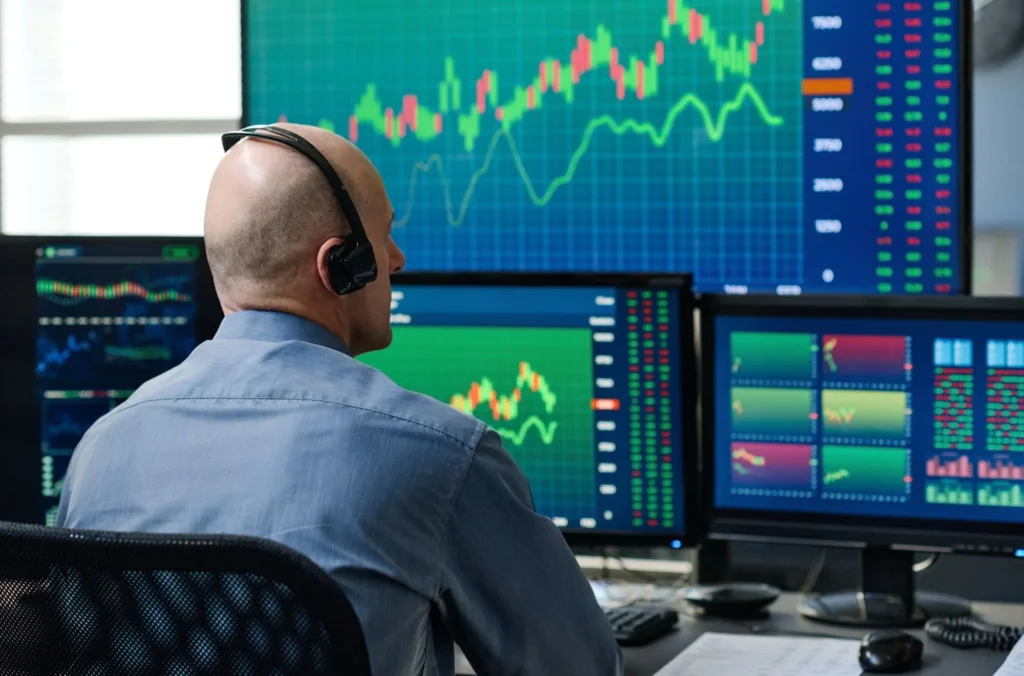
Image source: Getty Images.

Is this the beginning of the AI bubble bursting?

Nearly since the beginning of the AI boom, investors have drawn comparisons to the dot-com era, which saw the Nasdaq-100 jump more than 700% from August 1995 to its peak.

There are a number of similarities with that period, including the early stages of a breakthrough technology, a surge in tech stocks, and a ramp in capital expenditures to build infrastructure to support the new technology.

However, there are also important differences that may explain why the recent volatility in the QQQ is different from what occurred during the dot-com bust.

First, the QQQ’s valuation is much lower than it was during the height of the dot-com boom. Currently, the ETF trades at a price-to-earnings ratio of just 28, making it only slightly more expensive than the S&P 500. By contrast, the QQQ’s PE ratio was approximately 82 when it peaked during the dot-com bubble, or three times more expensive than it is today. The Nasdaq has also not even tripled from its bottom in 2022, meaning its gains are much smaller than they were in the dot-com era when the Nasdaq-100 doubled in a single year, 1999.

Additionally, the AI boom is largely being driven by established, highly profitable companies like Nvidia, Alphabet, and Microsoft that are justifiably worth trillions of dollars. On the other hand, the dot-com boom was characterized by hundreds of unprofitable start-ups flooding the market, which helped drive the bust once it became clear that their business models weren’t viable. In the current era, there have been few IPOs. However, there is some concern about the business models of OpenAI and Anthropic, the AI labs at the center of the boom, though Anthropic has now reported an adjusted operating profit. OpenAI, on the other hand, is still deeply unprofitable.

QQQ Invesco QQQ Trust

$690.38+$15.62 (+2.31%)

NASDAQ · As of 4:00 PM ET 11/11/26

Will history repeat itself?

Of the four dates above, only one came before the bubble burst, and that plunge was caused by strong economic data that was expected to trigger an interest rate hike from the Federal Reserve.

That’s not unlike the current situation where the Fed is expected to raise interest rates due to stubborn inflation, and investors are worried that that could squeeze the debt-fueled infrastructure build-out at the center of the boom. AI stocks jumped on Wednesday, in part because CoreWeave was able to tame concerns about a debt bubble in AI infrastructure and its own solvency.

Overall, while there are similarities between now and the dot-com era, I don’t think we’re on the verge of a bubble bursting the way the market was then.

Demand for AI infrastructure still greatly exceeds supply, as CoreWeave just reminded investors, and valuations are still reasonable or even cheap, reined in in part by the psychic scar of the dot-com bust.

Overall, investors can learn a lot from studying past market cycles and should be aware of the risks facing the AI boom, including debt-fueled spending and the cyclicality of chip demand. However, the facts on the ground don’t indicate that any bubble is on the verge of bursting, despite the volatility in the QQQ.

AI demand remains strong, and even CoreWeave, the most vulnerable AI infrastructure stock, just reassured investors that it can fund its ongoing expansion. The AI boom still looks healthy.

Where to invest $1,000 right now

When our analyst team has a stock tip, it can pay to listen. After all, Stock Advisor’s total average return is 835%* — a market-crushing outperformance compared to 208% for the S&P 500.

They just revealed what they believe are the 10 best stocks for investors to buy right now, available when you join Stock Advisor.

See the stocks ›

*Stock Advisor returns as of November 12, 2026.

Source link

Visited 1 times, 1 visit(s) today

Related Article

Cullen/Frost Bankers, Inc. Primary Exchange Listing will Change to Texas Stock Exchange from New York Stock Exchange

Market Closed – 04:00:02 2026-11-11 pm EST 5-day change 1st Jan Change 157.85 USD -0.20% -1.15% +24.65% Published on 11/11/2026 at 07:20 pm EST S&P Capital IQ Effective November 12, 2026, Cullen/Frost Bankers, Inc. primary exchange listing will change to Texas Stock Exchange from New York Stock Exchange. 07:20pm Cullen/Frost Bankers, Inc. Primary Exchange Listing

Cramer Says Tito’s Refused Costco on Price and Kirkland Made Vodka for Half

Quick Read Jim Cramer says Costco tells suppliers that raise prices it will make a Kirkland version at half the cost, citing Tito’s vodka. Costco’s CFO Gary Millerchip says Kirkland saves members at least 15% to 20% versus national brands with equal or better quality. Sam’s Club grew comparable sales 4.4% excluding fuel, trailing Costco’s

CoreWeave, Fossil Rally as BrightView Shares Plunge

Mumbai, 11 November 2026: US stock markets saw mixed corporate developments on Wednesday, November 11, 2026, as investors reacted to quarterly earnings, revised financial forecasts, acquisition updates and shareholder return announcements. Several companies reported results that exceeded analyst expectations, while others faced pressure from weaker profitability, revenue shortfalls and financial challenges. CoreWeave and Fossil Group

Jiangxi Copper’s Board Approves Proposed Share Buyback Plan

Delayed 08:45:26 2026-11-11 pm EST 5-day change 1st Jan Change 24.02 HKD -1.80% -6.16% -43.89% Published on 11/11/2026 at 07:12 pm EST MT Newswires This article is reserved for our members. Log in to continue Log inCreate an account DurationAuto.2 months3 months6 months9 months1 year2 years5 years10 yearsMax. PeriodDayWeek Jiangxi Copper Co Ltd is a

Prediction: Nvidia Stock Will Be Worth This Much by Year-End 2027

Nvidia‘s stock (NVDA +2.87%) closed at a record high of $239.24 per share on Oct. 6. But today, the AI chipmaker‘s stock trades at about $175. Let’s see what caused that 27% decline — and where Nvidia’s stock might be trading by the end of next year. Why was Nvidia the hottest AI stock? Nvidia

Nov. 13 Could Be a Huge Day for SpaceX Stock

On Friday, Nov. 13, Space Exploration Technologies Corp. (SPCX -2.33%) will try to catch both stages of an orbital rocket — the Super Heavy booster and the Starship upper stage — with the arms of its launch tower in Starbase, Texas. Wall Street is treating Starship Flight 15 like a major event for the stock

Jim Cramer’s Top 5 Dividend Stocks for Safe, Consistent Returns

From 2000 through 2009, dividends earned S&P 500 investors an annualized 1.8%, according to Hartford Funds. Even with those payments, the index posted a negative total return for the decade. Over the longer stretch from 1940 through 2025, Hartford found that dividend income accounted for an average of 33% of the index’s total return. For

If the stock market crashes, history says this FTSE 100 share could be a smart buy!

Image source: Getty Images Stock market tension’s growing, with AI stocks slumping as worries over a new tech bubble increase. Yet the FTSE 100 continues its march towards new record highs — as I type, it’s up roughly 2% over the past trading week. Yet this isn’t the time for investors to get complacent. If

Why the S&P 500 Could Be Heading for a Repeat of 2018

If the S&P 500 (^GSPC +1.63%) is able to stay above a 10% gain for the year, it’ll be the fourth consecutive year that it has been able to produce above-average returns. It’s a rare feat. But it’s not common for a reason, as sooner or later, there’s inevitably a pullback. The last time the

Costco (COST) Declares $30 Special Dividend And Reauthorizes $4 Billion Buyback

Costco Wholesale (NasdaqGS:COST) declared a special cash dividend of $30 per share on common stock. The retailer also reauthorized a $4b share repurchase program with an expiration date in January 2030. The one time $30 special dividend and long dated buyback plan matter, but they are only part of the Costco picture. Our analysis turns

The Stock Market Is Repeating a Pattern Not Seen in Decades, but History Says Investors Who Make This 1 Move Will Win Out

The stock market has been in a rough patch lately, with major market indexes stumbling hard last week. The S&P 500(SNPINDEX:^GSPC), Dow Jones Industrial Average(DJINDICES:^DJI), and Nasdaq Composite (NASDAQINDEX:^IXIC)all fell sharply from their recent all-time highs, with the Nasdaq plunging into correction territory. Missed Nvidia in 2009? This Rare Signal Is Flashing Again. In 2009,

Markets fluctuate as US rate worries temper tech bounce

After last week’s rout, fuelled by fears that Democrats would ramp up regulation of artificial intelligence, beaten-down tech stocks have bounced this week on bargain-buying and a feeling that their fears may have been overdone. ADVERTISEMENT ADVERTISEMENT Sentiment was also given a boost by earnings from data centre operator CoreWeave, which said sales would come

Warren Buffett’s Successor, Greg Abel, Just Bought $9.6 Billion of the Oracle of Omaha’s Favorite Stock (No, Not Alphabet!)

Few events garner more attention on Wall Street than Berkshire Hathaway‘s (NYSE:BRKA)(NYSE:BRKB) earnings reports. This is especially true now that Warren Buffett has retired and his successor, Greg Abel, is overseeing the company’s day-to-day operations and its closely watched $359 billion investment portfolio. While the September-ended quarter was more or less business as usual for

1 Reliable ETF I’m Buying Forever, Even if the Stock Market Crashes

Investors have no doubt been feeling mixed emotions lately. On one hand, all three major U.S. stock market indexes — the S&P 500 (^GSPC -0.38%), Nasdaq Composite, and Dow Jones — are all up for the year. On the other hand, many are worried about a potential crash due to AI bubble fears, stretched valuations,

Major US Companies Say No to New Tokenized Stock Platform

Over 60 major US-listed companies have formally shut the door on having tokenized versions of their shares traded on OKXICE, a collaborative platform built by crypto exchange OKX and Intercontinental Exchange (NYSE:ICE), owner of the New York Stock Exchange. The platform promised around-the-clock access to digital tokens designed to track the value of 63 US

0
Would love your thoughts, please comment.x
()
x