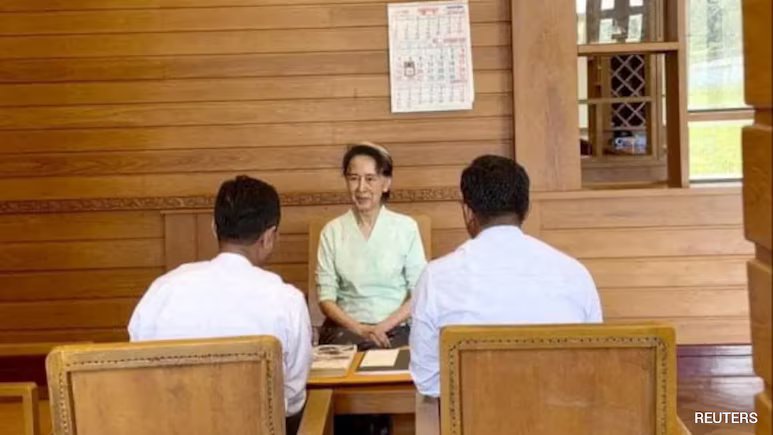
Prime Minister Mark Carney meets with Premier of Alberta Danielle Smith at his office in Ottawa on May 8.Sean Kilpatrick/The Canadian Press
Keep calm and…
Re “The Iran war has shown why Canada shouldn’t just take the world as it is” (May 8): Our Prime Minister is criticized for putting trade before our beliefs. But a lot has changed over the past year. We do have to “take the world as it is.”
No one seems more aware of the potential damage idealism can do to the economy than our Prime Minister, who helped guide Britain during Brexit. Every new job created gives a family financial support to enjoy life with a minimum of anxiety.
What change did our involvement in Afghanistan bring about? Has China changed because we criticized its human rights abuse? As long as the world nurtures authoritarian leaders, Canadian foreign policy should be directed through the United Nations.
Foreign aid should continue being our main approach. And our Prime Minister supports international law, which is a quiet rebuke of Mr. Trump’s foreign policy of might is right.
May God continue to give him the strength to carry on.
Ken Stock Port Hope, Ont.
Split decision
Re “South Korean, German bidders make final pitches on Canadian sub deal” (May 14): It appears the Canadian military is seeking a submarine that will fulfill two missions: Defend our approaches and support our allies in long-range offence.
Rather than select one over the other, which would be a compromise to achieving both missions, why not split the purchase? Have the German-Norwegian stealth submarines defend the St. Lawrence and Strait of Georgia approaches to Canada’s population centres, and the South Korean long-range attack submarines support our allies and defend the Arctic.
Paul Krabbe Centre Wellington, Ont.
Unsolicited advice
Re “Certain behaviour” (Letters, May 14): In a (presumably unintentionally) humorous letter, a writer from Ottawa notes his “respect” for Jacques Parizeau while disparaging Danielle Smith for not being “clear and unequivocal” in her oft-issued statements about her clear and unequivocal position on Alberta within a unified Canada.
Albertans should have expected a Laurentian schooling about how to “do” separatism and the unacceptable way the rubes in this province are going about it. It is always helpful to understand the correct way to go about life. While I am in no way a separatist, I am thankful for the guidance provided for those who are so inclined.
And so it seems irony is not dead, but merely resting comfortably, in Ottawa.
Dave McClurg Calgary
Small price to pay
Re “Carbon pricing would not spur oil and gas sector to reduce emissions, Cenovus CEO says” (Report on Business, May 14): Clean Energy Canada, Pembina Institute and other leading organizations are clear: A $130-a-tonne industrial carbon price by 2030 is the key to unlocking tens of billions of dollars in investment and a high-growth, low-carbon economy.
Yet Ottawa and Alberta’s proposed 2040 timeline, presumably driven by fear of separatists, risks leaving this potential untapped. With oil sands paying just dimes per barrel, weak pricing sacrifices both climate progress and economic opportunity.
The Prime Minister’s first duty is to unite the country. Mark Carney may be keeping Alberta happy, but the rest of Canada would be paying the piper.
Cathy Orlando Director Citizens’ Climate Lobby Canada; Sudbury
A quick search suggests that a $130-a-tonne carbon price adds about 50 cents a barrel to the cost of oil sands production. Is this one of the points holding up a pipeline deal?
The same search revealed that the oil sands is one of the lowest-cost oil producers in the world. What am I missing?
Marc Létourneau Toronto
Both can be true
Re “Two sides” (Letters, May 14): When decisions about eligibility for medical assistance in dying are based on diagnoses such as schizophrenia, there are, by necessity, disagreements.
This is because diagnoses of mental illnesses, in and of themselves, are subject to variability and differences in severity. As a result, both sides, one allowing eligibility for MAID and one denying it, can be right at the same time.
The degree of suffering from an affliction and unlikelihood of successful treatment are the crucial variables to be considered in granting eligibility for MAID, not diagnosis as such.
Bruce Hutchison Clinical psychologist (retired), Ottawa
No slam dunk
Re “Dunkin’ returning to Canada after nearly 10 years, with plans for hundreds of locations” (Report on Business, May 13): Having visited Dunkin’ Donuts shops in Canada and the United States in the distant past, I never thought the chain held a candle to its Canadian competitors. It was no surprise to me that it exited our market and I am not planning to give it another chance.
One thing I do find surprising, and irksome, is yet another example of classic Canadian “entrepreneurship” – investing in another American brand instead of creating something uniquely Canadian. I shake my head.
Jeff Andrew Toronto
Safety first
Re “One troubling reason you might not get CPR? Breasts” (Opinion, May 9): In a restaurant, I saved the life of my wife because I was not nervous about touching her breasts.
She actually required the Heimlich maneuver, but the lessons are the same. The three “have a go” persons who stepped up to help were tentative.
Rounding out our table of four were a pathologist and registered nurse. After the doctor had a go, a woman in line for a table tried next, but she was not big or strong enough. A young waiter followed – way too shy – and I found myself watching in slow-motion as my wife was expiring before my very eyes.
It so happened that, a few nights before, I had watched Mrs. Doubtfire for the nth time. One bechic blast did it.
Michael Dent Kingston, Ont.
One with nature
Re “How did this teen with ADHD find her focus? In a word, birds” (May 9): As a trained biologist and lifelong nature enthusiast, this feature resonated deeply. To put it simply, nature is both salve and saviour.
I have seen this firsthand in my own work taking students into natural settings; for many, the experience is transformative. It was true for me as well: As a child, my parents changed the course of my life by introducing me to the wild landscapes of Canada.
Biophilia, our innate connection to other species, remains a powerful, underappreciated force. When awakened, it offers something no screen, reel or streaming series can replicate.
The prescription is remarkably simple: Step outside. Whether into a forest, lakeside or urban park, good things will happen.
Chris Buddle Hudson, Que.
Letters to the Editor should be exclusive to The Globe and Mail. Include your name, address and daytime phone number. Keep letters to 150 words or fewer. Letters may be edited for length and clarity. To submit a letter by e-mail, click here: letters@globeandmail.com